
Revision summary
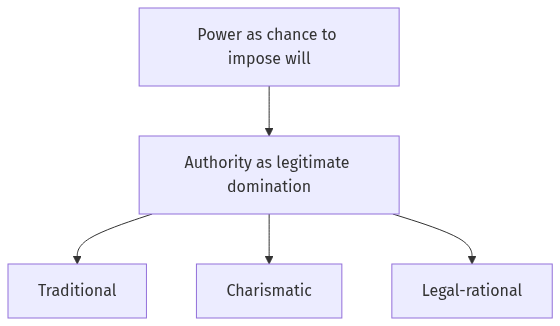
Power is the probability of carrying out one’s will even against resistance. Authority is power accepted as legitimate domination. Traditional authority rests on custom and inherited position. Charismatic authority rests on devotion to an exceptional leader. Legal-rational authority rests on enacted rules and bureaucratic office. The types mix in practice, as in parties that join charisma to legal office.
Model answer
Copper italics in this answer — like this — are the key facts. Each one is unpacked in the Facts & figures rail.
Introduction
Max Weber defined power as the chance that one actor in a social relationship will carry out his will even against resistance. Authority, or domination in his stricter vocabulary, is power that is accepted as legitimate. People obey not only from fear or interest but because they believe the command is justified. Weber then classified authority by the kind of belief that supports it.
Body
Power and authority
Power can rest on force, money, numbers or knowledge. A robber has power for a moment. A factory owner has power over wages. Steven Lukes later added hidden faces of power, such as the power to keep issues off the agenda. Authority is narrower. It is legitimate domination. The officer, the priest and the elected minister claim a right to be obeyed. Weber’s sociology of domination is about that claim and the staff that makes it routine.
Three types of authority
Traditional authority rests on the sanctity of custom and of the person who inherits a throne, a caste rank or a household headship. Obedience is owed to the traditional ruler, not to a set of abstract rules. Patrimonial administration is a common form.
Charismatic authority rests on devotion to the exceptional quality of a leader, prophet or hero. The bond is personal. It is unstable. It must be routinised into office or tradition if it is to last, as Weber said of the problem of succession. Gandhi’s moral leadership and later populist leaders show charisma in Indian politics, mixed with party organisation.
Legal-rational authority rests on belief in the legality of enacted rules and in the right of those appointed under the rules to issue commands. Bureaucracy is its typical staff: written files, hierarchy, specialist training and impersonality. The modern state and the large corporation aim at this type.
Weber knew that types mix. A civil servant may still use traditional patronage. A charismatic leader may capture a legal office. The distinction of power and authority still matters. Naked power without a legitimacy story is costly to maintain. Authority without any capacity to enforce can become empty ceremony.
Flow diagram
Conclusion
Power is the chance to realise one’s will against resistance. Authority is legitimate domination. Weber’s three types name the beliefs that make obedience seem rightful: custom, gift of grace, and enacted law. Real organisations combine them, but the classification remains the syllabus core.
Quick related
Students also ask
-
What is historical materialism? Examine its relevance in understanding contemporary societies
Next question on this syllabus topic (2023 · Q2(b)). View answer →
-
Is authority always moral?
Legitimate in Weber’s sense means accepted as valid by followers, not necessarily just by an independent ethical test.
-
Can a bureaucracy have charismatic leaders?
Yes. Types mix. A minister may be charismatic while the secretariat remains legal-rational.
Same topic · past papers
UPSC has asked this before
These previous-year questions sit on the same topic. Open one to practise the earlier ask.
-
2026 · Q5(d) · Sociology GS 1 · 10 marks
How does Max Weber's 'theory of authority' shape bureaucracy? Analyse. -
2015 · Q5(d) · Sociology GS 1 · 10 marks
Is male authority absent in matrilineal society? Discuss.
More from this topic
Q7(c) · UPSC Mains 2026 · Sociology GS 1 · 10 marks · Solution
Compare the social organisation of work in industrial capitalism and platform capitalism
Sociological Thinkers: Karl Marx
• **Setting:** Industrial capitalism centres work in physical factories; platform capitalism disperses it via digital apps. • **Control:** Factories use direct managerial supervision and time-discipline; platforms use invisible algorithms and automated ratings. • **Contracts:** Industrial work relies on standard, secure employment with welfare benefits; platform work relies on gig contracts and independent contractors. • **Risk:** Factories shoulder capital costs; platform capitalism shifts risks and equipment costs onto individual workers. • **Solidarity:** Shared factory spaces foster collective class consciousness; digital isolation creates an atomised "precariat." • **Surplus Value:** Both systems extract surplus value, but platforms obscure exploitation behind the illusion of entrepreneurial freedom.
Q5(d) · UPSC Mains 2026 · Sociology GS 1 · 10 marks · Solution
How does Max Weber's 'theory of authority' shape bureaucracy? Analyse.
Sociological Thinkers: Karl Marx
Max Weber's sociological framework links different forms of legitimate domination directly to the rise of modern rational-legal bureaucracy. Traditional and charismatic authority provide historical context, but rational-legal authority creates the impersonal rules, hierarchy, and technical expertise defining bureaucratic structures. While ensuring efficiency, this iron cage of rationalisation also poses risks of alienation and goal displacement, which later thinkers critiqued.
Q3(c) · UPSC Mains 2026 · Sociology GS 1 · 10 marks · Solution
How does Emile Durkheim conceptualize religion as a 'social fact'? Explain
Sociological Thinkers: Karl Marx
Emile Durkheim treats religion as a quintessential social fact in 'The Elementary Forms of the Religious Life' (1912). Moving away from supernatural or animistic definitions, he argues that religion is fundamentally a collective product. Society objectifies its own moral authority and solidarity through sacred symbols and rituals. By separating the sacred from the profane, religious practices reinforce social integration and collective consciousness. Thus, religion is society worshipping itself, operating as an external and coercive constraint upon individual thought and action.