
Revision summary
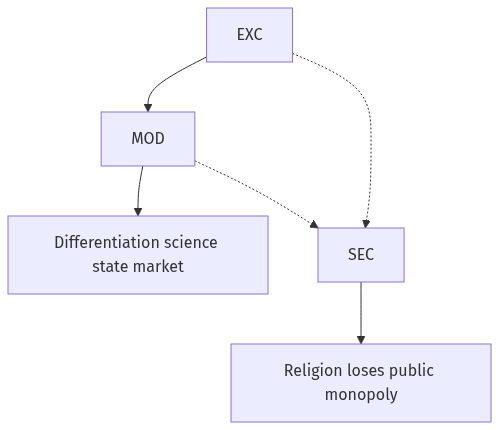
Modernisation means industrial, bureaucratic, scientific and urban transformation. Secularisation means religion losing authority over public institutions and sometimes over belief. Weberian rationalisation made the pair look necessary. The United States, global religious revivals and India show modern life with strong religion. Berger revised the classical secularisation story. The two processes often meet, but they do not have to travel as one.
Model answer
Copper italics in this answer — like this — are the key facts. Each one is unpacked in the Facts & figures rail.
Introduction
Modernisation is the cluster of changes that produce industrial economies, bureaucratic states, science-based knowledge and more individual choice. Secularisation is the process by which religion loses authority over law, education, politics and, in stronger versions, over personal belief. Many classical sociologists expected the two to move together. The question asks whether that necessity holds. My view is that they often accompany each other and that they do not necessarily do so.
Body
Why they have been linked
Max Weber’s rationalisation thesis tied the modern world to disenchantment. Calculation, office and science crowd out magical and priestly control of public life. Emile Durkheim expected the cult of the individual and occupational ethics to grow as mechanical solidarity of a common church weakened, though he also looked for new forms of the sacred. Peter Berger, for a time, described a secularising modern consciousness. Functional differentiation, in Talcott Parsons and later Niklas Luhmann, gives religion a specialised slot rather than a canopy over all institutions. European histories of church and state seemed to confirm the pair: industrial society, liberal constitutions and declining Sunday practice.
Why they do not necessarily go together
The United States modernised while remaining highly religious in church membership. Jose Casanova showed public religions returning to politics. Berger later revised his own secularisation thesis after looking at global Pentecostalism and other revivals. India is a decisive case for this question. Colonial and postcolonial modernisation brought railways, universities, industry and a secular constitutional state. Religious identity, pilgrimage, televised ritual and communal politics did not fade. Ashis Nandy and T. N. Madan questioned a simple Western secularism as the only modern path. Rajeev Bhargava’s idea of principled distance describes an Indian state that is not the same as French laicite. Instrumental modernisation can even intensify religious organisation, because parties and media use sacred symbols. Fundamentalist movements use modern technology.
So modernisation tends to differentiate institutions and to create secular law in some spheres. It does not necessarily empty the public square of religion, and it does not necessarily make individuals unbelievers. Secularisation, where it occurs, has more than one path: decline of belief, privatisation, or merely the state’s refusal to be a theocracy. Those paths are historical and political, not automatic companions of the factory and the smartphone.
My view, stated plainly
I do not treat the classical pair as a law. Factories, universities and ballots can grow while pilgrimage, televangelism and religious parties also grow. What often does go together with modernisation is differentiation: the hospital is not run as a temple, and the civil code is not a sermon. That is a limited secularisation of institutions. Belief and identity can remain strong, and can even use modern media to become stronger. Turkey, the United States, Iran after a modernising state, and India after 1991 all show different pairings. A student who writes that they must go together has repeated a European expectation. A student who writes that they never meet has ignored law, science and the bureaucratic state. They often meet in part. They do not necessarily meet in full.
Flow diagram
Conclusion
Modernisation and secularisation have often been partners in Western classical theory and in some European histories. They are not necessary twins. Modern societies can remain publicly religious, and secular law can coexist with intense belief. India shows that pairing with special clarity.
Quick related
Students also ask
-
Modern families have not just become nuclear and neo-local, but also filiocentric. How do you explain this trend?
Next question on this syllabus topic (2024 · Q8(a)). View answer →
-
Does a secular constitution prove a secular society?
No. Law can be secular while everyday life and electoral politics remain saturated with religion.
-
Is decline of temple attendance the only secularisation?
No. Sociologists also study privatisation of belief and the shrinking of religion’s control over education and law.
Same topic · past papers
UPSC has asked this before
These previous-year questions sit on the same topic. Open one to practise the earlier ask.
-
2022 · Q5(d) · Sociology GS 1 · 10 marks
Write a note on global trends of secularization.
More from this topic
Q8(c) · UPSC Mains 2026 · Sociology GS 1 · 10 marks · Solution
Discuss the significance and limitations of 'intersectionality' in social research
Sociology
Intersectionality, coined by Kimberlé Crenshaw, examines how overlapping identities like race, class, and gender shape systemic oppression. Its significance in social research lies in capturing lived realities beyond single-axis frameworks and preventing reductive generalisations. However, limitations include methodological complexity, risks of infinite regress, and difficulties in operationalising fluid categories. Effective application requires balancing structural macro-analysis with micro-level lived experiences.
Q6(b) · UPSC Mains 2026 · Sociology GS 1 · 20 marks · Solution
Critically analyse the nature-nurture debate from different perspectives
Sociology
1. The nature-nurture debate explores whether biology or society primarily shapes human behavior
Q6(a) · UPSC Mains 2026 · Sociology GS 1 · 20 marks · Solution
Discuss the intellectual origins of sociology and its evolution as a distinct field of study
Sociology
Sociology arose in 19th-century Western Europe to make sense of massive upheavals caused by the Industrial and French Revolutions. Enlightenment thinkers laid the groundwork by championing reason, empirical observation, and human agency over traditional dogma. Auguste Comte gave the discipline its name, pushing for a positivist "physics of society" based on scientific laws. Émile Durkheim secured its academic legitimacy by defining "social facts" and using empirical methods to study human behavior. Max Weber introduced interpretive sociology, while Karl Marx focused on material conditions and class struggle. In the 20th century, Talcott Parsons advanced structural-functionalism to study systemic equilibrium. Later, conflict theories, the Frankfurt School, and postmodern critiques broadened the field to address power and marginalisation. Today, sociology continues to evolve by analyzing globalisation, digital shifts, and modern identity politics.