
Revision summary
Scientific method requires evidence, clear concepts, testable claims, systematic procedure, and publicity. Popper stressed falsifiability. Kuhn stressed that paradigms also organise what counts as a test. Sociology cannot be foolproof because action is meaningful, reactive, and ethically constrained. Durkheim’s comparisons and Weber’s verstehen must be held together. Method disciplines dogma. It does not issue a final certificate of truth.
Model answer
Copper italics in this answer — like this — are the key facts. Each one is unpacked in the Facts & figures rail.
Introduction
Scientific method is a public way of turning questions into evidence that others can check. Sociology borrowed this ideal from the natural sciences and from Auguste Comte’s positivism. The method has stable characteristics. It is not foolproof when the object is meaningful human action.
Body
Characteristics
- Empirical reference: claims must meet observations, not only authority.
- Conceptual clarity: terms such as class or anomie must be defined so that another worker can use them.
- Hypothesis and test: a stated relation is exposed to data that could fail it, which Karl Popper later called falsifiability.
- Systematic procedure: sampling, measurement, and recording follow a plan that can be reported.
- Logical inference: induction from cases and deduction from theory are both disciplined.
- Replication and publicity: others must be able to repeat or reanalyse.
- Provisionality: findings are open to revision, which Thomas Kuhn described as the life of paradigms, not as a single climb to final truth.
- Durkheim’s suicide study displayed rates, comparison, and the search for concomitant variation.
Is it foolproof in sociology?
- No. Foolproof would mean that the same procedure always yields the same true map of society. Sociology does not have that guarantee.
- Max Weber’s verstehen requires interpretation of motive. Two trained readers may still disagree on a text or a rite.
- The Hawthorne studies showed that the act of observation changes work behaviour.
- Values enter the choice of problem. Weber asked for value neutrality in the analysis, not in the choice of why a topic matters.
- Human subjects lie, forget, and perform for the interviewer, which Goffman makes ordinary.
- Experiments on people face ethical limits that physics does not face in the same way.
- Historical uniqueness, which Wilhelm Dilthey and later historicists stressed, limits the covering-law model.
What still holds
- The method is a control on dogma. It is not a machine that cannot err.
- Mixed methods, triangulation, and reflexivity reduce error without producing certainty.
- Feminist and interpretative critiques correct positivist blindness. They do not licence invention.
- Indian field studies, from M. N. Srinivas at Rampura to later village restudies, show both the power of method and the revision of earlier findings.
Elaboration in one line of judgement
- Treat scientific method as necessary discipline. Treat foolproof as a false promise in a science of meaning, power, and historical change.
Flow diagram
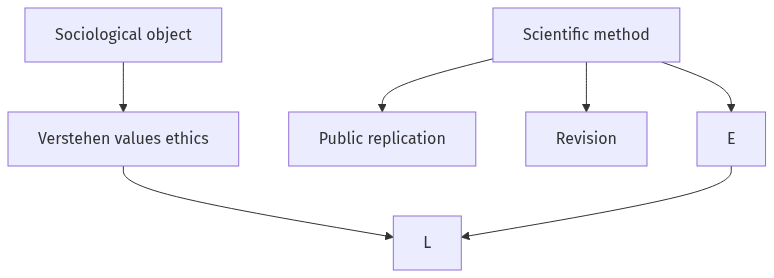
Conclusion
Scientific method in sociology is empirical, public, systematic, and revisable. It is not foolproof, because meaning, values, reactivity, and ethics block a laboratory guarantee. Durkheim showed what comparison can do. Weber showed why interpretation remains. The honest position is disciplined method without a claim of perfect proof.
Quick related
Students also ask
-
How does a researcher achieve objectivity in interpretative research?
Next question on this syllabus topic (2022 · Q1(b)). View answer →
-
If it is not foolproof, is sociology not a science?
It is a science of a different object. Lack of laboratory certainty is not the same as lack of method.
-
Does interpretation cancel comparison?
No. Weber used both ideal types and historical comparison. Meaning and test can be joined.
Same topic · past papers
UPSC has asked this before
These previous-year questions sit on the same topic. Open one to practise the earlier ask.
-
2018 · Q5(c) · Sociology GS 1 · 10 marks
Does scientific method make Sociology a Science? Illustrate your answer with Durkheim's method. -
2016 · Q3(b) · Sociology GS 1 · 15 marks
Describe the basic postulates of scientific method. How far are these followed in sociological research? -
2024 · Q5(a) · Sociology GS 1 · 10 marks
Describe various characteristics of a 'social fact'. How is the rate of suicide a social fact according to Durkheim? -
2018 · Q7(c) · Sociology GS 1 · 15 marks
What, according to Pareto, are the basic characteristics of elites? Discuss.
More from this topic
Q7(a) · UPSC Mains 2026 · Sociology GS 1 · 20 marks · Solution
Compare and critically assess 'the grounded theory' with 'theory-driven research method' in sociology
Sociology as Science
• Grounded theory uses inductive emergence and constant comparison to build concepts directly from raw data without prior hypotheses. • Theory-driven research uses deductive verification, starting with established frameworks to test specific hypotheses against empirical reality. • Grounded methodology relies on iterative coding (open, axial, selective) happening simultaneously with ongoing data collection. • Theory-driven methodology requires strict operational definitions, variable isolation, and standardized protocols before field deployment. • Grounded theory excels at generating thick, micro-level context and thick descriptions, but struggles with macro-level generalizability. • Theory-driven research risks forcing complex social realities into rigid conceptual boxes, while grounded approaches risk subjective bias. • Contemporary sociology increasingly uses a pragmatic synthesis, leveraging grounded insights to refine broader macro-theoretical frameworks.
Q5(d) · UPSC Mains 2025 · Sociology GS 1 · 10 marks · Solution
How does Weber's Verstehen address the objectivity-subjectivity debate in sociology?
Sociology as Science
Verstehen is interpretative understanding of meaningful social action. Ideal types help compare cases without pretending to be full copies of reality. Value relevance selects topics; value freedom forbids twisting evidence to preach. This rejects naive positivist objectivity as a view from nowhere. It also rejects the idea that interpretation is only the scholar’s private feeling. Actors’ meanings remain checkable through comparison, documents and consequences.
Q2(c) · UPSC Mains 2025 · Sociology GS 1 · 10 marks · Solution
What do you mean by reliability? Discuss the importance of reliability in social science research.
Sociology as Science
Reliability is the consistency of a measure across time, items and raters. It differs from validity, which asks whether the right concept is being measured. Types include test–retest, split-half or alpha, and inter-coder agreement. Durkheimian rates and modern surveys both depend on stable classification. Qualitative work still needs transparent, repeatable coding. Without reliability, comparison, replication and policy use of data collapse.