
Revision summary
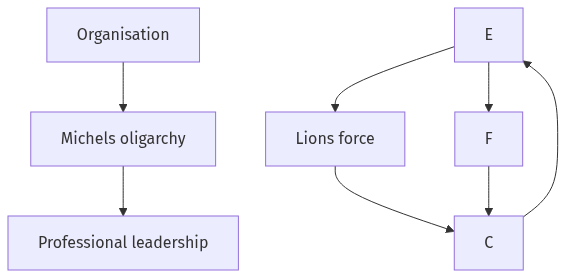
Michels held that organisation produces a ruling minority even in democratic socialist parties. His case was the German Social Democratic Party and its professional apparatus. Pareto’s lions rule by force and persistence. Foxes rule by combination and cunning. They differ as styles. They do not differ as elites. Circulation replaces one style with the other. Marx on property and Weber on legitimacy remain necessary beside both elite theories.
Model answer
Copper italics in this answer — like this — are the key facts. Each one is unpacked in the Facts & figures rail.
Introduction
Robert Michels and Vilfredo Pareto both denied that mass organisations stay equal in practice. Michels stated an iron law of oligarchy inside parties. Pareto described a circulation of elites between lions and foxes. The two accounts meet on minority rule. They differ on how that minority is composed and replaced.
Body
Michels and the iron law
- In Political Parties, Michels argued that organisation itself produces a ruling minority, even in parties that preach democracy and socialism.
- Technical needs create leaders who speak, write, negotiate, and control funds. Members cannot all do this work.
- Psychological needs create a mass that wants direction and a leadership that wants to keep office.
- The German Social Democratic Party was his main case: a workers’ party that grew a professional apparatus.
- The law is iron in his wording because he treated oligarchy as the fate of organisation, not as a passing abuse.
- Limits: unions and parties have later introduced term limits, primaries, and recall. Michels underplayed counter-organisation. He still named a real tendency that Indian cadre parties and trade unions display when offices harden.
Pareto’s lions and foxes
- Pareto divided residues. Class I residues favour combination, fraud, and innovation. Class II residues favour persistence, force, and conservation.
- Foxes govern by cunning, deals, and speculation. Lions govern by force, faith, and cohesion.
- Elites circulate. A fox elite that loses the will to use force is replaced by lions. A lion elite that cannot adapt is replaced by foxes.
- They differ in method and residue. They do not differ in being a minority that takes the best of the social surplus.
- They are not two species of human nature frozen forever. Persons and groups can shift, and circulation is the point of the theory.
Do they essentially differ?
- Yes, as styles of rule: force versus combination. No, as a class of rulers: both are elites.
- Michels explains why a socialist party still grows a closed leadership. Pareto explains why that leadership, and the wider governing stratum, changes colour without becoming the mass.
- Marx remains the contrast: he locates minority rule in property, not only in organisation or residues.
- Weber’s party and status groups sit between them: organisation plus honour, not only instinct.
- Indian illustrations include the hardening of party high commands, and the swing between coercive and bargain-based elite styles in state politics.
Assessment
- Use Michels for internal party structure. Use Pareto for replacement of elite styles. Do not treat either as a complete theory of class.
Flow diagram
Conclusion
Michels’s iron law is that organisation produces oligarchy, shown in the socialist party that grew a professional leadership. Pareto’s lions and foxes differ in residues and methods, not in elite status, and they replace one another through circulation. Together they describe minority rule. They do not replace Marx on property or Weber on legitimacy.
Quick related
Students also ask
-
How do you assess the changing patterns in kinship relations in societies today?
Next question on this syllabus topic (2023 · Q3(b)). View answer →
-
Did Michels say democracy is impossible?
He said large organisation tends to oligarchy. Later rules can slow the tendency. He did not supply a working democratic machine.
-
Are lions morally better than foxes?
Pareto did not write a moral ranking. He wrote two techniques of elite survival.
Same topic · past papers
UPSC has asked this before
These previous-year questions sit on the same topic. Open one to practise the earlier ask.
-
2021 · Q5(b) · Sociology GS 1 · 10 marks
Critically examine the relevance of Vilfredo Pareto's theory of Circulation of Elites in the present scenario
More from this topic
Q8(c) · UPSC Mains 2026 · Sociology GS 1 · 10 marks · Solution
Discuss the significance and limitations of 'intersectionality' in social research
Sociology
Intersectionality, coined by Kimberlé Crenshaw, examines how overlapping identities like race, class, and gender shape systemic oppression. Its significance in social research lies in capturing lived realities beyond single-axis frameworks and preventing reductive generalisations. However, limitations include methodological complexity, risks of infinite regress, and difficulties in operationalising fluid categories. Effective application requires balancing structural macro-analysis with micro-level lived experiences.
Q6(b) · UPSC Mains 2026 · Sociology GS 1 · 20 marks · Solution
Critically analyse the nature-nurture debate from different perspectives
Sociology
1. The nature-nurture debate explores whether biology or society primarily shapes human behavior
Q6(a) · UPSC Mains 2026 · Sociology GS 1 · 20 marks · Solution
Discuss the intellectual origins of sociology and its evolution as a distinct field of study
Sociology
Sociology arose in 19th-century Western Europe to make sense of massive upheavals caused by the Industrial and French Revolutions. Enlightenment thinkers laid the groundwork by championing reason, empirical observation, and human agency over traditional dogma. Auguste Comte gave the discipline its name, pushing for a positivist "physics of society" based on scientific laws. Émile Durkheim secured its academic legitimacy by defining "social facts" and using empirical methods to study human behavior. Max Weber introduced interpretive sociology, while Karl Marx focused on material conditions and class struggle. In the 20th century, Talcott Parsons advanced structural-functionalism to study systemic equilibrium. Later, conflict theories, the Frankfurt School, and postmodern critiques broadened the field to address power and marginalisation. Today, sociology continues to evolve by analyzing globalisation, digital shifts, and modern identity politics.