
Revision summary
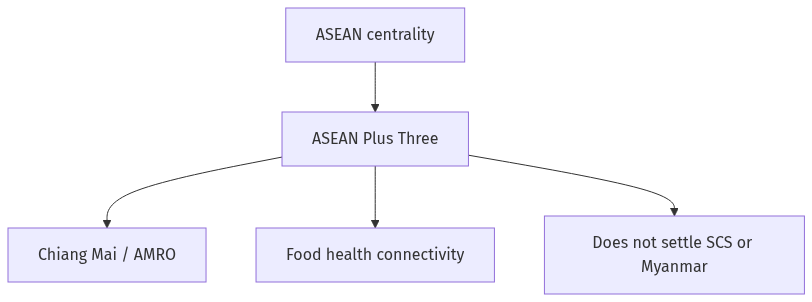
ASEAN Plus Three is ASEAN plus China, Japan and South Korea, institutionalised after the 1997 financial crisis. Chiang Mai / CMIM and AMRO are the clearest successes: a regional liquidity net and surveillance. Functional cooperation on rice, health and convening of a bitter Northeast Asian triangle also count. Limits are the South China Sea, Myanmar, the ASEAN way, and modest money next to the IMF. APT is a functional regime, not a NATO or a court of last resort for force.
Model answer
Copper italics in this answer — like this — are the key facts. Each one is unpacked in the Facts & figures rail.
Introduction
ASEAN Plus Three (APT) joins the ten ASEAN states with China, Japan and South Korea. It was institutionalised after the 1997–98 Asian financial crisis, when the region learned that the IMF could be both rescuer and political shock. The question is not whether APT is a NATO. It is whether it has addressed regional problems — money, food, health, and some diplomacy — with a success that can be named and limited.
Body
Successes
The Chiang Mai Initiative, later multilateralised (CMIM), is a swap network against liquidity crises, watched by AMRO (ASEAN+3 Macroeconomic Research Office) in Singapore. That is a specific answer to 1997: a regional safety net, still small next to IMF resources, but real. APT also hosts functional cooperation on rice reserves, pandemic information, and connectivity talk. It keeps China–Japan–Korea in the same room as ASEAN, which matters when bilateral history is poisonous. During COVID-19, APT statements and medical supply coordination were more usable than a frozen Northeast Asian political triangle. ASEAN centrality is the diplomatic method: the weaker ten convene the stronger three.
- Compared with SAARC, APT looks successful: it meets, it has a fund, it survived great-power weather. ASEAN Plus Three is also a building block toward the East Asia Summit and RCEP’s political climate, even when membership lists differ.
Limits
APT does not settle the South China Sea. Code of Conduct talks crawl; Chinese coast-guard and militia pressure on the Philippines and Vietnam continues. Myanmar after the 2021 coup exposed the ASEAN way — consensus, non-interference — as paralysis; the Plus Three cannot impose what ASEAN will not. North Korea is a Plus Three neighbourhood problem that APT does not command. U.S. alliance structures (Japan, Korea, Philippines) and the Quad handle deterrence that APT will not. Financial firepower remains modest; in a true crash, Washington and the IMF still matter, as does the dollar.
Success is therefore functional and financial, not strategic. APT addresses regional problems that can be framed as technical. It ducks problems that require naming a revisionist or a junta. That is both the secret of its survival and the ceiling of its achievement.
Flow diagram
Conclusion
- ASEAN Plus Three succeeded as a post-1997 money-and-meeting machine: CMIM, AMRO, and convening of Northeast Asia through ASEAN. It has not become a security community. Regional problems of force and regime violence remain largely outside its usable toolkit.
Quick related
Students also ask
-
"Trump's return to the White House is a jolt to push the European Union to invest in its own defence and economic and technological revival." Comment
Next question on this syllabus topic (2025 · Q4(c)). View answer →
-
Is APT the same as RCEP?
No. RCEP is a wider trade agreement (includes Australia, New Zealand, and until geopolitics shifted, was negotiated with a different logic). APT is the older +3 political-financial process.
-
Why not include India?
India is in the East Asia Summit and some ASEAN-led forums, not in the +3 financial core, which is Northeast Asian plus ASEAN.
Same topic · past papers
UPSC has asked this before
These previous-year questions sit on the same topic. Open one to practise the earlier ask.
More from this topic
Q7(a) · UPSC Mains 2026 · PSIR GS 2 · 20 marks · Solution
How does illegal cross border migration pose challenges to India's security? Discuss the steps taken by the government in this direction and their effectiveness
Comparative Politics
Illegal cross-border migration undermines India's national security by altering demographic balances, straining economic resources, and exacerbating internal security vulnerabilities. The government has responded through border fencing, technological integration like SMART fencing, institutional mechanisms, and bilateral agreements. However, porous terrain, regional political complexities, and local connivance limit the complete effectiveness of these measures. A holistic approach combining strict border management with socio-economic development and robust legal frameworks is essential for sustainable containment.
Q5(d) · UPSC Mains 2026 · PSIR GS 2 · 10 marks · Solution
Discuss the main features of the land-boundary agreement between India and Bangladesh.
Comparative Politics
• Operationalized via the 100th Constitutional Amendment Act of 2015 to resolve Radcliffe Line anomalies. • Rooted in the unratified 1974 bilateral agreement and the 2011 additional protocol. • Involved the peaceful exchange of 111 Indian enclaves in Bangladesh and 51 Bangladeshi enclaves in India. • Granted affected residents the sovereign right to choose their nationality and place of residence. • Demarcated roughly 6.1 km of previously un-demarcated land boundaries to end administrative confusion. • Secured human rights and welfare access for over 50,000 formerly stateless enclave residents. • Reduced bilateral trust deficits, paving the way for deeper cooperation in security and connectivity.
Q4(c) · UPSC Mains 2026 · PSIR GS 2 · 15 marks · Solution
What is UNCLOS? Explain its salient features
Comparative Politics
UNCLOS, established in 1982, serves as the constitution of the oceans, codifying customary international law regarding maritime jurisdictions. Its salient features include distinct maritime zones ranging from territorial waters to the high seas, balancing coastal state sovereignty with freedom of navigation. It establishes compulsory dispute settlement mechanisms through institutions like ITLOS. The convention also mandates environmental protection and sustainable management of marine resources. For India, UNCLOS provides a rules-based order in the Indo-Pacific while respecting navigational rights. It remains central to addressing contemporary maritime security and resource challenges.