
Revision summary
Political socialisation is the learning of political attitudes, skills and identities. Open societies use competing agents — family, school, parties, plural media — and allow doubt. Closed societies monopolise the story through party, clergy or police and punish dissent. Almond, Verba, Easton, Hyman and Popper supply the vocabulary; Iran, China and backsliding democracies are living cases. No regime is perfectly open or closed; smartphones and migration leak closed systems.
Model answer
Copper italics in this answer — like this — are the key facts. Each one is unpacked in the Facts & figures rail.
Introduction
Political socialisation is the learning of political attitudes, skills and identities across a life. Herbert Hyman, Almond and Verba, and Easton and Dennis made it a comparative variable. The contrast between open and closed societies is about who may teach, what may be doubted, and whether exit and voice exist.
Body
Open societies
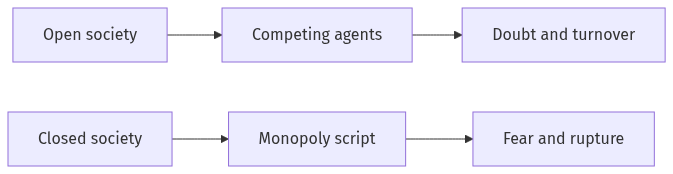
In an open society — Karl Popper’s phrase, used here as a political type — family, school, party, union, temple or mosque, and a plural press compete. Children meet disagreement. Adult socialisation continues through elections, courts and social media. The civic culture can be participant without being unanimous. Mistakes are public. Democratic backsliding in the 2020s shows the type is fragile: capturing the public broadcaster, punishing campuses, or flooding the net with a single story is how an open order begins to close.
Closed societies
A closed society monopolises the story of the state. The party, leader, clergy or secret police is the authorised teacher. Family and school repeat the line. Dissent is treated as disease or treason. Hannah Arendt on total ideology, and later studies of the Soviet Union, Maoist campaigns, North Korea and theocratic police, describe intense closed socialisation. Contemporary Iran after Woman, Life, Freedom shows both the monopoly (morality police, compulsory hijab) and its leak: private satellite, Instagram, and the red lipstick of protest. China combines market opening with tight control of history, Xinjiang and the internet — a hybrid, not a pure type.
Agents and outcomes
Agents are the same nouns — family, school, media, peer group, workplace — with unlike verbs. Open systems produce cross-pressured citizens and peaceful turnover, but also polarisation and conspiracy. Closed systems produce conformity, fear, and sudden breaks when the script fails (1989, Arab Spring, 2022 Iran). Migration and smartphones make perfectly closed socialisation harder. Perfectly open socialisation is a myth too: every democracy has official history, a flag, and a security taboo.
Comparative politics therefore treats openness as a spectrum. Electoral autocracies socialise for applause, not for alternation. Liberal democracies socialise for contest, and then argue about whether universities and platforms still allow it.
Flow diagram
Conclusion
Open societies socialise through competing teachers and the right to doubt. Closed societies socialise through monopoly and fear. Most living regimes sit between, and move.
Quick related
Students also ask
-
Of late, centrist and centre-left political parties have been facing setbacks while centre-right parties have been in ascendency the world over. Comment
Next question on this syllabus topic (2025 · Q3(a)). View answer →
-
Is social media opening closed societies?
It leaks information and organises protest, but it also lets closed regimes surveil, shame and flood. The net is an agent, not a liberal guarantee.
-
Are Indian schools ‘open’?
India is constitutionally open: many parties, a free press in law, and contested textbooks. Capture of boards, campus policing and communal pressure can still close the classroom in practice.
Same topic · past papers
UPSC has asked this before
These previous-year questions sit on the same topic. Open one to practise the earlier ask.
-
2024 · Q3(b) · PSIR GS 2 · 15 marks
Critically examine the role of political parties in sustaining and stabilising democracies in the developing societies. -
2022 · Q2(b) · PSIR GS 2 · 15 marks
Discuss the role of social movements in strengthening the democratic processes in developing societies -
2026 · Q2(a) · PSIR GS 2 · 20 marks
Discuss the factors responsible for the changing nature of states in contemporary industrial societies and explain its impact
More from this topic
Q3(a) · UPSC Mains 2025 · PSIR GS 2 · 20 marks · Solution
Of late, centrist and centre-left political parties have been facing setbacks while centre-right parties have been in ascendency the world over. Comment
Politics of Representation and Participation
Many democracies since the late 2010s show centre-left and centrist losses and centre-right or radical-right gains. Drivers include migration, post-COVID inflation, culture war, housing and the split of the old working-class vote. Inglehart’s counter-revolution and Piketty’s Brahmin-left sketch help; they do not travel unchanged to India or Latin America. UK Labour 2024 and other cases are exceptions; not every right victory is fascism. The wave still shapes IR: tariffs, NATO, WHO and China policy.
Q3(b) · UPSC Mains 2024 · PSIR GS 2 · 15 marks · Solution
Critically examine the role of political parties in sustaining and stabilising democracies in the developing societies.
Politics of Representation and Participation
Parties can sustain developing democracies by aggregating conflict, training elites and making peaceful turnover possible. Huntington’s institutionalisation and India’s early Congress incorporation illustrate the positive case. Failures include family vehicles, ethnic census parties, clientelism and polarising attacks on referees. Existence of parties is not the same as a party system that can lose. Critical verdict: necessary organisations whose quality decides whether democracy thickens or hollows.
Q3(a) · UPSC Mains 2024 · PSIR GS 2 · 20 marks · Solution
Discuss the major recent social movements related to the physical rights of women in various countries of the world.
Politics of Representation and Participation
Physical rights of women concern safety, reproduction and control of the body in public. #MeToo, Ni Una Menos, India’s post-Nirbhaya protests, Argentina’s Green Tide, Poland’s abortion strikes and Iran’s Woman, Life, Freedom are major recent cases. Gains include legal reform and public naming of violence; losses include U.S. abortion rollback and repression in Iran. The wave is transnational in method and local in outcome. Counter-movements are part of the same comparative story.