
Revision summary
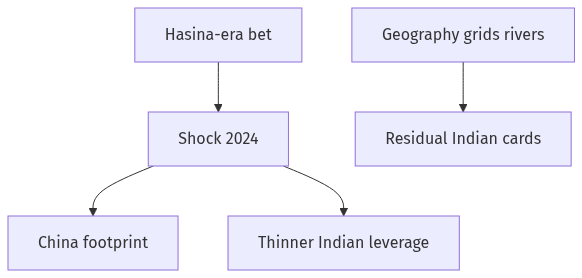
India’s Bangladesh leverage after 2009 was tied to Sheikh Hasina; her 2024 exit opened space for China. Beijing’s BRI projects, credit and defence courtship give Dhaka an omni-enmeshment option. Indian delays on Teesta, a trade surplus and political optics of patronage stored grievances. The shift weakens Delhi’s privileged access but does not erase geography, power trade or transit. A less personality-based Neighbourhood First is the repair, not a hyper-realist sulk.
Model answer
Copper italics in this answer — like this — are the key facts. Each one is unpacked in the Facts & figures rail.
Introduction
- India’s Bangladesh policy after 2009 rested on a close bet on Sheikh Hasina: security cooperation against northeast insurgents, transit, power trade, and a managed border. That bet was jolted when Hasina left office in August 2024 and an interim order under Muhammad Yunus began to reopen the external field. China’s growing footprint is both cause and beneficiary of that shift. India’s leverage in Dhaka has weakened. It has not vanished.
Body
The tangible shift
- Beijing already sat in Bangladesh’s infrastructure: bridges, power plants, and Belt and Road credit. After 2024, political permission for a more visible China — defence conversation, extra projects, and a less embarrassed equidistance — increased. For a smaller state, omni-enmeshment is rational: play India and China, as Nepal and Sri Lanka have. Reports of Chinese interest in dual-use facilities and of Dhaka’s wish to diversify arms away from a single neighbour are the security reading. The Teesta water file, long stalled, became a symbol of Indian delay that China offered, rhetorically, to fill with projects.
Why Indian leverage thinned
Leverage was personalised around Awami League networks and around India’s role as the 1971 midwife. It under-priced domestic anger: jobless youth, alleged electoral closure, and the optics of Delhi as a patron. A large bilateral trade surplus in India’s favour, occasional border killings, and CAA–NRC sensitivities among Bangladeshi Muslims were stored grievances. When the regime broke, those grievances became foreign policy. China does not carry 1971’s emotional debt; it carries cash and a UN veto.
Comment
The statement is largely right as a trend, overstated as a verdict. India remains the market, the electricity grid partner, the transit geography to the northeast, and the cultural neighbour. Delhi still holds visas, river data, and the capacity to spoil. A hyper-realist over-reaction would push Dhaka further east. A smarter line is Neighbourhood First with less regime-personality: water-sharing, trade access, and quiet security coordination that does not look like tutelage. China’s rise in the Bay is real. India’s loss is political capital, not the map.
Flow diagram
Conclusion
China’s opening in a post-Hasina Bangladesh has cut India’s privileged access. Geography, grids and markets still give Delhi cards. Leverage is weaker because it was too personal and too slow on water and trade dignity. It is not yet a lost neighbourhood.
Quick related
Students also ask
-
For India, a multipolar world order would also mean a multipolar Asia. Comment.
Next question on this syllabus topic (2025 · Q5(c)). View answer →
-
Has Bangladesh ‘switched camps’?
No. It is widening options. Camp-switch language is a Delhi anxiety, not a Dhaka communiqué.
-
Does 1971 still matter?
As memory, yes, especially among some elites. As a blank cheque for Indian influence, 2024 showed it does not.
Same topic · past papers
UPSC has asked this before
These previous-year questions sit on the same topic. Open one to practise the earlier ask.
-
2025 · Q8(a) · PSIR GS 2 · 20 marks
India's reluctance to perceive any 'existential threat' inevitably made the multilateral path to nuclear security a 'default option' until it decided to cross nuclear Rubicon in 1998. Identify and analyze some of the major reasons behind this shift in India's position on the nuclear question
More from this topic
Q8(b) · UPSC Mains 2026 · PSIR GS 2 · 15 marks · Solution
India has recognised that West Asia is not a single contest, but a tangle of rivalries, bargains and anxieties. Comment
Recent developments in Indian Foreign policy
This 15-mark model answer for UPSC CSE Mains examines India's evolved diplomacy in West Asia, transitioning from a monolithic view to navigating complex regional rivalries, strategic bargains, and security anxieties. It highlights India's de-hyphenated engagement with Israel, Iran, and the Arab Gulf, robust energy diplomacy, diaspora protection, and minilateral frameworks like I2U2. The conclusion anchors this pragmatic realism within India's strategic autonomy and Act West policy.
Q5(b) · UPSC Mains 2026 · PSIR GS 2 · 10 marks · Solution
What strategic options can India exercise as a response to the tensions between Pakistan and Afghanistan?
Recent developments in Indian Foreign policy
India faces a complex security landscape due to Durand Line tensions and cross-border terrorism between Pakistan and Afghanistan. Strategic options include proactive diplomatic engagement with the Taliban regime to secure developmental investments, intelligence-sharing and capacity-building with regional partners like Iran and Central Asian Republics, and maintaining a strict posture on counter-terrorism. By leveraging multilateral platforms such as the Shanghai Cooperation Organisation and reinforcing soft-power outreach through humanitarian aid, New Delhi can safeguard its core security interests. Simultaneously, India must balance its defensive posture with strategic autonomy, ensuring regional stability without direct military entanglement in the Pashtun belt.
Q5(c) · UPSC Mains 2025 · PSIR GS 2 · 10 marks · Solution
For India, a multipolar world order would also mean a multipolar Asia. Comment.
Recent developments in Indian Foreign policy
A multipolar world is several great-power centres; it is hollow for India if Asia is Sino-centric. India’s threats, trade and waters are Asian, so Asian power-sharing is the real test of the slogan. Japan, ASEAN centrality, Korea, Australia and India beside China and the U.S. are the intended map. Quad and FOIP are instruments of pluralism, not a finished concert. The claim is right as strategy and still aspirational as fact.