
Revision summary
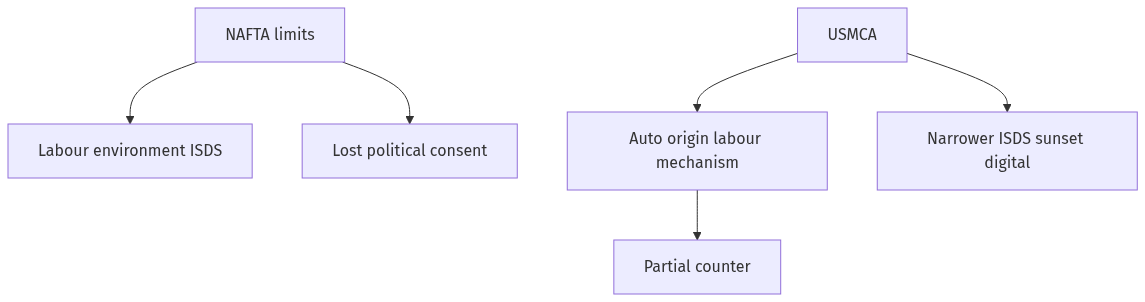
NAFTA deepened North American production but was blamed for wage pressure, weak labour and environment side deals, ISDS and U.S. political backlash. Mexico–U.S. asymmetry and the absence of EU-style adjustment funds were structural limits. USMCA tightened auto rules of origin and wage-related content, added a rapid-response labour mechanism, and moved environment into the core. ISDS was narrowed; digital trade and a sunset/review clause addressed legitimacy and a 1990s text. The replacement is managed regionalism, not a social union.
Model answer
Copper italics in this answer — like this — are the key facts. Each one is unpacked in the Facts & figures rail.
Introduction
The North American Free Trade Agreement (NAFTA), in force from 1994, locked Canada, Mexico and the United States into a regional free-trade area. It deepened auto and manufacturing chains. It also accumulated political enemies. The United States-Mexico-Canada Agreement (USMCA) replaced it in 2020. The question is what NAFTA could not solve, and how the successor tried to counter those limits.
Body
Limitations of NAFTA
First, labour and wages. Critics in the United States argued that firms moved production to Mexico, hollowing industrial towns, while Mexican wages and union freedom did not rise in line with productivity. Second, environment. The side accords were weaker than the commercial core; pollution and weak enforcement at the border remained a campaign fact. Third, asymmetry. Mexico was the developing partner in a deal written around U.S. law and investor comfort. Wallerstein’s core–periphery language is too crude for Mexico’s industrial upgrade, but the power imbalance was real. Fourth, investor–state dispute settlement (ISDS) allowed firms to sue governments in ways that looked, to publics, like a veto on regulation. Fifth, agriculture and dairy fights, especially with Canada, never disappeared. Sixth, no development or adjustment politics equal to the shock: there was no EU-style cohesion fund. Seventh, legitimacy. By the 2016 U.S. election NAFTA was a symbol of globalisation’s domestic cost, which is the politics behind question 2(a).
NAFTA did raise intra-North American trade and locked in Mexican liberalisation. The limitations were distribution, democracy of regulation, and political consent.
How USMCA tried to counter them
USMCA kept the regional production club and rewrote the bargain. Rules of origin for automobiles were tightened so that more content had to come from North America and from higher-wage labour, a direct reply to offshoring politics. A rapid-response labour mechanism, especially aimed at Mexican factories, gave the United States a tool that NAFTA’s side agreement lacked. Environmental provisions were moved into the core text with stronger dispute potential. ISDS was narrowed sharply between the United States and Canada and limited with Mexico, a reply to the regulatory-chill charge. Digital trade chapters updated a 1990s text for data and platforms. A sixteen-year sunset with periodic review was meant to stop the deal from looking eternal and unaccountable. Canadian dairy access was adjusted in the U.S. interest. Intellectual property terms were tightened in ways critics still call Northern.
How far the counter goes
USMCA is managed trade, not a labour international. Mexican labour reform is incomplete; U.S. industrial decline has many causes besides NAFTA; climate is still not a full North American industrial plan. The replacement countered the most explosive political limits — labour optics, ISDS, auto origin — so that regional integration could survive deglobalisation talk. It did not turn North America into a social union.
Flow diagram
Conclusion
NAFTA’s limits were labour dislocation, weak environment and labour teeth, investor privilege, and lost consent in the United States. USMCA countered them with tighter auto rules, a labour rapid-response tool, a stronger environmental text, trimmed ISDS and a review sunset. The repair is political and partial, not a new theory of equality.
Quick related
Students also ask
-
The return of trade barriers and economic sanctions has diminished the spirit of GATT. In this context, discuss the factors contributing to the decline of WTO in recent times.
Next question on this syllabus topic (2024 · Q4(b)). View answer →
-
Did USMCA bring factories back to the United States?
It changed incentives at the margin, especially in autos. It did not reverse every post-1994 location decision.
-
Is USMCA anti-Mexico?
It is more conditional on Mexican labour practice. Mexico still wanted access to the U.S. market more than a collapse of the regional club.
Same topic · past papers
UPSC has asked this before
These previous-year questions sit on the same topic. Open one to practise the earlier ask.
-
2023 · Q7(c) · PSIR GS 2 · 15 marks
What are the challenges and limitations in India - Iran relations? -
2022 · Q1(a) · PSIR GS 2 · 10 marks
Discuss the main limitations of the comparative method to the study of Political Science.
More from this topic
Q7(a) · UPSC Mains 2026 · PSIR GS 2 · 20 marks · Solution
How does illegal cross border migration pose challenges to India's security? Discuss the steps taken by the government in this direction and their effectiveness
Comparative Politics
Illegal cross-border migration undermines India's national security by altering demographic balances, straining economic resources, and exacerbating internal security vulnerabilities. The government has responded through border fencing, technological integration like SMART fencing, institutional mechanisms, and bilateral agreements. However, porous terrain, regional political complexities, and local connivance limit the complete effectiveness of these measures. A holistic approach combining strict border management with socio-economic development and robust legal frameworks is essential for sustainable containment.
Q5(d) · UPSC Mains 2026 · PSIR GS 2 · 10 marks · Solution
Discuss the main features of the land-boundary agreement between India and Bangladesh.
Comparative Politics
• Operationalized via the 100th Constitutional Amendment Act of 2015 to resolve Radcliffe Line anomalies. • Rooted in the unratified 1974 bilateral agreement and the 2011 additional protocol. • Involved the peaceful exchange of 111 Indian enclaves in Bangladesh and 51 Bangladeshi enclaves in India. • Granted affected residents the sovereign right to choose their nationality and place of residence. • Demarcated roughly 6.1 km of previously un-demarcated land boundaries to end administrative confusion. • Secured human rights and welfare access for over 50,000 formerly stateless enclave residents. • Reduced bilateral trust deficits, paving the way for deeper cooperation in security and connectivity.
Q4(c) · UPSC Mains 2026 · PSIR GS 2 · 15 marks · Solution
What is UNCLOS? Explain its salient features
Comparative Politics
UNCLOS, established in 1982, serves as the constitution of the oceans, codifying customary international law regarding maritime jurisdictions. Its salient features include distinct maritime zones ranging from territorial waters to the high seas, balancing coastal state sovereignty with freedom of navigation. It establishes compulsory dispute settlement mechanisms through institutions like ITLOS. The convention also mandates environmental protection and sustainable management of marine resources. For India, UNCLOS provides a rules-based order in the Indo-Pacific while respecting navigational rights. It remains central to addressing contemporary maritime security and resource challenges.