
Revision summary
Sanctions after the JCPOA crisis cut India’s Iranian oil and complicated Chabahar contractors. INSTC is a map still waiting on regional stability. I2U2 and Israel ties sit poorly with Tehran’s regional map. Afghanistan 2021 is both a shared file and a source of different bets. The challenge is to keep a working corridor without a sanctions-proof or all-weather pact.
Model answer
Copper italics in this answer — like this — are the key facts. Each one is unpacked in the Facts & figures rail.
Introduction
India and Iran share civilisational contact, a stake in Afghanistan, and the Chabahar–INSTC connectivity idea. The relationship is repeatedly strained by United States sanctions, energy payment problems, Israel policy, and slow project delivery. Challenges are structural, not only diplomatic mood.
Body
Sanctions and energy
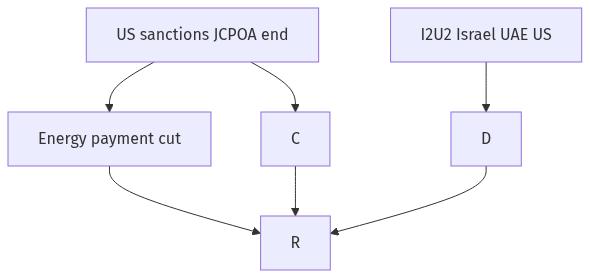
- Iran was a major crude supplier to India. US withdrawal from the JCPOA and secondary sanctions cut that trade for long stretches.
- Payment, insurance, and shipping became the daily challenge. Rupee and third-country mechanisms were incomplete substitutes.
- After 2022 India also had discounted Russian oil, which further reduced Iran’s share.
Connectivity that moves slowly
- Chabahar is the flagship. It competes with time, with Gwadar’s China–Pakistan story, and with US sanctions risk for firms.
- INSTC needs Russian, Iranian, and Caucasian stability. War in Ukraine and Caucasus shocks delay a corridor sold as geopolitics.
Regional politics
- India deepened ties with Israel, the UAE, and the United States, including I2U2, while Iran remains in a hostile set toward Israel and often toward Washington.
- Afghanistan after August 2021 is a shared interest against some militant groups and a divergence on who holds legitimate power.
- Iran–Saudi and Iran–Gulf cycles pull Indian labour, energy, and Hajj-related diplomacy in two directions.
Domestic and identity files
- Shia pilgrimage, Chabahar workers, and occasional statements on Kashmir or on minorities can irritate either capital.
- Neither side treats the other as an enemy. Neither can offer a full strategic cover against the other’s main threat.
Reading
- Keohane’s complex interdependence is thin here because finance and insurance are weaponised by a third State.
- Pragmatic foreign policy keeps Chabahar alive as a hedge. It has not produced a sanctions-proof partnership.
Flow diagram
Conclusion
India–Iran challenges are US sanctions on energy and firms, slow corridors, and India’s simultaneous West Asia partnerships with Iran’s rivals. The relationship survives as a limited connectivity and regional-security file, not as an all-weather alliance.
Quick related
Students also ask
-
Discuss the major drivers of India's interests in Africa
Next question on this syllabus topic (2023 · Q8(c)). View answer →
-
Has India abandoned Iran for Israel?
No. India runs both relationships. The challenge is that Tehran treats the Israel–US set as a threat, so parallelism has a ceiling.
-
Why keep Chabahar if sanctions hurt?
It is India’s main publicly built option for a western land-sea route to Afghanistan and Central Asia. Abandoning it would leave only Pakistan-blocked geography.
Same topic · past papers
UPSC has asked this before
These previous-year questions sit on the same topic. Open one to practise the earlier ask.
-
2026 · Q3(b) · PSIR GS 2 · 15 marks
Theories of international relations which claim objectivity inevitably harbour subjective biases. Elucidate
More from this topic
Q7(a) · UPSC Mains 2026 · PSIR GS 2 · 20 marks · Solution
How does illegal cross border migration pose challenges to India's security? Discuss the steps taken by the government in this direction and their effectiveness
Comparative Politics
Illegal cross-border migration undermines India's national security by altering demographic balances, straining economic resources, and exacerbating internal security vulnerabilities. The government has responded through border fencing, technological integration like SMART fencing, institutional mechanisms, and bilateral agreements. However, porous terrain, regional political complexities, and local connivance limit the complete effectiveness of these measures. A holistic approach combining strict border management with socio-economic development and robust legal frameworks is essential for sustainable containment.
Q5(d) · UPSC Mains 2026 · PSIR GS 2 · 10 marks · Solution
Discuss the main features of the land-boundary agreement between India and Bangladesh.
Comparative Politics
• Operationalized via the 100th Constitutional Amendment Act of 2015 to resolve Radcliffe Line anomalies. • Rooted in the unratified 1974 bilateral agreement and the 2011 additional protocol. • Involved the peaceful exchange of 111 Indian enclaves in Bangladesh and 51 Bangladeshi enclaves in India. • Granted affected residents the sovereign right to choose their nationality and place of residence. • Demarcated roughly 6.1 km of previously un-demarcated land boundaries to end administrative confusion. • Secured human rights and welfare access for over 50,000 formerly stateless enclave residents. • Reduced bilateral trust deficits, paving the way for deeper cooperation in security and connectivity.
Q4(c) · UPSC Mains 2026 · PSIR GS 2 · 15 marks · Solution
What is UNCLOS? Explain its salient features
Comparative Politics
UNCLOS, established in 1982, serves as the constitution of the oceans, codifying customary international law regarding maritime jurisdictions. Its salient features include distinct maritime zones ranging from territorial waters to the high seas, balancing coastal state sovereignty with freedom of navigation. It establishes compulsory dispute settlement mechanisms through institutions like ITLOS. The convention also mandates environmental protection and sustainable management of marine resources. For India, UNCLOS provides a rules-based order in the Indo-Pacific while respecting navigational rights. It remains central to addressing contemporary maritime security and resource challenges.