
Revision summary
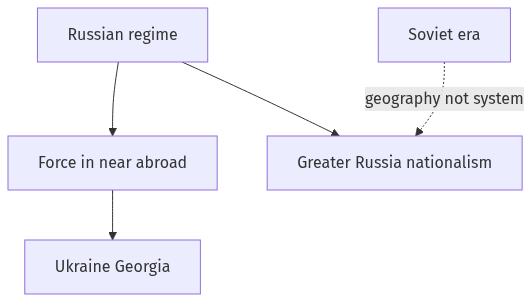
Russia’s wars in Georgia and Ukraine, plus pressure on Belarus and nuclear signalling, show expansionist intent in the post-Soviet space. The Greater Russia story denies full independence of neighbours, especially Ukraine. The Soviet analogy fits geography of control more than ideology: today’s regime is nationalist and oligarchic, not a communist world-system. Morgenthau and Waltz explain power and structure; they do not make the war merely defensive. Comment: accept expansionism; reject a simple USSR restoration.
Model answer
Copper italics in this answer — like this — are the key facts. Each one is unpacked in the Facts & figures rail.
Introduction
The current Russian regime has used force, frozen conflicts and energy pressure in the post-Soviet space. The statement that this shows an intention to realise a Greater Russia on Soviet-era lines is therefore a serious claim. It should be partly accepted. The expansionist pattern is visible. The Soviet analogy is incomplete.
Body
What is visible
Georgia 2008, the seizure of Crimea in 2014, the war in the Donbas, and the full-scale invasion of Ukraine in 2022 are not defensive border incidents. They are attempts to rewrite another state’s territory and to deny its independent foreign-policy choice, especially a path toward the European Union and NATO. Official language about ‘one people’, historical Russia, and the denial of Ukrainian nationhood is a Greater Russia script. Belarus is bound by Union-State structures and military basing. The CSTO and energy leverage over neighbours show a sphere of privileged interest. Nuclear signalling and the suspension of New START-era restraints show that the regime will raise the cost of Western help to Ukraine.
Hans Morgenthau would read this as a classic interest defined as power, dressed in national history. Kenneth Waltz would add structure: a former superpower in a unipolar-then-contested system, facing NATO’s eastward enlargement, choosing revision rather than adjustment. Those theories explain aggression. They do not excuse it.
Why ‘Soviet era’ is only a partial match
The Union of Soviet Socialist Republics was a party-state with a planned economy, a Marxist-Leninist claim, and a Warsaw Pact of communist regimes. The present regime is nationalist, oligarchic and capitalist in property form, even when the state directs energy and war industry. It does not export a communist international. It exports influence, mercenaries, and a civilisational story of Orthodoxy and empire. Restoration of 1991 borders of Soviet control is a maximum nationalist horizon, not a return of Gosplan and the Comintern.
The Soviet Union also contained Ukraine as a Union republic with a seat at the United Nations. Putin’s war treats Ukrainian statehood as a mistake. That is imperial nationalism, closer to Tsarist and Eurasianist themes than to Lenin’s formal federalism.
Comment
Expansionist intention toward a Greater Russia in the near abroad should be accepted as a working description of the 2010s–2020s. Equating that project with a Soviet restoration overstates ideology and understates the new mix of kleptocracy, television nationalism and conventional war. NATO’s role is part of Moscow’s justification and part of the security dilemma. It does not turn the invasion into a purely defensive act. The honest comment is: sphere rebuilding, yes; USSR 2.0, no.
Flow diagram
Conclusion
The Russian regime has shown expansionist conduct aimed at a privileged sphere and at denying Ukrainian independence. That is a Greater Russia project. It is not a recreation of the Soviet system. The Soviet analogy helps as a map of geography. It misleads as a map of ideology.
Quick related
Students also ask
-
"Deglobalisation is displacing globalisation." Comment.
Next question on this syllabus topic (2024 · Q2(a)). View answer →
-
Did NATO cause the war?
NATO enlargement is part of Russia’s stated grievance and of the security dilemma. It does not legally or morally transfer responsibility for invasion to Ukraine or to the Alliance.
-
Is Eurasianism the same as Soviet communism?
No. Eurasianism is a civilisational-imperial story. Soviet power used Marxist-Leninist language and a party monopoly.
Same topic · past papers
UPSC has asked this before
These previous-year questions sit on the same topic. Open one to practise the earlier ask.
-
2025 · Q6(b) · PSIR GS 2 · 15 marks
India maintains strong ties with countries that will assure a free and open Indo-Pacific and guarantee greater connectivity with rest of the world. Analyze -
2022 · Q5(b) · PSIR GS 2 · 10 marks
Discuss the ways and means to realise greater economic co-operation among the Member States of South Asia.
More from this topic
Q7(a) · UPSC Mains 2026 · PSIR GS 2 · 20 marks · Solution
How does illegal cross border migration pose challenges to India's security? Discuss the steps taken by the government in this direction and their effectiveness
Comparative Politics
Illegal cross-border migration undermines India's national security by altering demographic balances, straining economic resources, and exacerbating internal security vulnerabilities. The government has responded through border fencing, technological integration like SMART fencing, institutional mechanisms, and bilateral agreements. However, porous terrain, regional political complexities, and local connivance limit the complete effectiveness of these measures. A holistic approach combining strict border management with socio-economic development and robust legal frameworks is essential for sustainable containment.
Q5(d) · UPSC Mains 2026 · PSIR GS 2 · 10 marks · Solution
Discuss the main features of the land-boundary agreement between India and Bangladesh.
Comparative Politics
• Operationalized via the 100th Constitutional Amendment Act of 2015 to resolve Radcliffe Line anomalies. • Rooted in the unratified 1974 bilateral agreement and the 2011 additional protocol. • Involved the peaceful exchange of 111 Indian enclaves in Bangladesh and 51 Bangladeshi enclaves in India. • Granted affected residents the sovereign right to choose their nationality and place of residence. • Demarcated roughly 6.1 km of previously un-demarcated land boundaries to end administrative confusion. • Secured human rights and welfare access for over 50,000 formerly stateless enclave residents. • Reduced bilateral trust deficits, paving the way for deeper cooperation in security and connectivity.
Q4(c) · UPSC Mains 2026 · PSIR GS 2 · 15 marks · Solution
What is UNCLOS? Explain its salient features
Comparative Politics
UNCLOS, established in 1982, serves as the constitution of the oceans, codifying customary international law regarding maritime jurisdictions. Its salient features include distinct maritime zones ranging from territorial waters to the high seas, balancing coastal state sovereignty with freedom of navigation. It establishes compulsory dispute settlement mechanisms through institutions like ITLOS. The convention also mandates environmental protection and sustainable management of marine resources. For India, UNCLOS provides a rules-based order in the Indo-Pacific while respecting navigational rights. It remains central to addressing contemporary maritime security and resource challenges.