
Revision summary
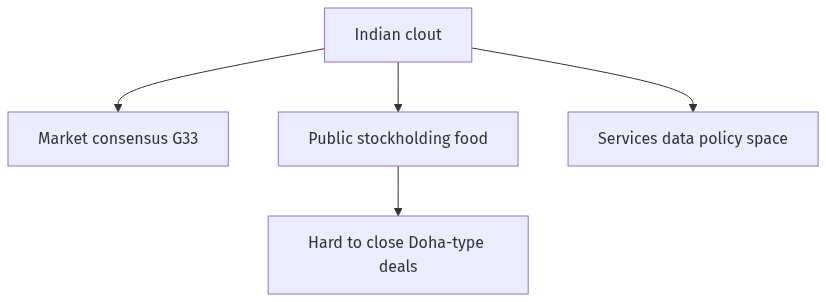
The claim that WTO talks cannot move without India is shorthand, not a literal rule of the house. Clout grew from market size, consensus voting, G33 coalitions and a non-negotiable public-stockholding/food-security line after Bali. India also has offensive services interests and defensive digital policy space, so it matters on more than farms. The U.S. and China can still freeze the system on their own; plurilaterals can proceed without Indian enthusiasm. On a multilateral development bargain, India’s consent is now a political requirement.
Model answer
Copper italics in this answer — like this — are the key facts. Each one is unpacked in the Facts & figures rail.
Introduction
The remark that nothing moves in WTO negotiations unless India is on board is diplomatic shorthand. It is overstated as a law of Geneva. It is fair as a description of India’s increased clout since the Doha years. India is no longer a quiet developing member. It is a veto-capable coalition maker on the issues that still define the round.
Body
Why the clout grew
First, economic weight. A large and growing market, a major agricultural population, and a competitive services and generic-pharma sector mean that a deal which ignores India leaves a hole in any ‘world’ trade bargain. Second, the consensus rule of the WTO, discussed as a cause of decline in 4(b), turns a determined large developing member into a blocking player. Third, India learned to organise: the G33 on food, alliances with African and Caribbean states on public stockholding, and a consistent line on special and differential treatment. Fourth, food security after the 2008 price spike and India’s National Food Security Act made public stockholding a non-negotiable. The Bali 2013 peace clause and later fights to make it permanent showed that the membership cannot close agriculture without Delhi. Fifth, services and movement of people (Mode 4) give India offensive interests, not only defensive farm politics. Sixth, digital and e-commerce plurilaterals meet Indian caution on data and policy space, so ‘willing clubs’ still feel India’s absence as a legitimacy problem. Seventh, after the Appellate Body crisis, political bargains matter more than panel law; a vocal India in G20 and Voice of Global South settings carries that politics into Geneva.
What the slogan gets wrong
The United States and China can still move or freeze the system without India, as tariffs and the appellate crisis show. Many plurilaterals proceed with India in the room as a sceptic or outside as a non-party. ‘Nothing moves’ is caucus language. The true statement is: on development, agriculture and a multilateral single undertaking, India’s no is still a hard no, and India’s yes is now needed for any claim that the South consented.
- Clout also comes from coherence: India links WTO food rules to livelihood, and links that to a democratic mandate. That is harder to buy off than a small member’s tariff line.
Flow diagram
Conclusion
India’s WTO clout rests on market size, consensus, G33 coalition practice and an immovable food-security file. The slogan that nothing moves without India is too absolute. It is accurate for the surviving multilateral development agenda. That is why Geneva still waits on Delhi.
Quick related
Students also ask
-
"India has of late, chosen to debunk non-alignment in its pursuit of multi-alignment." Comment.
Next question on this syllabus topic (2024 · Q8(c)). View answer →
-
Is India only a spoiler?
It has blocked texts it sees as unbalanced. It has also sought a permanent food peace clause and services openings. Spoiler is a Northern campaign word.
-
Does clout survive WTO decline?
Yes in remaining multilateral files. If trade moves only to megaregionals, India’s clout must be rebuilt in those rooms too.
Same topic · past papers
UPSC has asked this before
These previous-year questions sit on the same topic. Open one to practise the earlier ask.
-
2024 · Q7(a) · PSIR GS 2 · 20 marks
Discuss the future of SAARC in the light of India's increased focus on other regional groupings like ASEAN and BIMSTEC.
More from this topic
Q5(a) · UPSC Mains 2026 · PSIR GS 2 · 10 marks · Solution
Describe India's objections to agricultural negotiations at the World Trade Organisation.
India’s Contribution to the Non-Alignment Movement
India's objections at WTO agricultural negotiations stem from protecting livelihood security for over 800 million rural citizens against subsidized Western agricultural exports. Key sticking points include the Peace Clause ambiguity regarding public stockholding for food security, lack of permanent solutions for domestic support limits, and safeguarding Special Safeguard Mechanisms against import surges. India balances defensive multilateral interests in plurilateral trade forums while championing Global South coalitions like the G-33. The strategy prioritizes food sovereignty over unfettered market access in developing country agriculture.
Q8(c) · UPSC Mains 2025 · PSIR GS 2 · 15 marks · Solution
Discuss the potential role India can play in initiating a possible phase of trilateral economic engagement among India, China and Nepal
India’s Contribution to the Non-Alignment Movement
Map-logic supports India–China–Nepal talks on hydropower, trade, tourism and Himalayan disasters. The trust deficit is structural: LAC after Galwan, BRI in Nepal, and Kalapani–Lipulekh map fights. Nepal will omni-enmesh; Delhi cannot veto that without pushing Kathmandu further toward Beijing. India’s realistic role is initiator of thin technical engagement, not chair of a Himalayan concert. Grade potential as moderate and politically capped — the same honesty used for Latin American regionalism.
Q6(a) · UPSC Mains 2025 · PSIR GS 2 · 20 marks · Solution
Critically analyze the different phases of India's foreign policy since independence. How justified, do you think, is S. Jaishankar's classification of the current phase as the phase of 'energetic diplomacy'? 15+5=
India’s Contribution to the Non-Alignment Movement
Phases: Nehruvian NAM, post-1962/1971 realism, 1991 economic opening, 1998 nuclear break, U.S. civil nuclear bargain, then Modi-era multi-alignment. The core across phases is strategic autonomy, not a simple Nehru-to-neoliberal conversion. Jaishankar’s energetic diplomacy fairly describes tempo: G20, minilaterals, argumentative Global South voice. It is weaker as a claim of structural success: LAC, Bangladesh and industrial depth still bind. Treat ‘energetic’ as method, not as a new telos.