
Revision summary
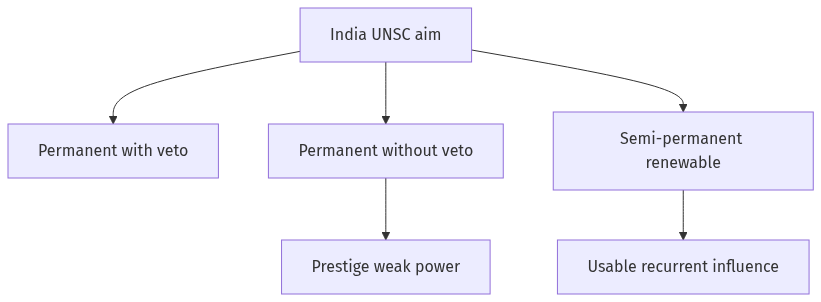
India’s G4 line seeks a permanent UNSC seat; the P5 have no wish to multiply vetoes. A permanent seat without veto is prestige without the instrument that makes permanence matter in crises. Semi-permanent renewable long terms would increase India’s presence and coalition practice, closer to elected-term diplomacy. The comment is right as a ranking of second-best outcomes, not as a demand to abandon the public permanent-seat claim. What India needs is a Council that cannot ignore it; recurrence plus coalitions may beat a mute nameplate.
Model answer
Copper italics in this answer — like this — are the key facts. Each one is unpacked in the Facts & figures rail.
Introduction
India has sought a permanent seat on the United Nations Security Council as part of a reformed Council that matches twenty-first-century power. The statement that India should instead strive to become a semi-permanent member, rather than a permanent member without the veto, is a comment on what is worth having. It should be taken seriously. It should not be read as a surrender of India’s case.
Body
The existing Indian line
India argues from population, democracy, peacekeeping, and a nuclear-and-economic weight that the 1945 P5 does not reflect. The G4 (India, Japan, Germany, Brazil) has asked for permanent seats. The Uniting for Consensus group, including Pakistan and Italy, has blocked easy expansion. African states want two permanent seats of their own. The veto is the core of P5 privilege. Existing permanent members have no incentive to multiply vetoes that could bind them. A ‘permanent’ Indian seat without veto has therefore appeared in some compromise talk. It would give a continuous presence and prestige. It would not give the power that makes the Council oligarchic.
Semi-permanent as a design
Semi-permanent membership usually means longer, renewable elected terms — for example eight-year seats for a small set of major states, possibly with consecutive re-election, unlike the present two-year non-renewable elected six. India would sit more often, build chair-experience, and still need coalitions. That is closer to how India already operates when it wins an elected term: as a voice of the Global South on terrorism, development and Council working methods, not as a veto player.
Comment
A permanent seat without veto is status without the instrument that defines permanence. In crises — Ukraine, Gaza, Syria — the veto is the fact. India would be a distinguished non-P5 with a better chair. Semi-permanent membership, if the term is long and renewable, can yield more practical influence than a hollow permanent badge, and it is more negotiable with the Coffee Club and with Africa.
The statement is too neat if it asks India to drop the permanent-with-veto claim in public diplomacy. That claim is leverage. It is right as a ranking of outcomes: veto-less permanence is a poor second prize; a designed semi-permanent seat with real recurrence may be better than that prize. India’s interest remains a Council that cannot ignore Delhi. Frequency plus coalitions can serve that interest more than a nameplate beside a mute gavel.
Flow diagram
Conclusion
India should not treat a veto-less permanent seat as victory. The veto is the Council’s hard currency. A well-designed semi-permanent, renewable seat could give more usable presence than an empty permanent title. The public claim for full permanence can still be kept as bargaining stock.
Quick related
Students also ask
-
Discuss the structure and functions of UN Security Council.
Next question on this syllabus topic (2023 · Q1(e)). View answer →
-
Has India given up on a veto?
Officially it has not. The exam statement is a strategic comment on second-best institutional design.
-
Do elected terms already give clout?
They give a voice for two years. Semi-permanent design is about making that voice recurrent without pretending India is a 1945 victor.
Same topic · past papers
UPSC has asked this before
These previous-year questions sit on the same topic. Open one to practise the earlier ask.
-
2023 · Q6(b) · PSIR GS 2 · 15 marks
Discuss the importance of India's role in UN peacekeeping operations as a ground for its claim to a permanent seat in the UN Security Council -
2022 · Q7(c) · PSIR GS 2 · 15 marks
Explain the factors which justify India's claim for a permanent seat at the UN security council
More from this topic
Q6(b) · UPSC Mains 2023 · PSIR GS 2 · 15 marks · Solution
Discuss the importance of India's role in UN peacekeeping operations as a ground for its claim to a permanent seat in the UN Security Council
India and the UN System
India is a historic top troop contributor to UN peacekeeping. That record supports a claim to help write the mandates, not only to staff them. G4 and African positions seek Council expansion; Charter amendment needs P5 consent. China is a central political obstacle among the five. Peacekeeping strengthens India’s case; it cannot by itself create a seat.
Q2(c) · UPSC Mains 2023 · PSIR GS 2 · 15 marks · Solution
How does the regime change and political crisis in Myanmar threaten regional security and peace?
India and the UN System
The February 2021 military takeover ended Myanmar’s elected government and widened civil war. Refugees, drugs, and stalled Kaladan and trilateral-highway work hit India and Bangladesh. China kept infrastructure and political access to the junta. ASEAN’s Five-Point Consensus was not implemented. Regional security declined because a weak State on several borders became a vacuum, not a buffer.
Q1(e) · UPSC Mains 2023 · PSIR GS 2 · 10 marks · Solution
Discuss the structure and functions of UN Security Council.
India and the UN System
The Security Council has five permanent members with a veto and ten elected members for two years. Nine votes including the P5 are needed on substance. Chapter VI covers disputes; Chapter VII covers threats, sanctions, and force. Peacekeeping is a Council practice that the 1945 text did not fully name. The veto makes the Council a concert of major powers as well as a legal organ.