
Revision summary
India is a historic top troop contributor to UN peacekeeping. That record supports a claim to help write the mandates, not only to staff them. G4 and African positions seek Council expansion; Charter amendment needs P5 consent. China is a central political obstacle among the five. Peacekeeping strengthens India’s case; it cannot by itself create a seat.
Model answer
Copper italics in this answer — like this — are the key facts. Each one is unpacked in the Facts & figures rail.
Introduction
India has been among the largest cumulative contributors of troops and police to United Nations peacekeeping. It uses that record, plus population, democracy, and economy, to claim a permanent Security Council seat. Contribution and representation are the two halves of the argument.
Body
Peacekeeping record
- Indian personnel have served in operations from Korea and the Congo to Namibia, Somalia, South Sudan, and the Democratic Republic of the Congo in later decades.
- India has taken casualties in UN service and has supplied force commanders and formed units, not only observers.
- The record is a Chapter VI–VII practical contribution to Council mandates that India does not write as a permanent member.
- Limits exist: great-power wars are not UNPKO tasks, and some missions have weak mandates. India still shows up with troops when many P5 members do not.
The permanent-seat claim
- The G4 (India, Japan, Germany, Brazil) seek expansion of permanent and non-permanent membership. The African Ezulwini Consensus seeks two African permanent seats.
- India’s case: share of world population, a large economy, nuclear and space capability, democracy, NAM and Global South voice, and peacekeeping numbers.
- The 1945 P5 map omits India, Africa as a continent with permanent rights, and Latin America.
Link and tension
- Peacekeeping is the moral and practical link: those who carry out Article 42-adjacent tasks should sit where Article 24 power is.
- The veto is the hard problem. Existing P5 members do not easily dilute it. China has been the most explicit political obstacle to India’s permanent seat among the five.
- Reform needs Charter amendment, which needs P5 consent. That is why the claim is long, not why it is empty.
- Keohane would note that institutions lag power. Waltz would note that seats follow capability only when incumbents allow it.
Flow diagram
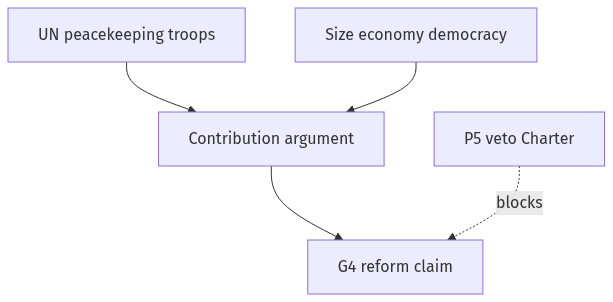
Conclusion
India’s peacekeeping record is a standing contribution to UN security work. The permanent-seat claim rests on that record plus size and capability. The Council’s 1945 structure, not India’s contribution, is the binding constraint.
Quick related
Students also ask
-
Explain the factors which justify India's claim for a permanent seat at the UN security council
Next question on this syllabus topic (2022 · Q7(c)). View answer →
-
Would a permanent seat without veto be worth taking?
India has discussed transitional models. A seat without veto is still more voice than a two-year elected term. The G4 prefer permanence with the same rights, which is the harder ask.
-
Does peacekeeping equal a legal right to a seat?
No. It is a political argument about fairness and effectiveness, not a Charter clause that self-executes.
Same topic · past papers
UPSC has asked this before
These previous-year questions sit on the same topic. Open one to practise the earlier ask.
-
2022 · Q7(c) · PSIR GS 2 · 15 marks
Explain the factors which justify India's claim for a permanent seat at the UN security council -
2024 · Q5(a) · PSIR GS 2 · 10 marks
"India must strive to become a semi-permanent member of the UNSC, rather than a permanent member without the right to veto." Comment.
More from this topic
Q5(a) · UPSC Mains 2024 · PSIR GS 2 · 10 marks · Solution
"India must strive to become a semi-permanent member of the UNSC, rather than a permanent member without the right to veto." Comment.
India and the UN System
India’s G4 line seeks a permanent UNSC seat; the P5 have no wish to multiply vetoes. A permanent seat without veto is prestige without the instrument that makes permanence matter in crises. Semi-permanent renewable long terms would increase India’s presence and coalition practice, closer to elected-term diplomacy. The comment is right as a ranking of second-best outcomes, not as a demand to abandon the public permanent-seat claim. What India needs is a Council that cannot ignore it; recurrence plus coalitions may beat a mute nameplate.
Q2(c) · UPSC Mains 2023 · PSIR GS 2 · 15 marks · Solution
How does the regime change and political crisis in Myanmar threaten regional security and peace?
India and the UN System
The February 2021 military takeover ended Myanmar’s elected government and widened civil war. Refugees, drugs, and stalled Kaladan and trilateral-highway work hit India and Bangladesh. China kept infrastructure and political access to the junta. ASEAN’s Five-Point Consensus was not implemented. Regional security declined because a weak State on several borders became a vacuum, not a buffer.
Q1(e) · UPSC Mains 2023 · PSIR GS 2 · 10 marks · Solution
Discuss the structure and functions of UN Security Council.
India and the UN System
The Security Council has five permanent members with a veto and ten elected members for two years. Nine votes including the P5 are needed on substance. Chapter VI covers disputes; Chapter VII covers threats, sanctions, and force. Peacekeeping is a Council practice that the 1945 text did not fully name. The veto makes the Council a concert of major powers as well as a legal organ.