
Revision summary
The Asian century meant a shift of growth and weight to Asia with China and India as co-engines. Doklam, Galwan, a hard LAC and Chinese Indian Ocean presence make China India’s central strategic problem. Trade can continue without a political concert; the Quad and BRI are rival organising projects. Economically the shift to Asia can still happen; politically the century looks contested or bipolar, not harmonious. Feasible as theatre of world politics, not as a Sino-Indian team.
Model answer
Copper italics in this answer — like this — are the key facts. Each one is unpacked in the Facts & figures rail.
Introduction
The Asian century is the claim that this century’s growth, population and eventually security weight would sit in Asia, with China and India as co-engines beside Japan, Korea and ASEAN. Growing friction between India and China asks whether that co-engine still exists. The idea remains feasible as arithmetic. It is less feasible as a shared political project.
Body
Why it looked feasible
East Asian industrialisation, China’s rise, and India’s post-1991 growth produced a shift of GDP and manufacturing toward Asia. Demography, a middle class, and regional production networks (even after deglobalisation) still point east of Suez. An Asian century did not require India–China friendship. It required both to grow inside one world-economy.
What friction does
Doklam 2017, Galwan 2020, a militarised Line of Actual Control, and China’s partnerships with Pakistan and in the Indian Ocean (Hambantota, other ports) turn China from a fellow Asian riser into India’s principal strategic problem. Trade remains large, but investment screening, app bans, and border deaths poison the political story of a joint Asian leadership. The Belt and Road is a Chinese order, not a Sino-Indian one. If Asia’s security splits into a Chinese sphere and an Indo-Pacific coalition around the Quad, the century is Asian in location and bipolar in structure. That is not the harmonious Asian century of early 2000s speeches.
- Friction also wastes resources: both states arm the Himalaya; India must still grow with a two-front problem; China must still manage the United States. Waltz would say two large neighbours in the same system tend toward rivalry. Kant’s pacific federation is not the LAC.
Verdict
The Asian century continues as a feasible economic description if China and India keep growing even while they quarrel — just as Europe’s century of power included Franco-German enmity. It does not continue as a feasible concert. Leadership of Asia will be contested. ASEAN will try to avoid choosing. India’s role becomes hinge of a multipolar Asia, not co-chair of a Beijing-friendly century. Feasible, then, with a changed meaning: Asia as the main theatre of world politics, not Asia as a team.
Flow diagram
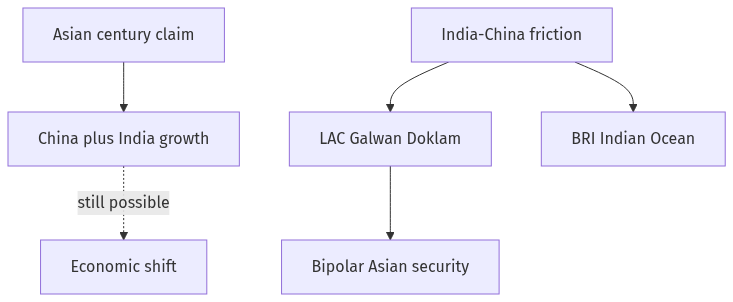
Conclusion
India–China friction does not cancel Asian economic weight. It cancels the idea of a joint, peaceful Asian leadership. The Asian century remains feasible as a shift of wealth and attention. It is no longer feasible as a Sino-Indian partnership project.
Quick related
Students also ask
-
What are the reasons for lack of 'regionness' in South Asia?
Next question on this syllabus topic (2023 · Q5(b)). View answer →
-
Can trade save the Asian century?
Trade keeps the economic shift alive. It has not produced a security community. That split is the answer.
-
Is Japan still part of the Asian century?
Yes as capital and technology. Politically Japan is in the Quad, which is one reason the century is not China-led by default.
Same topic · past papers
UPSC has asked this before
These previous-year questions sit on the same topic. Open one to practise the earlier ask.
-
2023 · Q5(d) · PSIR GS 2 · 10 marks
Why do ethnic conflicts and insurgencies continue to remain major impediments to regional co-operation in South Asia?
More from this topic
Q8(c) · UPSC Mains 2026 · PSIR GS 2 · 15 marks · Solution
Examine India and South Africa co-operation through bilateral and multi-lateral forums
India and South Asia
This model answer examines India-South Africa cooperation across bilateral and multilateral dimensions. It traces their strategic ties built on shared anti-colonial histories, growing bilateral trade, and energy cooperation. It then evaluates their collaboration in key minilateral and multilateral platforms such as BRICS, IBSA, and the G20. The response highlights their joint advocacy for reformed multilateralism and equitable global governance representing the Global South. Finally, it concludes with a policy forward-looking stance on enhancing technological and maritime security partnerships in the Indo-Pacific/Indian Ocean region.
Q6(a) · UPSC Mains 2026 · PSIR GS 2 · 20 marks · Solution
Accelerating Chinese influence across South Asia is fundamentally reshaping the region's geopolitical landscape. This is a big foreign policy challenge for India. Analyse
India and South Asia
This PSIR answer analyses how expanding Chinese footprint through the Belt and Road Initiative and strategic investments is transforming South Asian geopolitics. It evaluates the resulting security, economic, and diplomatic challenges for India's traditional primacy in its neighbourhood. The response highlights India's strategic imperatives, advocating for robust economic connectivity, maritime security cooperation, and adherence to the Neighborhood First policy. It outlines institutional adaptations and bilateral engagements to counter strategic encirclement. A Mermaid flowchart illustrates the shift in South Asian geopolitics, and constitutional-policy linkages ground the conclusion.
Q5(e) · UPSC Mains 2026 · PSIR GS 2 · 10 marks · Solution
Analyse the relevance of India-Brazil economic co-operation in strengthening the bilateral relations between the two countries.
India and South Asia
• India and Brazil drive bilateral ties through strong economic cooperation as key Global South leaders. • Agricultural trade balances sugar and edible oil imports with Indian exports. • Brazil supplies crude oil and biofuels, advancing India’s energy transition and security. • Indian generic pharmaceuticals improve healthcare affordability in Brazil. • The India-MERCOSUR Preferential Trade Agreement boosts market access and bilateral trade volumes. • Forums like BRICS and IBSA help both nations counter Western-centric global trade rules. • Cooperation in critical minerals and technology builds resilient supply chains, reducing single-nation dependencies.