
Revision summary
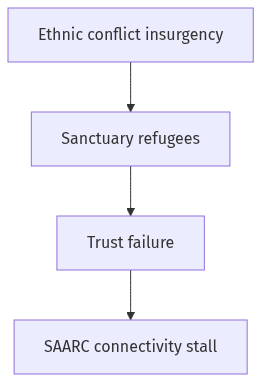
Insurgency and ethnic war in South Asia routinely cross borders. Sanctuary charges, refugees, and military alerts replace trade talks. SAARC and road-and-port plans stall on insecure stretches, including Afghanistan 2021 and Myanmar 2021. Domestic ethnic politics also block a regional “we.” Cooperation needs a security floor that these conflicts remove.
Model answer
Copper italics in this answer — like this — are the key facts. Each one is unpacked in the Facts & figures rail.
Introduction
Ethnic conflict and insurgency in South Asia cross borders. They produce refugees, accusations of sanctuary, and military alerts. Regional cooperation needs trust and open borders. Those conflicts work against both.
Body
Cross-border chains
- Insurgents use neighbouring territory as sanctuary. States then treat neighbours as security problems rather than as market partners.
- Refugee flows, as with Rohingya in Bangladesh and populations after the Myanmar 2021 coup, strain host politics and bilateral agendas.
- Tamil conflict in Sri Lanka, Maoist and hill conflicts, and Afghanistan’s wars after decades of intervention all fed suspicion among capitals.
Direct hits on cooperation
- SAARC cannot run a normal summit politics when terrorism and Kashmir dominate India–Pakistan exchanges.
- Connectivity projects stop at insecure stretches: Afghanistan after August 2021, Myanmar after February 2021, and parts of the North-East–Myanmar frontier.
- Intelligence and army staffs crowd out trade ministries in bilateral time.
Identity politics inside cooperation
- Ethnic parties and diaspora lobbies in one State mobilise against another State’s government, which makes “regional identity” harder than a brochure.
- Majority nationalism in several States reads minority kin across the border as a threat.
- BIMSTEC and SCO then become partial clubs that manage some issues while the full South Asian table stays empty.
Flow diagram
Conclusion
Ethnic war and insurgency hamper South Asian cooperation by closing borders, blocking summits, and turning neighbours into security files. Functional trade cannot spill over, in Mitrany’s sense, while sanctuary and refugee crises remain first.
Quick related
Students also ask
-
Discuss the ways and means to realise greater economic co-operation among the Member States of South Asia.
Next question on this syllabus topic (2022 · Q5(b)). View answer →
-
Is terrorism the only block to SAARC?
It is a central India–Pakistan block. Asymmetry, China, and weak institutions also matter. Insurgency is one sufficient stopper among several.
-
Can sub-regional groups ignore ethnic conflict?
They can work around one dyad, as BIMSTEC does with Pakistan. They cannot ignore a war on their own roads, as with Myanmar.
Same topic · past papers
UPSC has asked this before
These previous-year questions sit on the same topic. Open one to practise the earlier ask.
-
2021 · Q6(c) · PSIR GS 2 · 15 marks
Write a brief analysis of the ethnic conflicts and cross-border migrations along India-Myanmar and India-Bangladesh borders -
2024 · Q6(b) · PSIR GS 2 · 15 marks
Does the idea of the 21st century as 'Asian century' continue to remain feasible given the growing friction between India and China?
More from this topic
Q8(c) · UPSC Mains 2026 · PSIR GS 2 · 15 marks · Solution
Examine India and South Africa co-operation through bilateral and multi-lateral forums
India and South Asia
This model answer examines India-South Africa cooperation across bilateral and multilateral dimensions. It traces their strategic ties built on shared anti-colonial histories, growing bilateral trade, and energy cooperation. It then evaluates their collaboration in key minilateral and multilateral platforms such as BRICS, IBSA, and the G20. The response highlights their joint advocacy for reformed multilateralism and equitable global governance representing the Global South. Finally, it concludes with a policy forward-looking stance on enhancing technological and maritime security partnerships in the Indo-Pacific/Indian Ocean region.
Q6(a) · UPSC Mains 2026 · PSIR GS 2 · 20 marks · Solution
Accelerating Chinese influence across South Asia is fundamentally reshaping the region's geopolitical landscape. This is a big foreign policy challenge for India. Analyse
India and South Asia
This PSIR answer analyses how expanding Chinese footprint through the Belt and Road Initiative and strategic investments is transforming South Asian geopolitics. It evaluates the resulting security, economic, and diplomatic challenges for India's traditional primacy in its neighbourhood. The response highlights India's strategic imperatives, advocating for robust economic connectivity, maritime security cooperation, and adherence to the Neighborhood First policy. It outlines institutional adaptations and bilateral engagements to counter strategic encirclement. A Mermaid flowchart illustrates the shift in South Asian geopolitics, and constitutional-policy linkages ground the conclusion.
Q5(e) · UPSC Mains 2026 · PSIR GS 2 · 10 marks · Solution
Analyse the relevance of India-Brazil economic co-operation in strengthening the bilateral relations between the two countries.
India and South Asia
• India and Brazil drive bilateral ties through strong economic cooperation as key Global South leaders. • Agricultural trade balances sugar and edible oil imports with Indian exports. • Brazil supplies crude oil and biofuels, advancing India’s energy transition and security. • Indian generic pharmaceuticals improve healthcare affordability in Brazil. • The India-MERCOSUR Preferential Trade Agreement boosts market access and bilateral trade volumes. • Forums like BRICS and IBSA help both nations counter Western-centric global trade rules. • Cooperation in critical minerals and technology builds resilient supply chains, reducing single-nation dependencies.