
Revision summary
The NPT recognises five weapon states and asks others to stay non-nuclear; India rejected this as nuclear apartheid. China–Pakistan nuclear conditions and empty P5 disarmament made signature look like unilateral abstinence. There is still no legal path for India to join as a weapon state; the 2008 waiver worked around the treaty. Persistent refusal is therefore structural, not mood. Costs remain in export controls and non-proliferation politics; a test moratorium and minimum deterrence are how India manages them.
Model answer
Copper italics in this answer — like this — are the key facts. Each one is unpacked in the Facts & figures rail.
Introduction
India has stayed outside the Nuclear Non-Proliferation Treaty since 1968. It is now a de facto nuclear-weapon state with a declared doctrine after 1998, and it has a civil nuclear waiver through the Nuclear Suppliers Group politics of 2008. The refusal to sign the NPT has nonetheless persisted. A critical examination must show why the treaty still looks like a cage, and what the refusal still costs.
Body
Why India would not sign
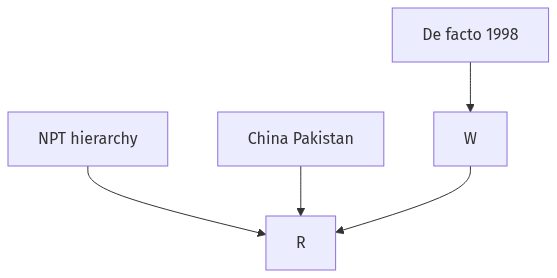
- The NPT froze a hierarchy: five recognised weapon states, the rest as non-weapon states. India called this nuclear apartheid. Article VI disarmament by the P5 was never completed. China, a recognised weapon state and a neighbour with a border dispute, would remain legal; India would become a permanent have-not. Pakistan’s programme, linked to China, made abstinence look like unilateral disarmament. The CTBT fight of the 1990s confirmed Delhi’s reading that new legal locks would close India’s options without opening the P5’s. Kantian disarmament idealism, discussed in 1(d) and 1(e), failed the Himalayan test.
Why refusal persists after de facto status
Signing now as a non-weapon state would require giving up a tested arsenal — politically impossible. The treaty has no honest accession path for India as a weapon state. That legal fact is the whole persistence. The U.S. civil nuclear deal and NSG waiver were designed to work around the NPT, not to put India inside it. Joining as a weapon state would explode the treaty’s core bargain and is not on offer. So India remains a stand-out, like Pakistan and Israel in different ways, while practising unilateral moratorium on tests and a declared credible minimum deterrence.
Critical examination
The security case is strong. A China–Pakistan nuclear environment does not reward NPT conversion. The moral case against a hierarchy treaty is consistent with India’s old UN disarmament speeches. The costs are also real. India still faces export-control friction, some technology denial, and the charge of undermining universal non-proliferation just when 1(e)’s order is already unravelling. A purely status-driven refusal, if it ever outran security, would be harder to defend. In fact security and status have been fused since 1998.
- Criticism should also note: India wants membership of the NSG as a maker of rules it once defied. That is interest, not hypocrisy only — every nuclear state does this — but it should be owned. Persistent refusal is rational. It is not costless. It is not a temporary sulk waiting for a better NPT. The treaty would have to change its categories, or the world would have to disarm, before India’s signature as presently demanded made sense.
Flow diagram
Conclusion
India refuses the NPT because the treaty offers no weapon-state seat and would lock it below China. De facto nuclear status and the NSG waiver did not create a legal door. The refusal is sound as security. It still carries non-proliferation political costs that Delhi manages through doctrine, a test moratorium and selective regime entry.
Quick related
Students also ask
-
What is the structure and functions of International Court of Justice?
Next question on this syllabus topic (2023 · Q1(d)). View answer →
-
Could India join the NPT as a weapon state?
Not under the present text. That would require amending the treaty’s basic bargain, which members will not do.
-
Is refusal only about prestige?
Prestige mixed with security after 1998. The original 1960s–70s refusal was already about hierarchy and China, not only about status theatre.
Same topic · past papers
UPSC has asked this before
These previous-year questions sit on the same topic. Open one to practise the earlier ask.
-
2022 · Q6(c) · PSIR GS 2 · 15 marks
Discuss the reasons behind India's refusal to sign the nuclear non-proliferation treaty (NPT)
More from this topic
Q2(b) · UPSC Mains 2026 · PSIR GS 2 · 15 marks · Solution
International Human Rights frameworks are hostage to politics among nations. Comment
Contemporary Global Concerns
• Westphalian sovereignty and national interests frequently override universal human rights norms in global politics. • Powerful states often shield strategic allies from accountability while using human rights rhetoric selectively against adversaries. • The UN Security Council is frequently deadlocked by geopolitical rivalries, paralyzing responses to mass atrocities. • Human rights mechanisms depend heavily on voluntary funding from developed nations, skewing global priorities. • The principle of non-interference is routinely invoked to protect authoritarian regimes from international scrutiny. • Bridging enforcement gaps requires reforming multilateral institutions and amplifying the influence of the Global South.
Q5(e) · UPSC Mains 2023 · PSIR GS 2 · 10 marks · Solution
What diplomatic steps has India taken to articulate the interests of the Global South in International Politics?
Contemporary Global Concerns
Global South diplomacy continues NAM and G77 in a new institutional setting. India hosted South summits and used G20 2023 to seat the African Union. ITEC, credit, vaccines, and UN peacekeeping are the material side. WTO food and IP fights remain part of the same file. China’s finance is the main competitor for Southern attention.
Q1(d) · UPSC Mains 2023 · PSIR GS 2 · 10 marks · Solution
What is the structure and functions of International Court of Justice?
Contemporary Global Concerns
The ICJ is the UN’s principal judicial organ, with 15 judges elected by the Assembly and the Council. Contentious cases are between States that have consented to jurisdiction. Advisory opinions answer legal questions from authorised UN bodies. Article 38 lists the sources the Court applies. Enforcement of judgments can go to the Security Council, which limits the Court against the P5.