
Revision summary
The ICJ is the UN’s principal judicial organ, with 15 judges elected by the Assembly and the Council. Contentious cases are between States that have consented to jurisdiction. Advisory opinions answer legal questions from authorised UN bodies. Article 38 lists the sources the Court applies. Enforcement of judgments can go to the Security Council, which limits the Court against the P5.
Model answer
Copper italics in this answer — like this — are the key facts. Each one is unpacked in the Facts & figures rail.
Introduction
The International Court of Justice is the principal judicial organ of the United Nations. It sits at The Hague under the UN Charter and its own Statute. It settles legal disputes between States and gives advisory opinions to authorised UN organs.
Body
Structure
- The Court has 15 judges elected for nine-year terms by the General Assembly and the Security Council, voting separately.
- Five seats are filled every three years. No two judges may be nationals of the same State.
- Chambers, including a Chamber of Summary Procedure, may sit for particular cases.
- Only States may be parties in contentious cases. International organisations are not litigants there.
- The Registry is the permanent secretariat. Official languages are English and French.
Functions
- Contentious jurisdiction decides legal disputes when States consent, by special agreement, by a treaty clause, or by an optional-clause declaration under the Statute.
- Advisory jurisdiction answers legal questions put by the General Assembly, the Security Council, or other authorised organs and specialised agencies.
- The Court applies treaties, custom, general principles, and, as subsidiary means, judicial decisions and teachings of publicists, as listed in Article 38 of the Statute.
- Judgments are binding on the parties to that case. Article 94 of the Charter allows a party to seek Security Council action if the other side fails to comply.
Limits
- Consent is the gate. Powerful States often withhold it or ignore political disputes that they refuse to treat as legal.
- The Security Council’s enforcement role means the Court cannot police the P5 by itself.
- Advisory opinions are not judgments, though they carry legal and political weight.
Flow diagram
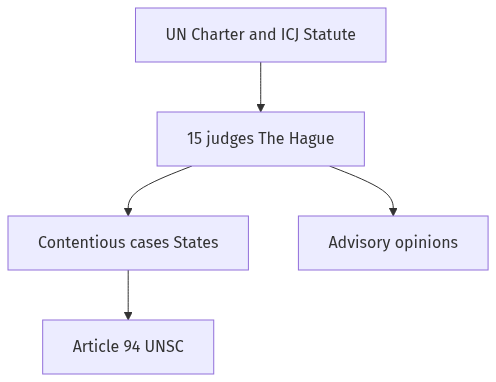
Conclusion
The ICJ is a 15-judge UN court for inter-State law and for advisory opinions. Its structure is elective and professional. Its functions depend on State consent and, for enforcement, on a Security Council that is itself political.
Quick related
Students also ask
-
What diplomatic steps has India taken to articulate the interests of the Global South in International Politics?
Next question on this syllabus topic (2023 · Q5(e)). View answer →
-
Can an individual sue at the ICJ?
No. Contentious cases are between States. Individuals use other courts and treaty bodies.
-
Is every UN member automatically under ICJ jurisdiction?
Members are parties to the Statute. Consent to a particular case still has to be shown by treaty, agreement, or optional clause.
Same topic · past papers
UPSC has asked this before
These previous-year questions sit on the same topic. Open one to practise the earlier ask.
-
2022 · Q2(c) · PSIR GS 2 · 15 marks
Describe the composition of the International Court of Justice (ICJ). Discuss its voluntary jurisdiction
More from this topic
Q2(b) · UPSC Mains 2026 · PSIR GS 2 · 15 marks · Solution
International Human Rights frameworks are hostage to politics among nations. Comment
Contemporary Global Concerns
• Westphalian sovereignty and national interests frequently override universal human rights norms in global politics. • Powerful states often shield strategic allies from accountability while using human rights rhetoric selectively against adversaries. • The UN Security Council is frequently deadlocked by geopolitical rivalries, paralyzing responses to mass atrocities. • Human rights mechanisms depend heavily on voluntary funding from developed nations, skewing global priorities. • The principle of non-interference is routinely invoked to protect authoritarian regimes from international scrutiny. • Bridging enforcement gaps requires reforming multilateral institutions and amplifying the influence of the Global South.
Q7(b) · UPSC Mains 2024 · PSIR GS 2 · 15 marks · Solution
Critically examine India's persistent refusal to sign the nuclear non-proliferation treaty (NPT) despite being recognized as a de facto nuclear power.
Contemporary Global Concerns
The NPT recognises five weapon states and asks others to stay non-nuclear; India rejected this as nuclear apartheid. China–Pakistan nuclear conditions and empty P5 disarmament made signature look like unilateral abstinence. There is still no legal path for India to join as a weapon state; the 2008 waiver worked around the treaty. Persistent refusal is therefore structural, not mood. Costs remain in export controls and non-proliferation politics; a test moratorium and minimum deterrence are how India manages them.
Q5(e) · UPSC Mains 2023 · PSIR GS 2 · 10 marks · Solution
What diplomatic steps has India taken to articulate the interests of the Global South in International Politics?
Contemporary Global Concerns
Global South diplomacy continues NAM and G77 in a new institutional setting. India hosted South summits and used G20 2023 to seat the African Union. ITEC, credit, vaccines, and UN peacekeeping are the material side. WTO food and IP fights remain part of the same file. China’s finance is the main competitor for Southern attention.