
Revision summary
Regionness is shared political identity plus working institutions. South Asia has a dominant India, a blocked India–Pakistan pair, and Chinese alternatives for smaller States. SAARC consensus cannot produce EU-style spillover. Security is a conflict complex, not a community. BIMSTEC is a work-around that still does not make a South Asian region.
Model answer
Copper italics in this answer — like this — are the key facts. Each one is unpacked in the Facts & figures rail.
Introduction
Regionness means a shared political identity and working regional institutions, as in the European Union’s dense law. South Asia has geography and some culture in common. It has not produced that political region.
Body
Structural reasons
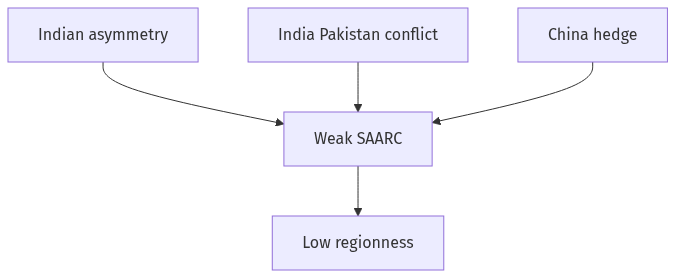
- India is so much larger in economy, military, and population that neighbours fear a centre rather than join a club. Asymmetry is the first fact.
- India–Pakistan conflict over Kashmir, terrorism, and nuclear signalling blocks SAARC, which works by consensus.
- Extra-regional China offers arms, infrastructure, and political backing that lets smaller States hedge against India.
Identity and security
- Barry Buzan’s regional security complex idea fits: South Asia is a conflict formation, not a security community.
- Nationalisms, Partition memory, and majority–minority politics inside States make a thin regional “we.”
- Ethnic conflict and insurgency, treated in 5(d), spill across borders and poison trust.
Institutional thinness
- SAARC’s charter and the South Asian Free Trade Area did not create EU-style spillover. Mitrany’s functional path needs a political floor that is missing.
- BIMSTEC and the Bay of Bengal exclude Pakistan and still move slowly. They prove the demand for work-arounds, not the existence of regionness.
- People-to-people trade and culture exist. They have not been turned into a regional political community.
Flow diagram
Conclusion
South Asia lacks regionness because of Indian asymmetry, the India–Pakistan freeze, Chinese extra-regional pull, and conflictual identities. Geography is not a region in the EU sense without institutions and trust.
Quick related
Students also ask
-
Why do ethnic conflicts and insurgencies continue to remain major impediments to regional co-operation in South Asia?
Next question on this syllabus topic (2023 · Q5(d)). View answer →
-
Is culture enough to make a region?
Shared languages and religions exist across borders. Regionness in IR means political community and institutions, which South Asia has not built.
-
Could connectivity create regionness later?
Functional links can help, as Mitrany argued. They have not overcome the security freeze so far.
More from this topic
Q8(c) · UPSC Mains 2026 · PSIR GS 2 · 15 marks · Solution
Examine India and South Africa co-operation through bilateral and multi-lateral forums
India and South Asia
This model answer examines India-South Africa cooperation across bilateral and multilateral dimensions. It traces their strategic ties built on shared anti-colonial histories, growing bilateral trade, and energy cooperation. It then evaluates their collaboration in key minilateral and multilateral platforms such as BRICS, IBSA, and the G20. The response highlights their joint advocacy for reformed multilateralism and equitable global governance representing the Global South. Finally, it concludes with a policy forward-looking stance on enhancing technological and maritime security partnerships in the Indo-Pacific/Indian Ocean region.
Q6(a) · UPSC Mains 2026 · PSIR GS 2 · 20 marks · Solution
Accelerating Chinese influence across South Asia is fundamentally reshaping the region's geopolitical landscape. This is a big foreign policy challenge for India. Analyse
India and South Asia
This PSIR answer analyses how expanding Chinese footprint through the Belt and Road Initiative and strategic investments is transforming South Asian geopolitics. It evaluates the resulting security, economic, and diplomatic challenges for India's traditional primacy in its neighbourhood. The response highlights India's strategic imperatives, advocating for robust economic connectivity, maritime security cooperation, and adherence to the Neighborhood First policy. It outlines institutional adaptations and bilateral engagements to counter strategic encirclement. A Mermaid flowchart illustrates the shift in South Asian geopolitics, and constitutional-policy linkages ground the conclusion.
Q5(e) · UPSC Mains 2026 · PSIR GS 2 · 10 marks · Solution
Analyse the relevance of India-Brazil economic co-operation in strengthening the bilateral relations between the two countries.
India and South Asia
• India and Brazil drive bilateral ties through strong economic cooperation as key Global South leaders. • Agricultural trade balances sugar and edible oil imports with Indian exports. • Brazil supplies crude oil and biofuels, advancing India’s energy transition and security. • Indian generic pharmaceuticals improve healthcare affordability in Brazil. • The India-MERCOSUR Preferential Trade Agreement boosts market access and bilateral trade volumes. • Forums like BRICS and IBSA help both nations counter Western-centric global trade rules. • Cooperation in critical minerals and technology builds resilient supply chains, reducing single-nation dependencies.