
Revision summary
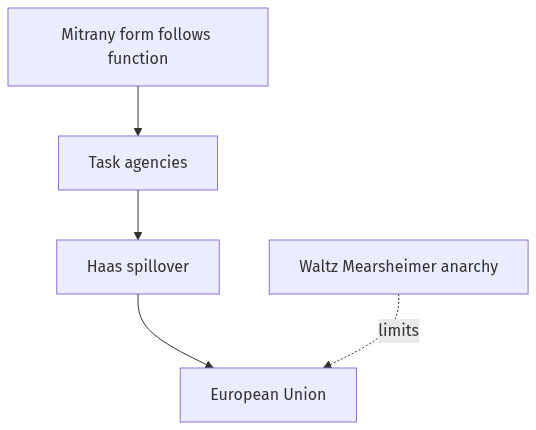
Mitrany argued that peace grows from agencies built around concrete functions. Haas’s neofunctionalism added spillover and used European integration as evidence. Keohane’s institutions are a related but more State-centric account of cooperation. The EU shows functional peace among members; it does not erase great-power anarchy. Cox notes that functional order can lock in a hierarchy unless the order itself is questioned.
Model answer
Copper italics in this answer — like this — are the key facts. Each one is unpacked in the Facts & figures rail.
Introduction
Functionalism in International Relations argues that peace is built by practical cooperation on shared tasks, not first by a world government or by a balance of power. David Mitrany is the main source. Later neofunctionalism used the European Union as the test case.
Body
Mitrany’s claim
- In A Working Peace System, David Mitrany held that form should follow function. Agencies should be designed around tasks such as health, posts, rivers, and trade.
- Loyalty would shift toward those agencies as they delivered welfare. War would become harder because societies were tied by working links.
- The approach was a reply to both power politics and to a single federal constitution imposed from above.
From functionalism to neofunctionalism
- Ernst Haas added spillover: cooperation in one sector creates pressure for cooperation in related sectors.
- The European Coal and Steel Community, the Treaty of Rome, and later the single market are the usual illustrations of that path toward the European Union.
- Robert Keohane’s later neoliberal institutionalism is a cousin, not a twin: institutions reduce transaction costs and cheating among self-interested States, without Mitrany’s hope that the State itself would fade.
Peace and order
- Functional ties can create zones of stable peace among members, as in Western Europe after 1950.
- United Nations specialised agencies, technical standards, and some peacekeeping support tasks follow a functional logic even when the Security Council remains realist.
- Order here is problem-solving order, which Robert Cox would call work within the given interstate system.
Limits
- High politics of security, identity, and survival do not spill over on a timetable. Charles de Gaulle, Brexit, and wars on the EU’s edge show the ceiling.
- Kenneth Waltz and John Mearsheimer treat anarchy and relative power as first. Functional clubs do not remove the security dilemma among great powers.
- The Global South often experienced functional agencies as rules written in the core, which is Cox’s point about whose order is being stabilised.
Flow diagram
Conclusion
Functionalist peace is cooperation by task, with Mitrany’s working agencies and Haas’s spillover. It explains the European Union’s internal order better than it explains great-power war. It is a method of tying States, not a substitute for power politics at the system’s top.
Quick related
Students also ask
-
Discuss the commonalities between the Marxist and Realist approach to the study of International Politics.
Next question on this syllabus topic (2022 · Q1(c)). View answer →
-
Is the United Nations a functionalist body?
Specialised agencies look functionalist. The Security Council is a concert of power. The UN is both.
-
Did functionalism fail because wars continue?
It never promised to end all war. It promised that welfare links can pacify some relationships. Europe’s internal peace is the strongest exhibit.
Same topic · past papers
UPSC has asked this before
These previous-year questions sit on the same topic. Open one to practise the earlier ask.
-
2023 · Q2(c) · PSIR GS 2 · 15 marks
How does the regime change and political crisis in Myanmar threaten regional security and peace?
More from this topic
Q3(c) · UPSC Mains 2026 · PSIR GS 2 · 15 marks · Solution
Does power transition theory reflect the dynamics of US-China relations?
Approaches to the Study of International Relations
Power transition theory, formulated by A.F. Organski, posits that hegemonic wars occur when a dissatisfied challenger approaches parity with the dominant power. In the context of US-China relations, the theory explains the structural anxieties, trade wars, and technological decoupling observed today. China's rapid economic and military rise fits the challenger profile, while its contestation of the US-led liberal international order signals systemic dissatisfaction. However, the theory's deterministic focus on war overlooks complex economic interdependence, nuclear deterrence, and institutional absorption. While power transition highlights the security dilemma at play, contemporary Sino-US dynamics are shaped equally by deterrence and globalization, making conflict neither inevitable nor strictly linear.
Q1(a) · UPSC Mains 2025 · PSIR GS 2 · 10 marks · Solution
Discuss the psychological approach to the study of comparative politics.
Approaches to the Study of International Relations
The psychological approach studies personality, attitudes, civic culture and cognition in comparative politics. Lasswell, Adorno, Almond and Verba, Easton and later political psychology are the main lineage. It explains voting, protest, obedience and leadership better than a constitution or a class map alone. Surveys, experiments and psychobiography are typical methods. It is a layer, not a substitute for institutions and political economy.
Q1(d) · UPSC Mains 2024 · PSIR GS 2 · 10 marks · Solution
Explain the various facets of the idealist approach to the study of international relations. Comment on its contemporary relevance.
Approaches to the Study of International Relations
Idealism in IR treats law, morality, public opinion and organisations as real forces, not only military power. Kant’s perpetual peace and Wilson’s League/UN lineage are the core facets, with collective security and disarmament as programmes. It is not naive pacifism; it seeks to change incentives through institutions. Morgenthau and Waltz remain the main critique: interest, anarchy and self-help. Contemporary relevance is institutional and normative — UN, NPT, courts — not a claim that power politics has ended.