
Revision summary
Citizenship in a democracy is made by law, votes, and social rights, not only by birth records. Marshall’s civil, political, and social rights describe how that status has thickened. Parties, movements, and civic education teach people to act as citizens. Democracies still contest migrants, minorities, and documents of belonging. Construction is therefore both inclusion and a fight over who is inside.
Model answer
Copper italics in this answer — like this — are the key facts. Each one is unpacked in the Facts & figures rail.
Introduction
Citizenship is not only a passport. Democratic politics constructs it by granting rights, demanding duties, and teaching who belongs to the political community. The construction is legal, social, and everyday.
Body
Legal construction
- Constitutions and statutes name who is a citizen, who can vote, and who can hold office.
- T. H. Marshall’s sequence of civil, political, and social rights shows how democracies have thickened citizenship from legal equality toward welfare claims.
- Universal adult franchise, independent courts, and equal protection make the citizen a rights-bearing person rather than a subject.
Political practice
- Parties, elections, and campaigns teach citizens to see themselves as choosers of governments.
- Civil society, unions, and social movements expand who is heard, including workers, women, and minorities.
- Public education, conscription in some states, and civic ritual create a shared political identity.
Contests inside democracy
- Democracies also exclude: property tests in the past, and today disputes over migrants, refugees, and dual nationality show that citizenship is fought over.
- In India, adult franchise from 1950, later panchayati raj, and debates on identification documents show construction as an ongoing process, not a finished list.
- Democratic politics therefore constructs citizenship by inclusion through rights and by conflict over the boundary of the people.
Flow diagram
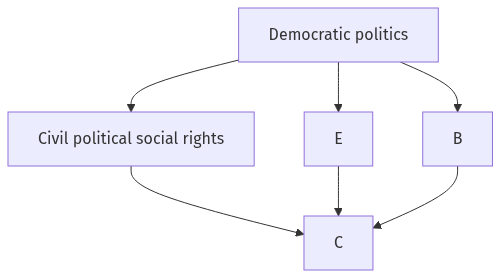
Conclusion
Democratic politics constructs citizenship through law, elections, welfare, and civic practice. It makes members into rights-holders and voters, while the boundary of membership remains a live political question.
Quick related
Students also ask
-
Narrate the various ways in which rapid environmental degradation is posing a serious threat to human security. Illustrate your answer with suitable examples
Next question on this syllabus topic (2023 · Q3(c)). View answer →
-
Is citizenship only a legal status?
The passport is the legal core. Democratic politics also constructs habits of claiming rights and judging governments.
-
Do all democracies construct citizenship in the same way?
No. Ethnic, civic, and multicultural models differ, and welfare depth differs. The common tool is political rights plus contest over membership.
Same topic · past papers
UPSC has asked this before
These previous-year questions sit on the same topic. Open one to practise the earlier ask.
-
2025 · Q2(a) · PSIR GS 2 · 20 marks
The world currently has been in the throes of a twin process of 'democratic backsliding' and 'democratic backlash'. How would you explain this paradox? -
2022 · Q2(a) · PSIR GS 2 · 20 marks
How has the electoral democracy augmented the participation of people in the democratic process? -
2022 · Q2(b) · PSIR GS 2 · 15 marks
Discuss the role of social movements in strengthening the democratic processes in developing societies
More from this topic
Q7(a) · UPSC Mains 2026 · PSIR GS 2 · 20 marks · Solution
How does illegal cross border migration pose challenges to India's security? Discuss the steps taken by the government in this direction and their effectiveness
Comparative Politics
Illegal cross-border migration undermines India's national security by altering demographic balances, straining economic resources, and exacerbating internal security vulnerabilities. The government has responded through border fencing, technological integration like SMART fencing, institutional mechanisms, and bilateral agreements. However, porous terrain, regional political complexities, and local connivance limit the complete effectiveness of these measures. A holistic approach combining strict border management with socio-economic development and robust legal frameworks is essential for sustainable containment.
Q5(d) · UPSC Mains 2026 · PSIR GS 2 · 10 marks · Solution
Discuss the main features of the land-boundary agreement between India and Bangladesh.
Comparative Politics
• Operationalized via the 100th Constitutional Amendment Act of 2015 to resolve Radcliffe Line anomalies. • Rooted in the unratified 1974 bilateral agreement and the 2011 additional protocol. • Involved the peaceful exchange of 111 Indian enclaves in Bangladesh and 51 Bangladeshi enclaves in India. • Granted affected residents the sovereign right to choose their nationality and place of residence. • Demarcated roughly 6.1 km of previously un-demarcated land boundaries to end administrative confusion. • Secured human rights and welfare access for over 50,000 formerly stateless enclave residents. • Reduced bilateral trust deficits, paving the way for deeper cooperation in security and connectivity.
Q4(c) · UPSC Mains 2026 · PSIR GS 2 · 15 marks · Solution
What is UNCLOS? Explain its salient features
Comparative Politics
UNCLOS, established in 1982, serves as the constitution of the oceans, codifying customary international law regarding maritime jurisdictions. Its salient features include distinct maritime zones ranging from territorial waters to the high seas, balancing coastal state sovereignty with freedom of navigation. It establishes compulsory dispute settlement mechanisms through institutions like ITLOS. The convention also mandates environmental protection and sustainable management of marine resources. For India, UNCLOS provides a rules-based order in the Indo-Pacific while respecting navigational rights. It remains central to addressing contemporary maritime security and resource challenges.