
Revision summary
The Objective Resolution, moved by Nehru on 13 December 1946, stated the aims of the Constitution before detailed drafting. It promised a sovereign republic, popular sovereignty, justice, equality, freedom, and safeguards for minorities, tribes, and depressed classes. The Preamble is its condensed public form. Parts III and IV give the aims legal and programmatic shape. Kesavananda used the Preamble as a guide to what Parliament may not destroy.
Model answer
Copper italics in this answer — like this — are the key facts. Each one is unpacked in the Facts & figures rail.
Introduction
The Objective Resolution was the Constituent Assembly’s statement of purpose for the Constitution. Jawaharlal Nehru moved it on 13 December 1946. It named sovereignty, republic, justice, equality, and safeguards for minorities before the detailed drafting began.
Body
Content
The Resolution declared India an independent sovereign republic. Power would be derived from the people. The Constitution would guarantee justice — social, economic, and political — equality of status and opportunity, and freedom of thought, expression, belief, faith, worship, vocation, association, and action, subject to law and public morality. Minorities, backward and tribal areas, and depressed classes would have adequate safeguards. The integrity of the territory and the just rights of the people on land were affirmed. Relations with the world would rest on peace and the honour of India.
Constitutional afterlife
The Preamble’s language of justice, liberty, equality, and fraternity is the Resolution’s child. Ambedkar and the Drafting Committee translated aims into Parts III and IV. Later, Kesavananda Bharati treated the Preamble as a guide to basic structure. The Resolution was not itself law. It was the political theory of the founding: popular sovereignty, a social as well as political republic, and minority protection as part of nationhood rather than as an afterthought.
Flow diagram
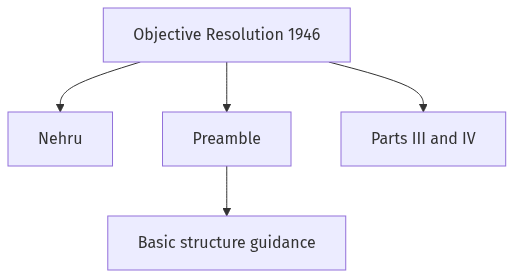
Conclusion
- Nehru’s Objective Resolution set the aims of the Indian Constitution: a sovereign republic, justice in three dimensions, liberty, equality, and safeguards for the vulnerable. The Preamble and the later basic-structure cases still speak in that register.
Quick related
Students also ask
-
Legal remedies in Part III of the Constitution of India.
Next question on this syllabus topic (2024 · Q5(c)). View answer →
-
Was the Resolution legally binding on the Drafting Committee?
It was a political mandate, not a statute. The Committee still had to turn aims into articles that could be enforced.
-
How does it relate to socio-economic justice?
It named social and economic justice at the start, which is why Directive Principles later claim a founding status beside Fundamental Rights.
Same topic · past papers
UPSC has asked this before
These previous-year questions sit on the same topic. Open one to practise the earlier ask.
More from this topic
Q8(b) · UPSC Mains 2026 · PSIR GS 1 · 15 marks · Solution
Critically comment on the shifts in the functioning of the Indian Parliament in the last two decades
Indian Nationalism
This 15-mark answer analyses the transformation of the Indian Parliament over the past two decades, moving from a deliberative forum to an arena of executive assertion. It highlights declining debate hours, bypassing of Department-Related Standing Committees (DRSCs), and the rise of ordinance-making and bypassing of bicameral consensus through Money Bills. The critique incorporates Morris-Jones and Pratap Bhanu Mehta's insights on the hollowing out of institutions. The conclusion argues for systemic institutional reforms to restore Parliament's core constitutional role as a deliberative check on executive power.
Q7(a) · UPSC Mains 2025 · PSIR GS 1 · 20 marks · Solution
Enunciate the impediments to women's participation in local governance in the process of political decentralisation
Indian Nationalism
The 73rd and 74th Amendments reserved local seats for women, which is a structural opening, not yet equal participation. Sarpanch-pati proxy rule, unpaid care, and a male bureaucracy remain the everyday patriarchal impediments. Caste and class decide which women can act; Dalit women office-holders face additional violence and veto. Thin devolution of money and staff makes many local offices ceremonial, so participation has no policy content. Parties and seat rotation often transfer the reserved ticket to a household rather than building a woman’s public career.
Q7(b) · UPSC Mains 2025 · PSIR GS 1 · 20 marks · Solution
Caste remains a vital axis for political mobilisation in India. How would the caste census address the aspirations of people? Discuss
Indian Nationalism
Caste remains a mobilisation axis because it still structures dignity, land, and access to the state, as Kothari, Mandal, and bahujan politics show. Parties already count jatis; the demand is that the official Census should too, beyond SC and ST. Aspirations include fairer reservation design, targeting of welfare, and recognition after the unpublished 2011 SECC caste data. Risks include reification of identity and a pure percentage war that forgets class, gender, and Ambedkar’s horizon of annihilation. A democratic census would publish usable aggregates while protecting persons and keeping constitutional individual rights at the centre.