
Revision summary
The Preamble’s socio-economic justice is pursued through both justiciable Fundamental Rights and non-justiciable Directive Principles. Article 37 calls Directives fundamental in governance while denying court enforcement, which is the original compromise. Early property-rights litigation blocked reform; amendments, Kesavananda, and Minerva Mills rebuilt the balance. Minerva Mills held that making Directives destroy Fundamental Rights would wreck the Constitution’s conscience. Agree that DPSPs are more fundamental as social-justice aims; disagree that they outrank rights as law. Harmony is the constitutional answer.
Model answer
Copper italics in this answer — like this — are the key facts. Each one is unpacked in the Facts & figures rail.
Introduction
The Preamble promises justice — social, economic, and political. Fundamental Rights in Part III give justiciable liberties. Directive Principles of State Policy in Part IV tell the state to pursue a social order of welfare, work, education, and reduced inequality. The question is whether the Directives are more fundamental than the Rights for that Preamble aim. The honest answer is that they are more fundamental as programme, and not more fundamental as law that can silence liberty.
Body
Two founding tools
Nehru’s Objective Resolution already named social and economic justice. Ambedkar explained that rights without a social programme would be incomplete, yet he made Part III enforceable and Part IV non-justiciable, a compromise with the Congress socialists and with liberal constitutionalism. Article 37 says Directives are fundamental in the governance of the country, but not enforceable by any court. That sentence is the constitutional grammar of the question.
If ‘more fundamental’ means ‘what the state must aim at to fulfil the Preamble’, the Directives carry the socio-economic load: living wage, equal pay, health, environment, village panchayats, and reduction of inequality. Fundamental Rights, especially Articles 14, 19, and 21, also serve socio-economic justice when courts read them as capabilities against destitution and arbitrary state power. They are not only a property-owner’s charter, though Article 19 and the old Article 31 were often used that way.
Judicial path
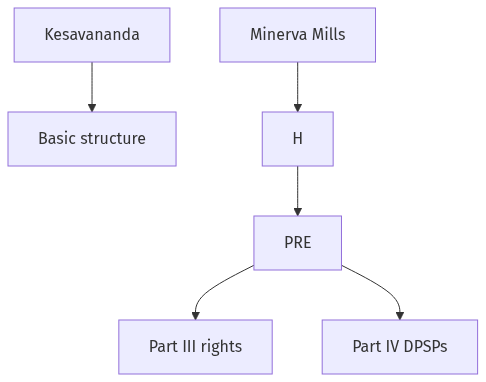
Early cases treated property and equality as trumps against agrarian reform. The First Amendment and later amendments tried to shield zamindari abolition and other measures. Golaknath limited amending power. Kesavananda Bharati (1973) saved a basic structure that includes both liberty and the Constitution’s identity, and accepted that amendment could pursue social justice within that structure. Minerva Mills (1980) is the decisive comment on this question. The Court struck down a clause that would have made Directive Principles immune from challenge even when they destroyed Fundamental Rights. It held that Parts III and IV together are the conscience of the Constitution. To destroy rights in the name of Directives, or to freeze Directives in the name of a rigid rights reading, would unbalance the founding design.
How far to agree
One should agree that socio-economic justice in the Preamble cannot be met by civil liberties alone. Land reform, labour protection, education, and health need Part IV and legislation. In that sense Directives are more fundamental as the charter of social transformation.
One should not agree that they are more fundamental in the hierarchy of justiciability. A state that jails the poor’s speech in the name of a plan has not met justice. Rawls’s lexical priority of basic liberties is a theoretical cousin of Minerva Mills: welfare is required, but not by erasing equal citizenship. Habermas would add that socio-economic aims still need public justification, not only a planning commission’s decree.
Indian practice after the 1970s — expansion of Article 21, rights to education and information, and the basic-structure shield — treats the two parts as complementary. The Planning Commission’s old growth-and-plan state sometimes spoke as if Directives outranked rights. The constitutional settlement after Minerva Mills is harmony, not a victory of Part IV over Part III.
Flow diagram
Conclusion
Directive Principles are more fundamental than Fundamental Rights as the Preamble’s socio-economic programme that the state must pursue. They are not more fundamental as enforceable law that may abolish liberty. Kesavananda and Minerva Mills require harmony. The Preamble is met only when both parts work: social justice through policy, and equal rights that keep that policy from becoming unchecked power.
Quick related
Students also ask
-
The main goal of the Fundamental Duties in the Indian Constitution is to generate civic responsibility among the citizens. Explain
Next question on this syllabus topic (2023 · Q7(b)). View answer →
-
Did Ambedkar think Directives were useless?
No. He thought they were moral and political commands to future legislatures, while still insisting that rights need courts.
-
Can courts enforce a Directive today?
Not as a free-standing writ in the Article 32 sense. They can interpret rights in the light of Directives and can push the state through other doctrines, which is still not a simple ranking of Part IV above Part III.
Same topic · past papers
UPSC has asked this before
These previous-year questions sit on the same topic. Open one to practise the earlier ask.
More from this topic
Q5(b) · UPSC Mains 2026 · PSIR GS 1 · 10 marks · Solution
The Constitution of India was secular even before the word was included in the Preamble. Comment.
Salient Features of the Indian Constitution
• The 42nd Amendment (1976) only added the word 'secular' to the Preamble; the original 1950 Constitution already guaranteed it substantively. • Article 14 ensures equality before the law without religious bias, while Article 15 strictly prohibits state discrimination based on religion. • Articles 25–28 guarantee freedom of conscience and the right to freely profess, practice, and propagate any religion. • Articles 29 and 30 safeguard minority interests by protecting their distinct cultures and right to run educational institutions. • Unlike the Western "wall of separation," Indian secularism follows *Sarva Dharma Sambhava*—treating all religions with equal respect. • The Supreme Court affirmed in the 1973 *Kesavananda Bharati* case that secularism was already a core, unwritten part of the basic structure.
Q7(b) · UPSC Mains 2023 · PSIR GS 1 · 15 marks · Solution
The main goal of the Fundamental Duties in the Indian Constitution is to generate civic responsibility among the citizens. Explain
Salient Features of the Indian Constitution
Article 51A, added in 1976, states Fundamental Duties of citizens. The main goal is civic responsibility to match Part III rights, in the line of Ambedkar’s constitutional morality. The list covers respect for the Constitution, unity, harmony, environment, scientific temper, public property, and, after the 86th Amendment, children’s education. Duties are mostly non-justiciable but guide interpretation and civic education. They must not be used to cancel protest and liberty under Part III.
Q7(a) · UPSC Mains 2022 · PSIR GS 1 · 20 marks · Solution
Examine the unique features of the 73rd Constitutional Amendment. Do you think this Amendment would contribute in achieving the goal of empowerment of marginalised sections of the society?
Salient Features of the Indian Constitution
The 73rd Amendment constitutionalised panchayats, gram sabhas, five-year elections, and State Election and Finance Commissions. Reservations for SC, ST, and women are the distinctive social mechanism. Eleventh Schedule lists developmental subjects including agriculture and poverty work. Seats have opened; sarpanch-pati, thin devolution, and caste violence still hollow many offices. The Amendment contributes to empowerment as a necessary institutional floor, not as a completed social revolution.