
Revision summary
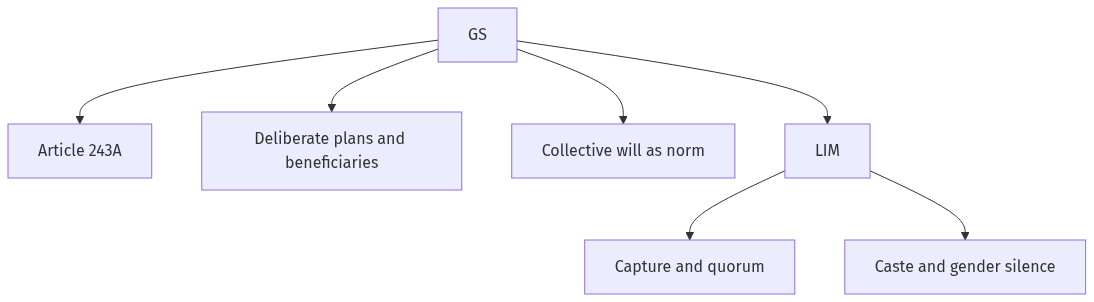
The Gram Sabha is the constitutional village assembly of voters under Article 243A and state panchayati raj laws. It is meant to approve plans, review the panchayat, and express local will, which is deliberative democracy at village scale. Gandhi’s Gram Swaraj is the moral ancestor; the 73rd Amendment is the legal form inside a still-centralised scheme state. Capture, quorum failure, caste and gender silencing, and weak devolution often prevent the assembly from being the people’s wisdom in fact. The statement is true as the institution’s purpose and as a standard of criticism, not as a uniform empirical description.
Model answer
Copper italics in this answer — like this — are the key facts. Each one is unpacked in the Facts & figures rail.
Introduction
The Gram Sabha is the assembly of registered voters of a village panchayat. The 73rd Amendment gave it constitutional status and required states to endow it with powers in law. The statement that it expresses the collective wisdom, aspirations, and will of the people is the official theory of this forum. A comment must test that theory against Gandhi’s Gram Swaraj and against how meetings actually run.
Body
Constitutional design
Article 243A says a Gram Sabha may exercise such powers and perform such functions at the village level as the legislature of a state provides. State panchayati raj Acts typically give it a role in approving plans, identifying beneficiaries, reviewing accounts, and, in some states, controlling local resources, including in scheduled areas under the PESA logic. This is deliberative democracy at the smallest territorial public: not Schumpeter’s distant elite competition only, but citizens speaking on common affairs.
The Amendment’s Eleventh Schedule lists subjects that may be devolved. The Sabha is the people’s moment; the panchayat is the committee. In theory, will is formed in the assembly and executed by the elected body.
Comment on the claim
The claim is right as a norm. A well-attended Sabha that debates a road, a school, or a liquor shop — as anti-arrack politics and later women’s ward members illustrate — can express aspiration and local knowledge that a district office lacks. Habermas’s conditions are partly met when talk is public and officials must answer.
The claim is overstated as a description of all India. Quorum failures, male capture, contractor lists, and party faction turn many meetings into a signature exercise. Caste can silence Dalit speech, which is why Ambedkar distrusted village republics that were not first equal. Funds and functionaries often remain with line departments, so the Sabha wills what it cannot fund. Gandhi wanted the village to be the plan’s unit; the 73rd Amendment made it a constitutional forum inside a still-centralised development state, including the legacy of the Planning Commission’s scheme world.
A fair comment therefore affirms the statement as the purpose of the institution and adds that expression of collective will requires social equality, real devolution, and protection of dissent. The Gram Sabha is the republic’s local public. It becomes the people’s wisdom only when those conditions are worked for, not when the statute is merely cited.
Flow diagram
Conclusion
The Gram Sabha is the 73rd Amendment’s village public, meant to gather will, aspiration, and local knowledge. That is its democratic meaning. Practice often falls short because of capture, thin devolution, and social hierarchy. The comment is that the statement names the standard by which panchayati raj should be judged, not an automatic fact in every village.
Quick related
Students also ask
-
Fascism displays an ambivalent stance towards parliamentary democracy. Explain
Next question on this syllabus topic (2023 · Q3(a)). View answer →
-
Is the Gram Sabha the same as the Gram Panchayat?
No. The Sabha is the assembly of voters. The panchayat is the elected executive committee that should remain accountable to that assembly.
-
Why did Ambedkar doubt the village?
He saw the village as a site of caste domination. A Gram Sabha without equal standing can express the will of the locally powerful, not of the people as equals.
Same topic · past papers
UPSC has asked this before
These previous-year questions sit on the same topic. Open one to practise the earlier ask.
-
2023 · Q8(c) · PSIR GS 1 · 15 marks
Do you agree that over the years the Supreme Court has become a forum for policy evolution? Justify your answer
More from this topic
Q8(b) · UPSC Mains 2026 · PSIR GS 1 · 15 marks · Solution
Critically comment on the shifts in the functioning of the Indian Parliament in the last two decades
Indian Nationalism
This 15-mark answer analyses the transformation of the Indian Parliament over the past two decades, moving from a deliberative forum to an arena of executive assertion. It highlights declining debate hours, bypassing of Department-Related Standing Committees (DRSCs), and the rise of ordinance-making and bypassing of bicameral consensus through Money Bills. The critique incorporates Morris-Jones and Pratap Bhanu Mehta's insights on the hollowing out of institutions. The conclusion argues for systemic institutional reforms to restore Parliament's core constitutional role as a deliberative check on executive power.
Q7(a) · UPSC Mains 2025 · PSIR GS 1 · 20 marks · Solution
Enunciate the impediments to women's participation in local governance in the process of political decentralisation
Indian Nationalism
The 73rd and 74th Amendments reserved local seats for women, which is a structural opening, not yet equal participation. Sarpanch-pati proxy rule, unpaid care, and a male bureaucracy remain the everyday patriarchal impediments. Caste and class decide which women can act; Dalit women office-holders face additional violence and veto. Thin devolution of money and staff makes many local offices ceremonial, so participation has no policy content. Parties and seat rotation often transfer the reserved ticket to a household rather than building a woman’s public career.
Q7(b) · UPSC Mains 2025 · PSIR GS 1 · 20 marks · Solution
Caste remains a vital axis for political mobilisation in India. How would the caste census address the aspirations of people? Discuss
Indian Nationalism
Caste remains a mobilisation axis because it still structures dignity, land, and access to the state, as Kothari, Mandal, and bahujan politics show. Parties already count jatis; the demand is that the official Census should too, beyond SC and ST. Aspirations include fairer reservation design, targeting of welfare, and recognition after the unpublished 2011 SECC caste data. Risks include reification of identity and a pure percentage war that forgets class, gender, and Ambedkar’s horizon of annihilation. A democratic census would publish usable aggregates while protecting persons and keeping constitutional individual rights at the centre.