
Revision summary
Pressure groups influence policy without usually seeking office; they are central to pluralist theories of the democratic state. They work through consultation, litigation, protest, media, and party finance, and they can improve information in complex decisions. Lindblom, Gramsci, and resource inequality show that business and well-organised sections often outweigh unorganised citizens. Indian illustrations include industry lobbies, unions, caste associations, Chipko, Narmada, and the anti-arrack movement. The critical assessment is that pressure groups are constitutionally protected and democratically ambivalent: they must be transparent and balanced by rights of those not yet organised.
Model answer
Copper italics in this answer — like this — are the key facts. Each one is unpacked in the Facts & figures rail.
Introduction
Pressure groups are organised interests that seek to influence public decisions without themselves normally seeking to form the government. They are part of the pluralist map associated with Dahl, and they are also sites of Gramsci’s civil society. A critical assessment of their role in governmental decision-making must hold both the democratic case and the capture case.
Body
How they enter decisions
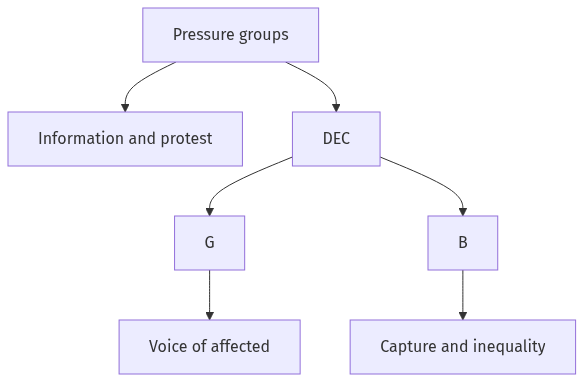
Groups supply information, draft, protest, litigate, fund campaigns, and occupy consultations. Business associations comment on industrial policy that still carries the Planning Commission’s successor habits. Trade unions press labour codes. Caste and farmer organisations bargain over reservations and support prices. Professional bodies shape education and health rules. Social movements — Chipko, Narmada, anti-arrack — force issues onto the agenda that ministries would prefer to treat as closed files. In a polyarchy, this is how ‘who governs’ varies by issue.
The National Commission for Women and similar bodies institutionalise some group claims inside the state. Parliamentary committees hear them. This can improve decisions by adding knowledge that a closed bureaucracy lacks.
Critical assessment
The democratic claim is incomplete. Resources are unequal. Organised capital often has a privileged position, as Lindblom argued, because investment strikes. Unorganised labour and unpaid women have less continuous access, except when they become movements. Opacity of lobbying weakens Habermas’s public reason: deals in corridors are not deliberation in the Gram Sabha. Groups may freeze a veto against a wider public good. Caste associations can deepen representation and can also deepen sectional bargaining that Ambedkar feared would not dissolve graded inequality.
Pressure groups are therefore necessary in a free society — Article 19 protects association — and they are a systematic bias in decision-making unless transparency, party programmes, and rights of the unorganised correct them. The critical assessment is not abolition. It is to judge each channel by whether it opens decision-making to those affected or only to those already organised.
Flow diagram
Conclusion
Pressure groups inform and press government, which pluralism treats as the life of a polyarchy. They also skew decisions toward the organised and the funded. Indian business, unions, caste bodies, and environmental and women’s movements show both faces. The task of democratic decision-making is to keep the first face and to discipline the second.
Quick related
Students also ask
-
Normative approach in Political Science.
Next question on this syllabus topic (2023 · Q1(a)). View answer →
-
How does a pressure group differ from a political party?
A party seeks to win office and a general programme. A pressure group seeks influence on issues and usually does not form the cabinet.
-
Are social movements pressure groups?
They can function as pressure groups when they target specific decisions. They may also seek a wider change of common sense, which is closer to hegemony than to a single-file lobby.
Same topic · past papers
UPSC has asked this before
These previous-year questions sit on the same topic. Open one to practise the earlier ask.
More from this topic
Q8(c) · UPSC Mains 2026 · PSIR GS 1 · 15 marks · Solution
"The lack of political will in preventing environmental degradation is one of the major challenges that India is experiencing." Comment
Political Theory
This 15-mark PSIR answer evaluates India's environmental degradation through the lens of political will, balancing developmental imperatives with ecological imperatives. It examines how electoral cycles, populist short-termism, and growth-first paradigms often sideline ecological security. Key thinkers like Ramachandra Guha and political economy frameworks are integrated to explain the structural inertia. The response provides Indian illustrations ranging from developmental clearances to air pollution crises. It concludes with a policy-forward outlook anchored in constitutional provisions like Article 48A and 51A(g).
Q8(a) · UPSC Mains 2026 · PSIR GS 1 · 20 marks · Solution
Discuss the causes and consequences of inter-State water disputes in India
Political Theory
This answer examines the structural causes and multi-dimensional consequences of inter-State water disputes in India. It highlights federal friction, climate variability, and legal-institutional gaps as primary causes. The consequences span socio-economic losses, inter-regional animosity, and challenges to federal integrity. The response incorporates institutional frameworks like the Inter-State Water Disputes Act and concludes with cooperative water federalism as the way forward.
Q7(c) · UPSC Mains 2026 · PSIR GS 1 · 15 marks · Solution
Map the different types of ethnic conflicts that have emerged in 21st century India
Political Theory
This 15-marker maps the typology of ethnic conflicts in 21st-century India, distinguishing between indigenous-immigrant clashes, tribal identity assertions, and sub-nationalist movements. It examines the structural roots of these conflicts in uneven development, resource competition, and cultural anxiety. The answer integrates theoretical insights on identity politics with concrete Indian case studies across the Northeast and mainland. It concludes with a policy-oriented view emphasizing federal accommodation, democratic dialogue, and inclusive development.