
Revision summary
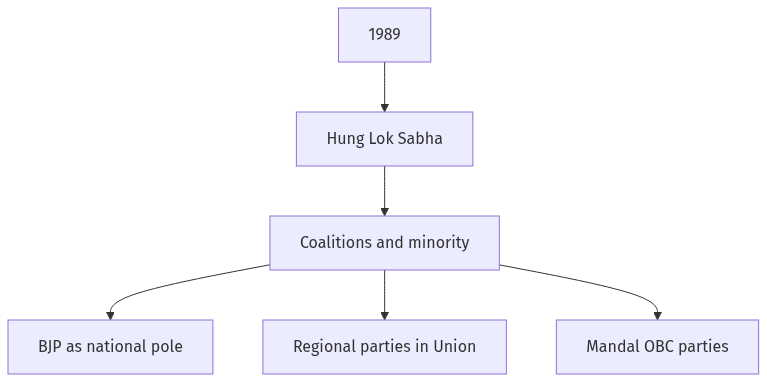
1989 ended the expectation of a Congress majority as the normal national result. The decade’s governments were minority or coalition: National Front, Congress minority, United Front, and NDA. The BJP rose as the second national pole; OBC and State parties became regular Union bargainers. Kothari’s Congress system gave way to a federalised multi-party system. The shift is epochal at the national level even though later majorities created a further phase.
Model answer
Copper italics in this answer — like this — are the key facts. Each one is unpacked in the Facts & figures rail.
Introduction
From 1989 to 1999 the national party system moved away from Congress dominance toward a multi-party, coalition, and federalised pattern. The shift is epochal because no single party again formed a full-term majority government in that decade, and because regional parties entered the Union executive as a regular fact.
Body
End of the old Congress system
- Rajni Kothari’s Congress system — a dominant party with factions and a weak opposition — broke after 1989.
- The 1989 election produced a hung Lok Sabha. V. P. Singh’s National Front government depended on outside support, a new national format.
- Congress returned in 1991 as a minority under P. V. Narasimha Rao and completed a term by management, not by restoration of one-party dominance.
- The 1996–98 United Front and the 1998–99 National Democratic Alliance made coalition the normal path to the Union cabinet.
Major national trends
- Hung parliaments and coalition or minority governments at the Centre, instead of a single-party majority as the expected result.
- Rise of the Bharatiya Janata Party as the principal national alternative, from a small 1984 tally to leading the NDA by 1998–99, with the 1992 Ayodhya sequence as a polarising national cleavage.
- Mandalisation: OBC parties and the Janata family fragments became national veto and alliance players after 1990 reservation politics.
- Federalisation of the national party system: State parties (TDP, DMK, AIADMK, SAD, Shiv Sena, RJD, SP, and others) bargained over Union portfolios and policy.
- Decline of a neat two-party alternative; a bipolar tendency around Congress and BJP still had to pass through regional allies.
- Economic liberalisation after 1991 changed the policy space that parties contested, even when caste and temple remained the mass languages.
- Fragmentation of the Janata tradition and of the Left’s national reach, with the Left still decisive in 1996–97 support politics.
Why it is epochal
- Dahl’s contestation became multi-polar at the Union level, not only a Congress-versus-rest election.
- Centralising Union governments had to share the cabinet, which is a party-system limit on the federal tilt discussed in Q7(a).
- The 1999 NDA full term after the decade’s instability confirmed that the new format could also deliver a completed Lok Sabha, still as a coalition.
- The epoch is 1989–99 as the break. Later single-party majorities after 2014 are another phase, not a return of the 1952–64 Congress system.
Flow diagram
Conclusion
The major national trends of 1989–1999 were the end of Congress dominance, hung Houses, coalition federalism, the BJP’s rise, and Mandal’s party effects. Together they created a multi-party national system. That is the epochal shift.
Quick related
Students also ask
-
High concentration of economic activities and consumption patterns in post-liberalisation period has led to the failure of environmental movements in India. Elucidate.
Next question on this syllabus topic (2022 · Q5(e)). View answer →
-
Was 1977 not already the epochal shift?
1977 was the first non-Congress Union government, but 1980 restored Congress majority. 1989 began a decade in which majority restoration failed.
-
Did national parties disappear?
No. Congress and the BJP remained the two national poles. What changed is that they usually needed State parties to govern.
Same topic · past papers
UPSC has asked this before
These previous-year questions sit on the same topic. Open one to practise the earlier ask.
More from this topic
Q8(c) · UPSC Mains 2022 · PSIR GS 1 · 15 marks · Solution
How far is it correct that the regional parties have strengthened the Indian democracy and federal system? Substantiate your answer with suitable examples
Party System
Regional parties widened democratic choice after 1967 and 1989. DMK, TMC, and AAP show linguistic, state-alternation, and new-urban routes into power. Coalition politics and Bommai-era federalism made states harder to dismiss or ignore. GST Council and linguistic statehood claims are federal gains with regional vehicles. Internal oligarchy and spoils are the democratic costs. The strengthening claim holds as a net historical judgment.
Q6(a) · UPSC Mains 2022 · PSIR GS 1 · 20 marks · Solution
Electoral behaviour of voters is governed more by the social and economic factors than the political factors. Explain
Party System
Indian voters use caste, religion, region, and household economy as the default map. Lipset–Rokkan cleavages and Mandal identity politics explain the social pull. Prices, jobs, and transfers explain the economic pull. Leadership, FPTP coalitions, and events remain political governors of the margin. The ranking social-economic over purely ideological politics is sound; organisation still converts those factors into seats.
Q5(e) · UPSC Mains 2022 · PSIR GS 1 · 10 marks · Solution
High concentration of economic activities and consumption patterns in post-liberalisation period has led to the failure of environmental movements in India. Elucidate.
Party System
Liberalisation clustered economic activity and high consumption in corridors, mines, and cities. That geography raised the cost of environmental vetoes compared with Chipko’s forest economy. Narmada, SEZ, and mining conflicts show frequent defeat and occasional gram sabha or court checks. Urban consumption politics is not the same as environmentalism of the poor. The statement explains many failures; it overstates a total end of movements.