
Revision summary
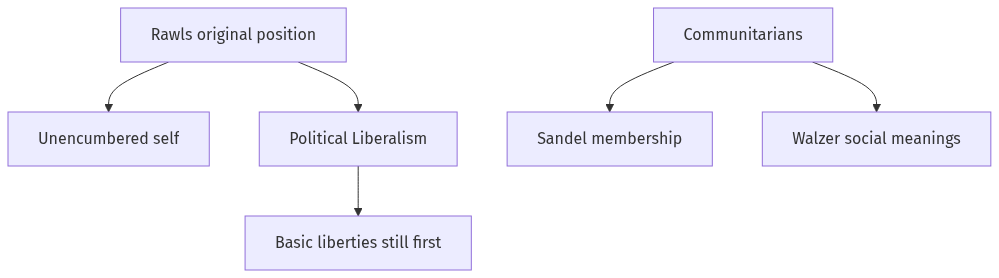
Rawls’s original position models persons as free and equal choosers who do not know their social identities. Sandel calls this an unencumbered self that cannot explain unchosen obligations. Walzer, MacIntyre, and Taylor add social meanings, narrative, and recognition. Political Liberalism replies that the self of justice is political, not a full metaphysics of the person. Indian group rights and Ambedkar’s civil equality show both the force and the limit of the communitarian critique.
Model answer
Copper italics in this answer — like this — are the key facts. Each one is unpacked in the Facts & figures rail.
Introduction
John Rawls models persons in the original position as free and equal, choosing principles of justice behind a veil of ignorance. Communitarian critics say that this ‘liberal self’ is too individualistic because it strips away the communities, histories, and goods that actually make a person who she is.
Body
Rawls’s liberal self
- In A Theory of Justice (1971), parties in the original position do not know their class, talent, sex, or conception of the good.
- They choose equal basic liberties, fair equality of opportunity, and the difference principle, which permits inequality only if it benefits the least advantaged.
- The self is prior to its ends: persons can revise their plans of life, so the state should not impose a single comprehensive good.
- Mill’s individuality is an ancestor of this picture; Hobbes’s atom of fear is not, because Rawls’s persons are reasonable, not only self-preserving.
Communitarian critique
- Michael Sandel in Liberalism and the Limits of Justice argued that the unencumbered self cannot account for obligations of membership, gratitude, and shared identity that we do not choose in a bargain.
- If the self is prior to its ends, civic republican virtue and constitutive attachments become optional tastes, which Sandel says is false to moral experience.
- Michael Walzer rejected a single original-position metric. Justice is internal to social meanings: what a doctor, a citizen, or a religious office may claim is not decided by one veil.
- Alasdair MacIntyre treated the liberal self as a person without a narrative, which cannot make sense of desert or tradition.
- Charles Taylor added that identity is dialogical and that recognition by others is a condition of freedom, not an extra.
Rawls’s later reply and the Indian bearing
- In Political Liberalism, Rawls presented the self of justice as a political, not metaphysical, conception: citizens of a constitutional regime, overlapping in a public reason, not unencumbered souls in all of life.
- The reply meets part of Sandel’s charge about comprehensive individualism. It does not meet Walzer’s claim that goods are sphere-specific.
- Indian personal law, Articles 25 to 30, and caste as a lived membership show Walzer’s point: people are not only veil-of-ignorance choosers.
- Ambedkar still required that those memberships not cancel civil liberty, which keeps a Rawlsian priority of equal basic liberties against an unlimited communitarian veto.
- A fair comment therefore holds both: Rawls’s device is too thin as a picture of the whole person, and still useful as a test of the basic structure of a constitutional state.
Flow diagram
Conclusion
Communitarians say Rawls’s liberal self is too individualistic because it abstracts persons from constitutive communities. Sandel, Walzer, MacIntyre, and Taylor state the critique. Rawls later recast the self as political. Equal basic liberties remain the limit on any community’s claim.
Quick related
Students also ask
-
Ambedkar's idea of social justice leads to 'egalitarian justice' as compared to Rawls' 'justice as fairness' which aims at the notion of 'pure procedural justice'. Comment
Next question on this syllabus topic (2022 · Q4(a)). View answer →
-
Did Rawls deny that people have communities?
No. He denied that those communities should set the basic structure of liberty and opportunity by their full comprehensive doctrines.
-
Does the critique destroy the difference principle?
Not by itself. It challenges the method of derivation. The difference principle can still be defended on other public grounds.
Same topic · past papers
UPSC has asked this before
These previous-year questions sit on the same topic. Open one to practise the earlier ask.
-
2026 · Q3(b) · PSIR GS 1 · 15 marks
Wollstonecraft developed first systematic feminist critique. Discuss her main ideas -
2021 · Q1(a) · PSIR GS 1 · 10 marks
Feminist critique of the State.
More from this topic
Q2(c) · UPSC Mains 2025 · PSIR GS 1 · 15 marks · Solution
Explain how Rawls used the liberal and egalitarian perspective to develop his theory of justice
Justice
Rawls rebuilds the social contract as a choice of principles behind a veil of ignorance. The liberal side is equal basic liberties with lexical priority, plus respect for persons as ends rather than a utilitarian aggregate. The egalitarian side is fair equality of opportunity and the difference principle, which permits inequality only if it benefits the least advantaged. Political Liberalism later seeks an overlapping consensus among reasonable doctrines without a state religion of the good. Nozick, Cohen, Sen, and Dworkin attack or extend the hybrid, which shows that justice as fairness is both liberal and egalitarian by design.
Q4(c) · UPSC Mains 2022 · PSIR GS 1 · 15 marks · Solution
Examine the entitlement theory of justice
Justice
Nozick’s entitlement theory judges holdings by a just historical chain, not by an end-state pattern. Acquisition, voluntary transfer, and rectification are the three principles. The Chamberlain example defends inequality that arises from consent. Rectification, if honest about conquest and caste, could undo much of the theory’s conservative use. Rawls and Indian social-revolution clauses reject the minimal state that the theory prefers.
Q4(a) · UPSC Mains 2022 · PSIR GS 1 · 20 marks · Solution
Ambedkar's idea of social justice leads to 'egalitarian justice' as compared to Rawls' 'justice as fairness' which aims at the notion of 'pure procedural justice'. Comment
Justice
Rawls’s justice as fairness models pure procedural justice: a fair original position defines just shares. Ambedkar’s social justice starts from graded inequality and aims at equal status, not only a fair bet among equals. Article 17, reservations, and annihilation of caste are substantive egalitarian tools. The original position assumes moral equality that caste society denies. Indian basic structure and reservation law sit closer to Ambedkar’s end-state than to a caste-blind procedure.