
Revision summary
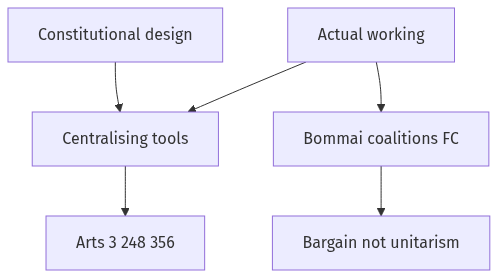
The Constitution designs a strong Union: Article 3, residuary power, All-India Services, and emergency including Article 356. Actual working has often followed that design through President’s Rule, centrally sponsored schemes, and Governors. S. R. Bommai (1994) and coalition politics after 1989 are the main federal counter-forces. Finance Commission devolution after the Planning Commission reduced one allocative lever of the Centre. The working is therefore Union-heavy federalism with cyclical State assertion, not either pure unitarism or dual federalism.
Model answer
Copper italics in this answer — like this — are the key facts. Each one is unpacked in the Facts & figures rail.
Introduction
Indian federalism is a constitutional division of power with a strong Union. The actual working often conforms to centralising tendencies that the text itself contains. The same working also shows State assertion through parties, the Finance Commission, and the Supreme Court’s limits on President’s Rule. The answer is therefore yes, with important counter-movements.
Body
Centralising design in the text
- K. C. Wheare called India quasi-federal. Granville Austin called the practice cooperative, but the Union remains the heavier partner.
- Article 3 allows Parliament to form and alter States; the Union is not a compact of indestructible States.
- The Union List, residuary power in Article 248, All-India Services, and Articles 256, 257, 355, 356, and 365 give the Centre tools of direction, protection, and takeover.
- Emergency provisions and a unified integrated judiciary pull interpretation toward national power.
- Single citizenship and a national election commission are nation-making centralisms that Austin’s cornerstone required after Partition.
Actual working that conforms to that design
- President’s Rule was used frequently until S. R. Bommai v. Union of India (1994) subjected it to judicial review and to the floor-test principle.
- Centrally sponsored schemes, the Planning Commission’s old Plan grants, and now Union indices and agencies still steer State policy in List II subjects such as health and urban development.
- Governors, the Lieutenant Governor in Union Territories, and central investigating agencies are recurrent sites of Union weight.
- GST created a shared tax but also a Council in which the Union’s voice and the need for a common rate structure limit State tax autonomy.
- During national crises, as in internal emergency 1975–77, the polity worked as a unitary command.
Counter-working that does not fully conform
- After 1989, regional parties and coalition governments federalised the Union cabinet itself, which Dahl would read as contestation inside the Centre.
- The Finance Commission’s rise after Plan grants ended, and the Fourteenth Finance Commission’s higher tax devolution, moved money by formula rather than by Plan bargaining.
- Linguistic States, Article 370’s long special status until 2019, and the 73rd and 74th Amendments created other power centres.
- Bommai, Kesavananda, and inter-state water benches are judicial federalism, not only Union will.
- Ambedkar had said the Constitution can be both federal and unitary as conditions require; the question is whether conditions or convenience drive the shift.
Reasoned answer
- Yes, actual working still conforms in large part to centralising tendencies, because the text invites them and because Union politics uses them.
- No, not as a completed unitarism, because States, parties, and courts regularly force bargains.
- The accurate political-science statement is a strong-Centre federation whose centralising tilt is structural, and whose federal practice is cyclical with the party system.
Flow diagram
Conclusion
Indian federalism’s working does conform to centralising tendencies built into Articles 3, 248, 256, and 356 and into schemes, Governors, and emergencies. Bommai, coalitions, and Finance Commission devolution are the main limits. The polity remains a Union-heavy federation, not a compact of equal States.
Quick related
Students also ask
-
Do you agree that over the years the Supreme Court has become a forum for policy evolution? Justify your answer
Next question on this syllabus topic (2023 · Q8(c)). View answer →
-
Did Ambedkar want a unitary state?
He described a dual constitution that could be federal in normal times and more unitary in emergency. That is a designed tilt, not accidental centralisation.
-
Did 1989 end centralisation?
It federalised national coalitions. It did not repeal Article 356 or Union scheme power. Centralisation returned with single-party majorities as well.
Same topic · past papers
UPSC has asked this before
These previous-year questions sit on the same topic. Open one to practise the earlier ask.
More from this topic
Q8(c) · UPSC Mains 2023 · PSIR GS 1 · 15 marks · Solution
Do you agree that over the years the Supreme Court has become a forum for policy evolution? Justify your answer
Principal Organs of the Union Government
Maneka Gandhi and PIL made the Supreme Court a place where social and environmental policy is often first written as rights. Vishaka guidelines, pollution and food orders, and federal cases such as Bommai are policy evolution by judgment. The Court fills vacuums left by the executive and legislature; that is the empirical basis of the statement. Electoral democracy still assigns general policy to removable legislatures. Agreement is therefore yes for rights-based gap-filling, and no for the Court as a general policy government.
Q8(b) · UPSC Mains 2021 · PSIR GS 1 · 15 marks · Solution
Examine the evolution of the jurisdiction of the Supreme Court of India as a constitutional court
Principal Organs of the Union Government
The Supreme Court began with writs, federal disputes, and appeals. Champakam showed rights jurisdiction that triggered constitutional amendment. Golaknath, Kesavananda, and Minerva Mills created basic-structure constitutional review. Article 21 and PIL expanded the Court into a wide public-law forum. A constitutional court here means custody of identity, not only private appellate justice.
Q6(b) · UPSC Mains 2021 · PSIR GS 1 · 15 marks · Solution
The role of the President of India becomes more significant during a minority government and a coalition government. Explain
Principal Organs of the Union Government
A majority Cabinet reduces the President to advice-bound head of state. Minority and coalition politics make formation and dissolution live presidential tasks. The 1989–91 hung Parliament is the classic national case. Floor tests, letters of support, and caretaker advice are the working tools. The office does not become a second government; it becomes a necessary referee.