
Revision summary
Dhamma is a public ethic of right conduct, non-injury, and welfare, not a priestly monopoly. It measures kingship by protection of the weak rather than by sacrifice or by Hobbesian war. The sangha’s procedures and Ashoka’s edicts treat political action as morally accountable. Ambedkar restated Dhamma as liberty, equality, and fraternity against caste. Emancipation is of political action from birth-rank and from force as the only law; it is not a claim that Buddhist states never used force.
Model answer
Copper italics in this answer — like this — are the key facts. Each one is unpacked in the Facts & figures rail.
Introduction
In Buddhist usage, Dhamma is the teaching of right conduct, non-injury, and the ending of craving. The claim of the question is that this teaching frees political action from ritual kingship, caste rank, and the war of unrestrained self-preservation. Emancipation here means that public action can be judged by a moral law that is not the same as a priest’s monopoly or a sovereign’s sword.
Body
Dhamma as a public standard
- Early Buddhist teaching placed intention, non-violence, and the Middle Path above birth as a measure of worth, which undercuts hereditary rank as a political title.
- The king is asked to rule by Dhamma: protection of the weak, just punishment, and welfare, rather than by sacrifice alone.
- Ashoka’s edicts after the Kalinga war state repentance, public works, and moral instruction as the business of rule, which is political action measured by Dhamma.
- This is not a theocracy. It is a lay public ethic that officials and householders can practise without a Vedic intermediary.
Emancipation of political action
- Against Hobbes, political action need not begin from a state of war of all against all; Dhamma names fear, hatred, and greed as the causes to be reduced, not as the nature to be armed.
- Against a closed ritual order, action in the assembly, the sangha’s own procedural rules of debate, and the king’s welfare work become legitimate public acts.
- B. R. Ambedkar’s The Buddha and His Dhamma and the 1956 conversion treated Dhamma as a religion of liberty, equality, and fraternity for those excluded by caste.
- Ambedkar’s triad Educate, Agitate, Organise is political action emancipated from waiting for upper-caste conscience, and he presented Navayana Buddhism as its ethical ground.
- Article 17 and the constitutional language of liberty, equality, and fraternity are the legal form of that emancipation in the republic.
Limits and comparisons
- Buddhist kingship could still wage war and collect tax; Dhamma is a criterion, not a guarantee of pacific history.
- Gandhi’s ahimsa and satyagraha overlap with Dhamma in non-injury, but Gandhi kept a Hindu social vocabulary that Ambedkar rejected as insufficient for civil liberty.
- Aurobindo’s spiritual swaraj is another Indian path of inner freedom; Buddhist Dhamma is more this-worldly in its attention to suffering and institutional sangha procedure.
- Rawls’s public reason and Mill’s harm principle can converse with Dhamma as a public ethic, without baptising the state as a church.
- Foucault would note that moral instruction is also a government of conduct; emancipation is therefore unfinished if Dhamma becomes only a new discipline.
What the explanation must conclude
- Dhamma emancipates political action by giving it a standard of non-injury, welfare, and equal moral worth independent of birth and of pure force.
- In India that standard was restated by Ashoka and by Ambedkar as a programme of civil liberty, not as withdrawal from politics.
Flow diagram
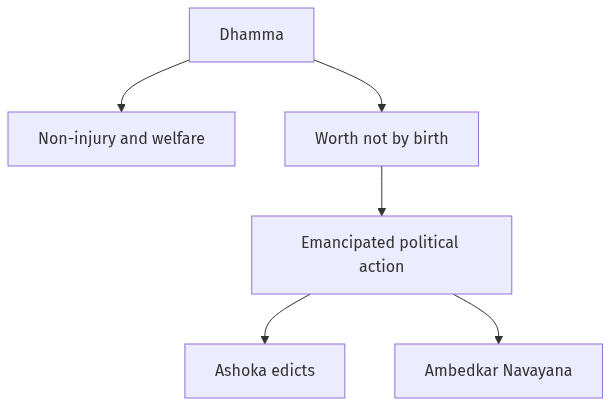
Conclusion
Buddhist Dhamma frees political action from war-as-nature, from birth-rank, and from ritual monopoly, by measuring rule against non-injury and welfare. Ashoka and Ambedkar are the two Indian public statements of that emancipation. The republic’s equality clauses are its legal residue.
Quick related
Students also ask
-
"When a nation becomes devoid of arts and learning, it invites poverty." (Sir Syed Ahmad Khan). In the light of this statement, assess the role of Sir Syed Ahmad Khan as a reformer in modern India
Next question on this syllabus topic (2021 · Q3(b)). View answer →
-
Is Dhamma a state religion in this explanation?
No. It is a public moral standard for action. Ambedkar used it to support a secular constitution of equal citizenship.
-
How does this differ from Hobbes?
Hobbes ends war by an unlimited common sword. Dhamma ends the causes of quarrel by a discipline of conduct and a welfare duty of rulers.
Same topic · past papers
UPSC has asked this before
These previous-year questions sit on the same topic. Open one to practise the earlier ask.
More from this topic
Q4(a) · UPSC Mains 2021 · PSIR GS 1 · 20 marks · Solution
Do you think that the Buddhist traditions have lent greater ethical foundation to the ancient Indian political thought? Give your arguments
Indian Political Thought
Buddhist political ethic centres ahimsa, restraint of craving, and a righteous king. Ashoka’s dhamma after Kalinga is the working Indian case of that ethic as policy. Kautilya’s Arthashastra is a parallel science of danda and treasury, morally thinner on universal non-injury. Dharmashastra often ties the king to varna order; Buddhism judges the king by harm to all beings. The greater ethical foundation is true of the Buddhist-Ashokan stream, not of every ancient text.
Q3(b) · UPSC Mains 2021 · PSIR GS 1 · 15 marks · Solution
"When a nation becomes devoid of arts and learning, it invites poverty." (Sir Syed Ahmad Khan). In the light of this statement, assess the role of Sir Syed Ahmad Khan as a reformer in modern India
Indian Political Thought
Sir Syed linked national poverty to the loss of arts and learning. Aligarh, the Scientific Society, and Tahzib-ul-Akhlaq were his reform tools. He sought modern sciences and a loyal path after 1857. The reform privileged ashraf men and later fed minority political caution. He is a major educational modernist, not a leader of inclusive mass nationalism.