
Revision summary
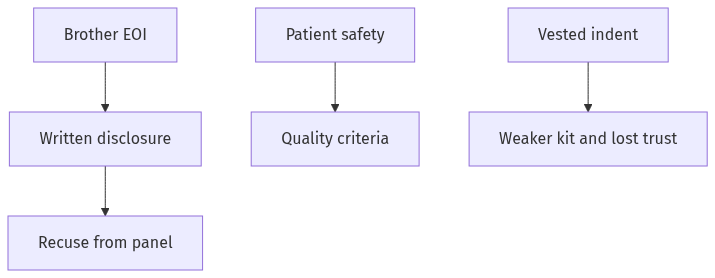
Sneha should disclose the brother’s EOI, recuse from all related decisions, and refuse to shape specifications around his firm. Private ownership does not cancel conflict-of-interest duty; patients still bear device risk. Justification is integrity, appearance of justice, and the patient as the moral centre rather than the brother’s debt. Medical ethics is compromised when a weaker product is bought to rescue a relative, when trust leaks, and when a brother-vendor cannot be dropped. Financial distress of the supplier is a quality red flag, not a reason to bend the indent.
Model answer
Copper italics in this answer — like this — are the key facts. Each one is unpacked in the Facts & figures rail.
Introduction
Sneha is Senior Manager, procurement, for a new super-speciality wing of a reputed private hospital chain. Her brother, a known supplier, has filed an expression of interest. The hospital is not bound to the lowest bidder. The brother’s firm is in financial trouble; a big order would save him. A family rescue and a favouritism charge sit on the same indent. Private ownership does not wash medical ethics or conflict of interest. Patients still bleed under those lights.
Body
(a) Course of action
Sneha should declare the relationship in writing the same day to her reporting director and to internal audit. She should recuse from evaluation, negotiation and sign-off on this EOI and on any re-tender in the same category while the brother’s firm is in the field. She should ask that a panel with no family link run a documented quality-and-price process, even though the law of public GFR does not bind a private chain: the hospital’s own probity policy and the patient’s body do. She should not coach her brother’s bid, not share rival quotes, and not design the specification around his catalogue. She should tell her brother, once, that she cannot be his market. If the firm is objectively the best on published criteria, the panel may still award; she must not be in the room. If the chain presses her to sign, she should refuse and escalate. A side letter that “we all knew” is not a defence.
(b) Justification
Integrity is one person, one interest on the file. Justice must be seen: even a fair award to the brother will look like a rescue, and staff and rival suppliers will price the next tender as a family shop. Role morality: she is trustee of procurement for a clinical purpose, not a sister with a chequebook. Private does not mean anything goes; clinical equipment that fails kills. Virtue: Aristotle’s liberality to family is a private virtue; here it is a public vice. Kant: a maxim of sister-awards cannot be a hospital rule. Gandhi’s talisman is the patient on the table, not the brother’s EMI. Courage: a bad ACR from a promoter who wanted the brother is cheaper than a device scandal. Justification to the board: process legitimacy protects the brand; a quiet family order is a time-bomb.
(c) Medical ethics compromised by vested interest
Beneficence and non-maleficence fail if a weaker ventilator or a tainted implant is bought because a sibling needed cash. Justice in the clinical sense is fair access to competent kit, not a family subsidy built into patient bills. Autonomy is wounded when consent is to a hospital that hid a conflict. Trust — the soul of the clinical relationship — leaks to the ward boy who saw the brother in the store. Professional codes (IMC/NMC spirit, nursing and admin alike) treat the patient as end. A vested indent treats the patient as a revenue pipe for a private distress. Pharmacovigilance and device safety need suppliers who can be dropped; a brother-vendor is harder to blacklist. Financial distress of the firm is a red flag for quality and for kickback pressure, not a humanitarian exception. Hippocrates did not add “unless your brother is broke.” The compromise is complete when clinical criteria are rewritten around a catalogue, when lowest competent is ignored without reasons, and when incident reports are softened to protect the sibling. That is how probity failure becomes a mortality statistic.
Flow diagram
Conclusion
Sneha must declare, recuse, and keep her brother off her pen. A private hospital still owes patients a conflict-free buy. A family rescue through a super-speciality indent turns medical ethics into a subsidy, and the patient pays in risk.
Quick related
Students also ask
-
Case study. With the summer heat being exceptionally severe, the district has been facing severe water shortage. The District Collector has taken strict measures for stopping the over-exploitation of groundwater. Farmers are agitated that they are not being allowed to irrigate their crops while big industries located near the river are drawing huge amounts of water. The farmers allege that the administration is anti-farmer and corrupt. The industry cannot be closed as this would result in a large number of workers being unemployed. (a) Discuss all options available to the District Collector as a District Magistrate. (b) What suitable actions can be taken in view of mutually compatible interests of the stakeholders? (c) What are the potential administrative and ethical dilemmas for the District Collector?
Next question on this syllabus topic (2024 · Q11). View answer →
-
What if the brother’s product is genuinely the best?
Then a recused panel may still award on recorded criteria. Sneha’s virtue is absence from that room, not a speech about quality.
-
Does ‘not lowest bidder’ mean she may prefer family?
It means quality can outrank price. It does not mean kinship outranks both.
Same topic · past papers
UPSC has asked this before
These previous-year questions sit on the same topic. Open one to practise the earlier ask.
More from this topic
Q12 · UPSC Mains 2026 · GS IV · 20 marks · Solution
Case study. Ajit has been recently promoted as the Head of the Department of Weapon Sales (DWS) in the Ministry of Defence Production (MDP). His charter of duties includes international sales of weapons produced domestically by MDP. In two recent wars, MDP weapons have performed admirably, resulting in many countries showing interest in buying them, particularly long-range artillery and missiles. Country A and country B have asked for these weapons. However, production constraints restrict DWS to accept only one purchase order. Country A is a developing nation with a sound technology base. MDP is planning R&D collaboration with it for the next generation of weapons. It is not part of any security alliance and needs weapons for protection from a troublesome neighbour. It seeks a large acquisition on a long-term loan. Country B is also a developing nation. Military strength is its priority, with the military budget often ingressing into allocations for human resources and infrastructure development. It is in security alliance with a superpower who has a large military base there and periodically allots it financial grants. It is a member of an economic bloc with which the government is currently negotiating a free trade agreement. It is not a signatory of NPT but possesses smaller nuclear weapons and delivery systems. It supports some guerrilla forces abroad. It has sought a smaller acquisition and is prepared to make some advance payment. It is currently negotiating arms purchases from another nation too. Ajit discussed this case with his counterparts in the related departments. Therein, the significant economic benefits, employment generation and stronger diplomatic relations arising from this sale were highlighted. It was also emphasized that refusing the deal could result in country B purchasing weapons from some other supplier. Ajit was aware that in arms sales, due diligence at each stage was pivotal to ensure conformity to national policy and international treaties. (a) Discuss the options available to Ajit. Which option should he select and why? (b) How can Ajit balance nation's economic and strategic interests with ethical considerations?
Ethics Case Studies
This case study examines ethical dilemma in defense exports, balancing economic gains, strategic partnerships, and non-proliferation norms. Ajit must choose between Country A for R&D collaboration and self-reliance, or Country B for immediate financial gains and FTA leverage. The recommended course prioritizes long-term strategic security, technological synergy, and international humanitarian norms over short-term mercantile interests.
Q11 · UPSC Mains 2026 · GS IV · 20 marks · Solution
Case study. Rajapuram is a border district. Jhara and Biru, its two major communities are in continual conflict with each other. The social fabric is fractured and demands mending. Ethnic tensions between the two communities have erupted into violence resulting in a large number of deaths. The stated causes are conflicting land claims, uneven resource allocation and inadequate political representation in government bodies. Separate relief camps had to be created for the two communities. The situation is volatile and appears to be getting out of control. Rajan has been appointed the District Magistrate (DM) of Rajapuram and tasked to quickly get the situation under control. His immediate tasks include restoring administrative authority, reopening the highway and initiating peace talks. On taking over his appointment, Rajan realized that the inter-community rivalry had even seeped into the local administration and police. With functional neutrality being the immediate casualty, it had made both communities distrustful of the government. The neighbouring country could utilize the opportunity to spur insurgent activity and further aggravate the situation. Rajan favoured a controlled approach starting with opening the highway to restore food and medical supplies. He toyed with the idea of requisitioning CRPF units to help restore administrative control. (a) Discuss the ethical issues that need to be addressed in this case. (b) What are the options open to Rajan? Which option would ensure protection of his non-partisan image without compromising ethics?
Ethics Case Studies
This GS4 case study examines the ethical dilemmas faced by a District Magistrate in managing an ethnic conflict in a sensitive border district. It analyses the ethical issues involving neutrality, human life, security, and institutional trust. It evaluates options ranging from purely coercive measures to inclusive peace-building. The recommended approach balances administrative firmness with transparent, unbiased stakeholder engagement to uphold public service values.
Q10 · UPSC Mains 2026 · GS IV · 20 marks · Solution
Case study. Vikas is a government officer with over a decade of service in public administration. He has recently moved as the District Collector (DC) of Nainipura, a remote hilly district bordering a forest. Due to Nainipura's low levels of economic development, one of his major duties is to ensure proper functioning of the public distribution system (PDS) amongst the economically weaker sections (EWS). During his on-site visits, Vikas was apprised of a typical administrative challenge in operating the PDS. To prevent leakages, all distributors were required to carry out real-time biometric identification of the beneficiaries, whose fingerprints were tallied with identity card records. This was creating problems as the operating system sometimes rejected fingerprint matching in the cases of growing children, manual labourers and senior citizens. The problem was further compounded in periods of low WIFI connectivity. The distributors, in such cases, resorted to personal discretion when they could identify the recipient. Vikas had to address this problem on priority. Strictly adhering to 'government regulations' would ensure fiscal probity but would greatly trouble the proposed beneficiary, i.e., EWS. It may even impinge on their fundamental right to life as per Article 21 of the Constitution. Conversely, leaving the resolution solely to the discretion of the distributors could lead to misuse and leakages. (a) What are the options open to Vikas? How should he balance fiscal probity with empathy towards the designated beneficiaries? (b) Discuss the ethics of using technology as a gatekeeper for welfare schemes.
Ethics Case Studies
• Balance strict digital rules with human empathy to prevent vulnerable citizens from losing entitled rations due to technical failures. • Avoid extreme approaches like rigid enforcement (causing exclusion) or unchecked discretion (causing leakage and corruption). • Implement practical offline workarounds like manual registers, paper slips, or OTPs backed by periodic audits. • Treat procedural norms and technology as tools for human welfare rather than rigid ends in themselves. • Recognize that digital gatekeeping creates ethical tensions between fiscal efficiency and the exclusion of genuine beneficiaries. • Guard against technology violating human dignity by forcing vulnerable groups to repeatedly prove their identity against system errors. • Ensure administrative accountability so systemic technological failures are not unfairly blamed on the citizens.