Q11 · UPSC Civil Services Mains 2023 · GS IV · 20 marks · 4 min read

← Q10 Q12 →

Case study. Vinod is an honest and sincere IAS officer. Recently, he has taken over as Managing Director of the State Road Transport Corporation, his sixth transfer in the past three years. His peers acknowledge his vast knowledge, affability and uprightness. The Chairman of the State Road Transport Corporation is a powerful politician and is very close to the Chief Minister. Vinod comes to know about many alleged irregularities of the Corporation and the high-handedness of the Chairman in financial matters. A Board Member of the Corporation belonging to the Opposition Party meets Vinod and hands over a few documents along with a video recording in which the Chairman appears to be demanding bribe for placing a huge order for the supply of QMR tyres. Vinod recollects the Chairman expediting clearing of pending bills of QMR tyres. Vinod confronts the Board Member as to why he is shying away from exposing the Chairman with the so-called solid proof he has with him. The member informs him that the Chairman refuses to yield to his threats. He adds that Vinod may earn recognition and public support if he himself exposes the Chairman. Further, he tells Vinod that once his party comes to power, Vinod's professional growth would be assured. Vinod is aware that he may be penalized if he exposes the Chairman and further be transferred to a distant place. He knows that the Opposition. Party stands a better chance of coming to power in the forthcoming elections. However, he also realizes that the Board Member is trying to use him for his own political gains.

Topic: Ethics Case Studies. Syllabus: Case Studies on above issues. Same official PYQ from year-wise 2023 and Ethics Case Studies.

Revision summary

Vinod holds a likely bribe video on QMR tyre procurement and a request to use it for opposition gain. The ethical duty is to protect passengers and public money without becoming a party worker. Silence and a leak timed for elections both fail. He should record the material, send it to vigilance and police under the Prevention of Corruption Act, 1988, audit the tender, and stop unsafe tyres. He should not hold a political press conference or give the Chairman a private first look that can destroy evidence.

Model answer

Introduction

Vinod is the IAS Managing Director of a State Road Transport Corporation. The Chairman is a politician. An opposition member of the board gives him a video of bribery in QMR tyre procurement and wants a public exposure that will help that party. The file is both a fraud against the corporation and a trap for the civil service.

Body

Stakeholders

  • Vinod as Managing Director and as a member of the All India Services.
  • The political Chairman of the corporation.
  • The opposition board member who holds the video and wants political use of it.
  • Employees, passengers and the public exchequer that pay for tyres.
  • The persons allegedly taking a bribe on QMR tyres.
  • Vigilance, police and courts who must try facts.

Ethical issues

  • Procurement fraud on tyres is a public wrong. Quality, material and rate (QMR) cheating can kill passengers if a tyre fails, and it steals public money.
  • Neutrality of the civil service: Vinod must not become the opposition’s loudspeaker, nor the Chairman’s shield.
  • The video may be true, edited, or a lure to destroy a rival. Ethics forbids both burying a likely crime and publishing an untested clip for votes.
  • Courage versus career: exposing a Chairman’s network can mean transfer; hiding it is a different kind of careerism.
  • Confidentiality of a board and of an inquiry versus the public’s right not to ride on corrupt rubber.
  • The Prevention of Corruption Act, 1988 is the criminal frame; a press conference is not a substitute for it.

Options

  • Option 1: Hand the video to the opposition member’s campaign and join the exposure.
  • Merit: speed and fear among the corrupt.
  • Demerit: Vinod becomes a party tool, the trial is by media, and a later government will treat him as a faction worker.
  • Option 2: Give the video to the Chairman and wait for instructions.
  • Merit: apparent loyalty to the present board head.
  • Demerit: if the Chairman is in the chain, the evidence may vanish.
  • Option 3: Ignore the video as “politics”.
  • Merit: quiet posting.
  • Demerit: possible deaths on the road and certain failure of integrity.
  • Option 4: Seize the process: receive the material against acknowledgement, send it to the competent vigilance and criminal agencies, order a technical audit of the tyre contract, recuse from any private briefing to either party, and inform the Chief Secretary through a factual note.
  • Merit: law, neutrality and passenger safety.
  • Demerit: both parties may be angry; that is the cost of the oath.

What Vinod should do

  • Take the video and any supporting files on the official record. Do not keep them only on a personal phone.
  • Forward them to the State vigilance organisation and, where the facts suggest a cognizable offence, to the appropriate police station or anti-corruption bureau, citing the Prevention of Corruption Act, 1988.
  • Order an immediate technical and financial audit of the QMR tyre tender: specifications, test certificates, actual fitment, and payments.
  • If safety is in doubt, stop further fitment of the suspect batch and protect passengers first.
  • Do not hold a political press conference and do not leak to one party’s channels.
  • Inform the Chairman only through a proper board or government channel after the evidence is copied to vigilance, so that the first act is not a private warning to a suspect.
  • Recuse from inquiry steps if his own earlier signatures are on the tender, and still do not sit on the video.
  • Remain civil to the opposition member as a board colleague, and refuse the bargain that exposure must be timed for an election.
  • Accept that a transfer may follow. Integrity is the posting; the next town is not the test.

Flow diagram
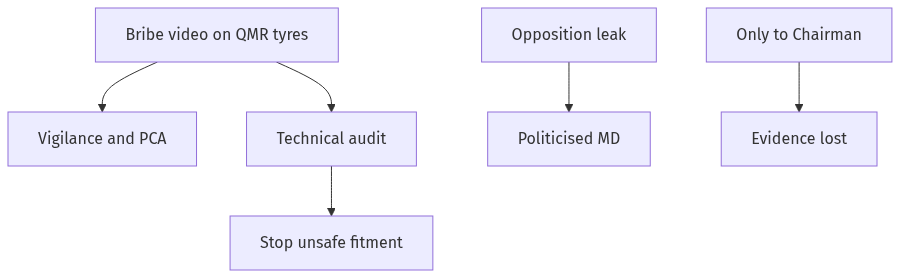
flowchart TD
  VID[Bribe video on QMR tyres] --> VIG[Vigilance and PCA]
  VID --> AUD[Technical audit]
  AUD --> SAFE[Stop unsafe fitment]
  OPP[Opposition leak] --> PART[Politicised MD]
  CH[Only to Chairman] --> RISK[Evidence lost]

Conclusion

The tyre fraud must be inquired under criminal and vigilance law. Vinod must not bury the video and must not run it as an opposition film. Neutrality is the method; passenger safety is the reason.

Quick related

Students also ask

  • Case study. In the light of the above case, comment upon the ethical issues that may arise due to the politicization of bureaucracy.

    Next question on this syllabus topic (2023 · Q12). View answer →

  • Is leaking to the press ever justified if vigilance is captured?

    If every internal door is closed, a lawful complaint to a Lokayukta, CBI where jurisdiction exists, or a court is still the path. A party-timed leak is not the same as a last-resort disclosure to a competent body.

  • Should Vinod resign to speak freely?

    Resignation is a personal choice. It is not required to start a vigilance file. While he is MD, he must act inside the law, not as a campaigner.

PYQ trend

When UPSC asked this

Related PYQs from other years, newest first. Open a question to read it.

  1. 2023 · Q7 · GS IV · 20 marks

    Case study. You are working as an executive in a nationalised bank for several years. One day one of your close colleagues tells you that her father is suffering from heart disease and needs surgery immediately to survive. She also tells you that she has no insurance and the operation will cost about Rs. 10 lakh. You are also aware of the fact that her husband is no more and that she is from a lower middle class family. You are empathetic about her situation. However, apart from expressing your sympathy, you do not have the resources to find her. A few weeks later, you ask her about the well-being of her father and she informs you about his successful surgery and that he is recovering. She then confides in you that the bank manager was kind enough to facilitate the release of Rs. 10 lakh from a dormant account of someone to pay for the operation with a promise that it should be confidential and be repaid at the earliest. She has already started paying it back and will continue to do so until it is all returned.

    View answer →

  2. 2023 · Q8 · GS IV · 20 marks

    Case study. A landslide occurred in the middle of the night on 20thJuly, 2023 in a remote mountain hamlet, approximately 60 kilometres from Uttarkashi. The landslide was caused by torrential rains and has resulted in large-scale destruction of property and life. You, as District Magistrate of that area, have rushed to the spot with a team of doctors, NGOs, media and police along with numerous support staff to oversee the rescue operations. A man came running to you with a request for urgent medical help for his pregnant wife who is in labour and is losing blood. You directed your medical team to examine his wife. They return and convey to you that this woman needs blood transfusion immediately. Upon enquiry, you come to know that a few blood collection bags and blood group test kits are available in the ambulance accompanying your team. Few people of your team have already volunteered to donate blood. Being a physician who has graduated from AIIMS, you know that blood for transfusion needs to be procured only through a recognized blood bank. Your team members are divided on this issue; some favour transfusion, while some others oppose it. The doctors in the team are ready to facilitate the delivery provided they are not penalized for transfusion. Now you are in a dilemma. Your professional training emphasizes on prioritising service to humanity and saving lives of individuals.

    View answer →

  3. 2023 · Q9 · GS IV · 20 marks

    Case study. At 9 pm on Saturday evening, Rashika, a Joint Secretary, was still engrossed in her work in her office. Her husband, Vikram, is an executive in an MNC and frequently out of town in connection with his work. Their two children aged 5 and 3 are looked after by their domestic helper. At 9:30 pm her superior, Mr. Suresh calls her and asks her to prepare a detailed note on an important matter to be discussed in a meeting in the Ministry. She realises that she will have to work on Sunday to finish the additional task given by her superior. She reflects on how she had looked forward to this posting and had worked long hours for months to achieve it. She had kept the welfare of people uppermost in discharging her duties. She feels that she has not done enough justice to her family and she has not fulfilled her duties in discharging essential social obligations. Even as recently as last month she had to leave her sick child in the nanny's care as she had to work in the office. Now, she feels that she must draw a line, beyond which her personal life should take precedence over her professional responsibilities. She thinks that there should be reasonable limits to the work ethics such as punctuality, hard work, dedication to duty and selfless service.

    View answer →

  4. 2023 · Q10 · GS IV · 20 marks

    Case study. Briefly describe at least four laws that have been enacted by the. Government with respect to providing a healthy, safe and equitable working environment for women.

    View answer →

  5. 2023 · Q12 · GS IV · 20 marks

    Case study. In the light of the above case, comment upon the ethical issues that may arise due to the politicization of bureaucracy.

    View answer →

  6. 2022 · Q7 · GS IV · 20 marks

    Case study. Prabhat was working as Vice President (Marketing) at Sterling Electric Ltd., a reputed multinational company. But presently the company was passing through the difficult times as the sales were continuously showing downward trend in the last two quarters. His division, which hitherto had been a major revenue contributor to the company's financial health, was now desperately trying to procure some big government order for them. But their best efforts did not yield any positive success or breakthrough. His was a professional company and his local bosses were under pressure from their London-based HO to show some positive results. In the last performance review meeting taken by the Executive Director (India Head), he was reprimanded for his poor performance. He assured them that his division is working on a special contract from the Ministry of Defence for a secret installation near Gwalior and tender is being submitted shortly. He was under extreme pressure and he was deeply perturbed. What aggravated the situation further was a warning from the top that if the deal is not clinched in favour of the company, his division might have to be closed and he may have to quit his lucrative job. There was another dimension which was causing him deep mental torture and agony. This pertained to his personal precarious financial health. He was a single earner in the family with two school-college going children and his old ailing mother. The heavy expenditure on education and medical was causing a big strain to his monthly pay packet. Regular EMI for housing loan taken from bank unavoidable and any default would render him liable for severe legal action. In the above backdrop, he was hoping for some miracle to happen. There was sudden turn of events. His Secretary informed that a gentleman Subhas Verma wanted to see him as he was interested in the position of Manager which was to be filled by him in the company. He further brought to his notice that his CV has been received through the office of the Minister of Defence. During interview of the candidate-Subhash Verma, he found him technically sound, resourceful and experienced marketeer. He seemed to be well-conversant with tendering procedures and having knack of follow-up and liaising in this regard Prabhat felt that he was better choice than the rest of the candidates who were recently interviewed by him in the last few days. Subhash Verma also indicated that he was in possession of the copies of the bid documents that the Unique Electronics Ltd. would be submitting the next day to the Defence Ministry for their tender. He offered to hand over those documents subject to his employment in the company on suitable terms and conditions. He made it clear that in the process, the Sterling Electric Ltd. could outbid their rival company and get the bid and hefty Defence Ministry order. He indicated that it will be win-win situation for both-him and the company. Prabhat was absolutely stunned. It was a mixed feeling of shock and thrill. He was uncomfortable and perspiring. If accepted, all his problems would vanish instantly and he may be rewarded for securing the much awaited tender and thereby boosting company's sales and financial health. He was in a fix as to the future course of action. He was wonder-struck at the guts of Subhash Verma in having surreptitiously removing his own company papers and offering to the rival company for a job. Being an experienced person, he was examining the pros and cons of the proposal/situation and he asked him to come the next day. (a) Discuss the ethical issues involved in the case. (b) Critically examine the options available to Prabhat in the above situation. (c) Which of the above would be the most appropriate for Prabhat and why?

    View answer →

  7. 2022 · Q8 · GS IV · 20 marks

    Case study. Ramesh is State Civil Services Officer who got the opportunity of getting posted to the capital of a border State after rendering 20 years of service. Ramesh's mother has recently been detected cancer and has been admitted in the leading cancer hospital of the city. His two adolescent children have also got admission in one of the best public schools of the town. After settling down in his appointment as Director in the Home Department of the State, Ramesh got confidential report through intelligence sources that illegal migrants are infiltrating in the State from the neighbouring country. He decided to personally carry out surprise check of the border posts along with his Home Department team. To his surprise, he caught red-handed two families of 12 members infiltrated with the connivance of the security personnel at the border posts. On further inquiry and investigation, it was found that after the migrants from neighbouring country infiltrate, their documentation like Aadhaar Card, Ration Card and Voter Card are also forged and they are made to settle down in a particular area of the State. Ramesh prepared the detailed and comprehensive report and submitted to the Additional Secretary of the State. However, he has summoned by the Additional Home Secretary after a week and was instructed to withdraw the report. The Additional Home Secretary informed Ramesh that the report submitted by him has not been appreciated by the higher authorities. He further cautioned him that if he fails to withdraw the confidential ort, he will not only be posted out from the prestigious appointment from the State capital but his further promotion which is due in near future will also get in jeopardy. (a) What are the options available to Ramesh as the Director of the Home Department of the bordering State? (b) What option should Ramesh adopt and why? (c) Critically evaluate each of the options. (d) What are the ethical dilemmas being faced by Ramesh? (e) What policy measures would you suggest to combat the menace of infiltration of illegal migrants from the neighbouring country?

    View answer →

  8. 2022 · Q9 · GS IV · 20 marks

    Case study. The Supreme Court has banned mining in the Aravalli Hills to stop degradation the forest cover and to maintain ecological balance. However, the stone mining to still prevalent in the border district of the affected State with connivance of certain corrupt forest officials and politicians. Young and dynamic SP who was recently posted in the affected district promised to himself to stop this menace. In one of his surprise checks with his team, he found loaded truck with stone trying to escape the mining area. He tried to stop the truck but the truck driver overrun the police officer, killing him on the spot and thereafter managed to flee. Police filed FIR but no breakthrough was achieved in the case for almost three months. Ashok who was the Investigative Journalist working with leading TV channel, suo moto started investigating the case. Within one month, Ashok got breakthrough by interacting with local people, stone mining masia and government officials. He prepared his investigative story and presented to the CMD of the TV channel. He exposed in his investigative report the complete nexus of stone mafia working with blessing of corrupt police and civil officials and politicians. The politician who was involved in the mafia was no one else but local MLA who was considered to be very close to the Chief Minister. After going through the investigative report, the CMD advised Ashok to drop the idea of making the story public through electronic media. He informed that the local MLA was not only the relative of the owner of the TV channel but also had unofficially 20 percent share in the channel. The CMD further informed Ashok that his further promotion and hike in pay will be taken care of in addition the soft loan of 10 lakhs which he has taken from the TV channel for his son's chronic disease will be suitably adjusted if he hands over the investigative report to him. (a) What are the options available with Ashok to cope up with the situation? (b) Critically evaluate/examine each of the options identified by Ashok. (c) What are the ethical dilemmas being faced by Ashok? (d) Which of the options, do you think, would be the most appropriate for Ashok to adopt and why? (e)In the above scenario, what type of training would you suggest for police officers posted to such districts where stone mining illegal activities are rampant?

    View answer →

More from this topic

Q12 · UPSC Mains 2025 · GS IV · 20 marks

Case study. Ashok is Divisional Commissioner of one of the border districts of the North East State. A few years back, Military has taken over the neighbouring country after overthrowing the elected civil government. Civil war situation is prevailing in the country especially in last two years. However, internal situation further deteriorated due to rebel groups taking over control of certain populated areas near own border. Due to intense fight between military and rebel groups, civilian casualties has increased manifold in recent past. In the meantime, in one night Ashok got information from the local police guarding the border check post that there are about 200-250 people mainly women and children trying to cross over to our side of the border. There are also about 10 soldiers with their weapons in military uniform part of this group who wants to cross over. Women and Children are also crying and begging for help. A few of them are injured and bleeding profusely need immediate medical care. Ashok tried to contact Home Secretary of the State but failed to do so due to poor connectivity mainly due to inclement weather. (a) What are the options available with Ashok to cope with the situation?(b) What are the ethical and legal dilemmas being faced by Ashok?(c) Which of the options, do you think would be more appropriate for Ashok to adopt and why?(d) In the present situation, what are the extra precautionary measures to be taken by the Border Guarding Police in dealing with soldiers in uniform?

Ethics Case Studies

Options range from pushing everyone back to opening the gate to armed men; both extremes fail. The dilemma is non-refoulement and medical duty versus sovereignty and the risk of a ruse. The better path is triage and shelter for civilians, especially women and children, and separate internment of disarmed soldiers pending the Centre. Border police should keep distance, seal weapons, separate camps, and avoid humiliation or leaks. Waiting for a dead phone while a child bleeds is not caution; it is omission.

Q11 · UPSC Mains 2025 · GS IV · 20 marks

Case study. Mahatma Gandhi National Rural Employment Guarantee Program, MGNREGA was earlier known as National Rural Employment Scheme, NREGA. It is an Indian Social Welfare Program that aimed at fulfilling the 'Right to Work' provisions made in the Constitution. MGNREGA was launched in 2006 under Rural Employment Sector by the Ministry of Rural Development. Main objective of the program is to give legal guarantee of wage employment to the adult members of rural households who are willing to do unskilled manual labour work subject to a maximum of 100 days per year for every household. Every rural household has the right to register under the scheme, job card is issued to the registered, Job Card holder can seek employment; State Government shall pay 25% of minimum wage for the first 30 days as compensatory daily unemployment allowance to the families and of wage for remaining period of the year. MGNREGA work was undertaken by various Gram Panchayats. You have been appointed as an Administrator Incharge of the District. You have been given the responsibility of monitoring MGNREGA work undertaken by various Gram Panchayats. You are also given the authority to give technical sanctions to all MGNREGA works. In one of the Panchayats in your jurisdiction, you notice that your predecessor has mismanaged the Program in terms of: (i) Money not disbursed to actual job-seekers.(ii) Muster Rolls of the Labourers not properly maintained.(iii) Mismatch between the work done and payments made.(iv) Payments made to fictitious persons.(v) Job Cards were given without looking into the need of person.(vi) Mismanagement of funds and to the extent of siphoning of funds.(vii) Approved works that never existed. (a) What is your reaction to the above situation and how do you restore the proper functioning of MGNREGA Program in this regard?(b) What actions would you initiate, to solve the various issues listed above?(c) How would you deal with the above situation?

Ethics Case Studies

The first duty is to protect records, tell workers the truth, and stop further theft. Arrears must reach real job-seekers while ghosts, fake works and siphoned funds go to vigilance and the police. Job cards should be re-verified without stripping genuine households. The predecessor deserves due process, not a media hanging or a cover-up. Social audit, geotagging and a public dashboard keep the repair from rotting again.

Q10 · UPSC Mains 2025 · GS IV · 20 marks

Case study. Rajesh is a Group A officer with nine years of service. He is posted as Administrative Officer in an Oil Public Sector undertaking. As an Administrative Officer he is responsible for managing and coordinating various administrative tasks to ensure smooth functioning of office. He also manages office supplies, equipment etc. Rajesh is now sufficient senior and is expecting his next promotion in JAG (Junior Administrative Grade) in the next one or two years. He knows that promotion is based on examination of ACRs/Performance Appraisal of last few years (5 years or so) of an officer by a DPC (Departmental Promotion Committee) and an officer lacking requisite grading of ACRs may not be found fit for promotion. Consequences of losing promotion may entail financial and reputational loss and set-back for career progression. Though he also puts his best efforts in official discharge of his duties, yet he is unsure of assessment by his superior officer. He is now putting extra efforts so that he gets thumping report at the end of financial year. As Administrative Officer, Rajesh is regularly interacting with his immediate boss, who is his reporting officer for writing his ACR. One day he calls Rajesh and wants him to buy computer-related stationery on priority from a particular vendor. Rajesh instructs his office to initiate action for procuring these items. During the day, the dealing Assistant brings an estimate of Rupees Thirty Five Lakhs covering all stationery items from the same vendor. It is noticed that as per delegated financial powers, as provided in the GFR (General Financial Rules) as applicable in that Organisation, expenditure for office items exceeding Rupees Thirty Lakhs requires sanction of the next higher authority (boss in the present case). Rajesh knows that immediate superior would expect all these purchases should be done at his level and may not appreciate such lack of initiative on his part. During discussions with office, he learns that common practice of splitting of expenditure (where large order is divided into a series of smaller ones) is followed to avoid obtaining sanction from higher authority. This practice is against the rules and may come to the adverse notice of Audit. Rajesh is perturbed. He is unsure of taking decision in the matter. (a) What are the options available with Rajesh in the above situation?(b) What are the ethical issues involved in this case?(c) Which would be the most appropriate option for Rajesh and why?

Ethics Case Studies

Splitting ₹35 lakh into smaller bills to avoid the boss’s sanction is a GFR violation, even if it is a common trick. The ethical issues are career fear, a named vendor, and the habit of collective cheating. Rajesh’s options include splitting, lawful phasing, written illegal orders, or a proper sanction. The right choice is a single proposal to the competent authority and a competitive purchase. A promotion that needs a false indent is not worth the integrity it costs.

Toppers' copies

Toppers' copies for this question will be uploaded soon.