
Revision summary
Politicisation is the use of officers and files for party gain rather than for law and public safety. Ethical harms include lost neutrality, fear of transfer, a political roof for corruption, and opposition capture of the same officer. Article 311’s spirit, the Second Administrative Reforms Commission and the Hota Committee all point to tenure and professional insulation. The way forward is lawful political policy, professional implementation, independent vigilance and no campaign theatre by serving officers. Vinod’s case is the test: a bribe video must go to the law, not to a party office.
Model answer
Copper italics in this answer — like this — are the key facts. Each one is unpacked in the Facts & figures rail.
Introduction
- The Vinod tyre case is one picture of a larger fault: when the civil service is used as a party tool, both integrity and delivery fail. This answer treats politicisation as that fault, not as ordinary democratic control by a lawful government.
Body
What politicisation means here
- Politicisation of bureaucracy is the use of postings, files and public servants to serve a party’s electoral interest rather than the Constitution and the law.
- A government is entitled to policy. It is not entitled to a Managing Director who hides a bribe or who times a raid for a rival’s rally.
Ethical issues that arise
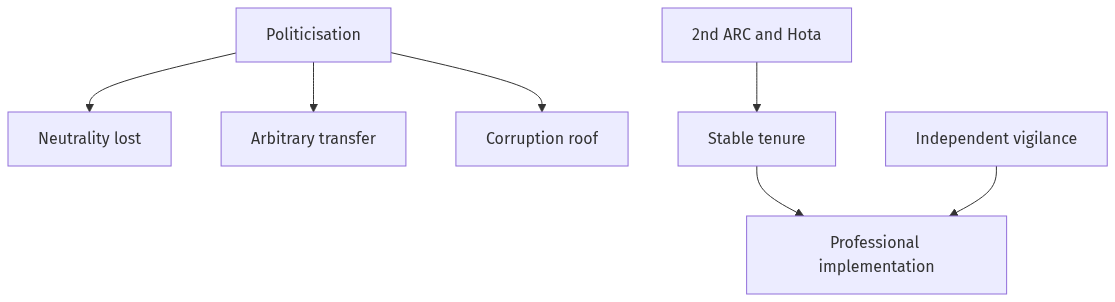
- Neutrality dies. The officer begins to ask “who benefits in the next election?” instead of “what is true in the file?”
- Transfers and humiliation become the currency. The spirit of Article 311 of the Constitution of India, which protects against arbitrary dismissal of civil servants, is mocked when the real punishment is a midnight transfer for honesty.
- Courage is punished and compliance is rewarded, so the average officer learns silence.
- Corruption finds a political roof. A Chairman who is a politician can treat a corporation as a war chest, as in the QMR tyre video.
- The opposition then tries to recruit the same officer as a weapon, which is only the other face of the same vice.
- Public interest — safe buses, fair tenders — is displaced by narrative. Passengers become extras in a party film.
- Collegiality inside the service breaks: officers are labelled by camp, and files move by faction.
- The citizen loses a referee. When both the minister and the secretary are campaigners, there is no one left to say that a tyre is unsafe.
Institutional lessons
- The Second Administrative Reforms Commission asked for a stable tenure, a civil service law, and a clearer split between policy that is political and implementation that is professional.
- The Hota Committee on civil service reforms similarly stressed domain competence, integrity and insulation of postings from arbitrary political use.
- A Civil Services Board for transfers, published transfer reasons, and a cooling-off from party office are practical ethics, not slogans.
- Vigilance must be able to take a Vinod video without waiting for the Chairman’s permission.
- Board appointments in public corporations should not make every professional MD a hostage to a single party’s whip.
Way forward
- Train officers that lawful policy of the elected government is to be implemented with energy, and that unlawful party work is to be refused in writing.
- Protect whistle-blowing through the Whistle Blowers Protection Act, 2014 in letter, not only in a speech.
- Keep the Prevention of Corruption Act, 1988 as a criminal path that does not depend on which party sent the clip.
- Ministers should own policy in public; officers should own the speaking order and the tender.
- The ethical civil servant in a politicised climate does what Vinod should do: facts to vigilance, safety to the passenger, and no theatre for either side.
Flow diagram
Conclusion
Politicisation turns the civil service into a party instrument. The ethical losses are neutrality, tenure, courage and public safety. The repair is lawful policy with professional implementation, protected tenure in spirit, and vigilance that can bite a Chairman as well as a clerk.
Quick related
Students also ask
-
Case study. Prabhat was working as Vice President (Marketing) at Sterling Electric Ltd., a reputed multinational company. But presently the company was passing through the difficult times as the sales were continuously showing downward trend in the last two quarters. His division, which hitherto had been a major revenue contributor to the company's financial health, was now desperately trying to procure some big government order for them. But their best efforts did not yield any positive success or breakthrough. His was a professional company and his local bosses were under pressure from their London-based HO to show some positive results. In the last performance review meeting taken by the Executive Director (India Head), he was reprimanded for his poor performance. He assured them that his division is working on a special contract from the Ministry of Defence for a secret installation near Gwalior and tender is being submitted shortly. He was under extreme pressure and he was deeply perturbed. What aggravated the situation further was a warning from the top that if the deal is not clinched in favour of the company, his division might have to be closed and he may have to quit his lucrative job. There was another dimension which was causing him deep mental torture and agony. This pertained to his personal precarious financial health. He was a single earner in the family with two school-college going children and his old ailing mother. The heavy expenditure on education and medical was causing a big strain to his monthly pay packet. Regular EMI for housing loan taken from bank unavoidable and any default would render him liable for severe legal action. In the above backdrop, he was hoping for some miracle to happen. There was sudden turn of events. His Secretary informed that a gentleman Subhas Verma wanted to see him as he was interested in the position of Manager which was to be filled by him in the company. He further brought to his notice that his CV has been received through the office of the Minister of Defence. During interview of the candidate-Subhash Verma, he found him technically sound, resourceful and experienced marketeer. He seemed to be well-conversant with tendering procedures and having knack of follow-up and liaising in this regard Prabhat felt that he was better choice than the rest of the candidates who were recently interviewed by him in the last few days. Subhash Verma also indicated that he was in possession of the copies of the bid documents that the Unique Electronics Ltd. would be submitting the next day to the Defence Ministry for their tender. He offered to hand over those documents subject to his employment in the company on suitable terms and conditions. He made it clear that in the process, the Sterling Electric Ltd. could outbid their rival company and get the bid and hefty Defence Ministry order. He indicated that it will be win-win situation for both-him and the company. Prabhat was absolutely stunned. It was a mixed feeling of shock and thrill. He was uncomfortable and perspiring. If accepted, all his problems would vanish instantly and he may be rewarded for securing the much awaited tender and thereby boosting company's sales and financial health. He was in a fix as to the future course of action. He was wonder-struck at the guts of Subhash Verma in having surreptitiously removing his own company papers and offering to the rival company for a job. Being an experienced person, he was examining the pros and cons of the proposal/situation and he asked him to come the next day. (a) Discuss the ethical issues involved in the case. (b) Critically examine the options available to Prabhat in the above situation. (c) Which of the above would be the most appropriate for Prabhat and why?
Next question on this syllabus topic (2022 · Q7). View answer →
-
Is implementing an elected government’s policy also politicisation?
No. That is democratic accountability. Politicisation begins when the officer is asked to break the law, hide a fraud, or campaign.
-
Can one honest MD cure a politicised corporation?
One file can still go to vigilance, as Vinod’s should. A durable cure needs tenure boards, independent vigilance and ministers who will own policy without owning the tender fraud.
Same topic · past papers
UPSC has asked this before
These previous-year questions sit on the same topic. Open one to practise the earlier ask.
-
2019 · Q8 · GS IV · 20 marks
Case study. In a modern democratic polity, there is a concept of the political executive and permanent executive. Elected people's representatives form the political executive and bureaucracy forms the permanent executive. Ministers frame policy decisions and bureaucrats execute these. In the initial decades after independence, the relationship between the permanent executive and the political executive were characterized by mutual understanding, respect, and cooperation, without encroaching upon each other's domain. However, in the subsequent decades, the situation has changed. There are instances of the political executive insisting upon the permanent executive to follow its agenda. Respect for an appreciation of upright bureaucrats has declined. There is an increasing tendency among the political executive to get involved in routine administrative matters such as transfers, posting, etc. Under this scenario, there is a definitive trend towards 'politicization of bureaucracy'. The rising materialism and acquisitiveness in social life have also adversely impacted upon the ethical values of both the permanent executive and the political executive. What are the consequences of this 'politicization of bureaucracy'? Discuss. -
2026 · Q7 · GS IV · 20 marks
Case study. Lata, a mother of two children, was admitted to a hospital for acute abdominal pain. Her sister-in-law, Sujatha, accompanied her. Dr. Mansi examined Lata and recommended a diagnostic laparoscopy. Lata's consent was taken to conduct the medical procedure under general anesthesia. During the laparoscopy, Dr. Mansi's team discovered a tumor in Lata's uterus. A closer examination suggested that the tumor could be malignant. One option before Dr. Mansi was to extract a sample for biopsy. In that case, if the tumor was malignant, Lata would have to undergo another surgery for removal of the uterus. An alternative was to remove the uterus immediately. Dr. Mansi had to take a quick decision. As Lata was under general anesthesia, Dr. Mansi explained the situation to Sujatha. Sujatha agreed with Dr. Mansi's recommendations for a hysterectomy, wherein Lata's uterus would be removed to avoid the risk and pain of undergoing another surgery. Dr. Mansi removed Lata's uterus after receiving Sujatha's consent in writing. Lata was informed of this the next day. She was very upset and felt betrayed as she had not consented to the removal of her uterus. Lata complained to the police who tried to convince her that Dr. Mansi had acted with good intention to help a patient. Sujatha was of the same opinion, however Lata was not convinced and decided to approach the court. (a) Discuss the ethical issues involved in this case. (b) Discuss the moral conduct of the doctor in this situation. -
2026 · Q8 · GS IV · 20 marks
Case study. Ravi is a senior police officer with vast experience in riot control and cyber-policing. Since one year, he has been the Superintendent of Police (SP) of a district with a history of frequent rioting. Last year, Ravi had sought installation of an AI enabled software for predictive policing. This system has been operational for approximately six months. This new system employs advanced algorithms for capturing the biometric data of persons in a crowd and swiftly relating it to a data library. This has enabled the police to identify the persons involved in various crimes. The system has identified an immigrant and low-income neighbourhood as a centre for gang violence and drug trafficking. Aided by this AI analysis, the local police has focused its patrolling, preventive detentions and establishing checkpoints. Consequently, public order and law enforcement has visibly improved. Last week, some community leaders, civil rights lawyers and human rights activists visited Ravi's office. They submitted a memorandum that the new system is faulty as it is based on incorrect historical data caused by social biases and discriminatory policing. The memorandum also alleges that the increased surveillance has created a climate of tension amongst residents. This feeling is aggravated by the fact that the residents are not aware of the data noted against their names. (a) What are the ethical issues including biases involved in the use of AI in data-driven policing? (b) Place yourself in Ravi's role and discuss the alternatives available. Justify the action that optimises compliance with ethics. -
2026 · Q9 · GS IV · 20 marks
Case study. Seema is a senior bureaucrat with a reputation of honesty and professional efficiency. She has recently been posted as the District Collector (DC) to Surinder Nagar, where a large industrial area is being established. The new industrial area had caused many farmers to submit applications for change of land use (CLU) to convert their farmlands into residential areas. There is an unusually large backlog of these applications awaiting processing. Seema noticed that some applications had been approved selectively with no visible chronological pattern. The case files showed a few complaints of some approvals being subject to receipt of large bribes from the applicants. On further fact-finding, Seema realized that a small group of touts was controlling this illegal activity through some subordinate officials in the Collectorate. This had created a fear in the other employees who were reluctant to process any application. The resultant backlog has been piling up thereby hindering local economic progress and causing public dissatisfaction. Seema was faced with a major moral and administrative challenge of dismantling this corruption network without hampering daily administrative operations. An aggressive internal investigation would result in institutional resistance and, possibly, a backlash from labour unions. Conversely, ignoring this situation would encourage the wrongdoers and unnecessarily continue this avoidable harassment to the populace. (a) What are the ethical issues involved in this case? (b) Discuss the options open to Seema. Identify the recommended option and justify it. -
2026 · Q11 · GS IV · 20 marks
Case study. Rajapuram is a border district. Jhara and Biru, its two major communities are in continual conflict with each other. The social fabric is fractured and demands mending. Ethnic tensions between the two communities have erupted into violence resulting in a large number of deaths. The stated causes are conflicting land claims, uneven resource allocation and inadequate political representation in government bodies. Separate relief camps had to be created for the two communities. The situation is volatile and appears to be getting out of control. Rajan has been appointed the District Magistrate (DM) of Rajapuram and tasked to quickly get the situation under control. His immediate tasks include restoring administrative authority, reopening the highway and initiating peace talks. On taking over his appointment, Rajan realized that the inter-community rivalry had even seeped into the local administration and police. With functional neutrality being the immediate casualty, it had made both communities distrustful of the government. The neighbouring country could utilize the opportunity to spur insurgent activity and further aggravate the situation. Rajan favoured a controlled approach starting with opening the highway to restore food and medical supplies. He toyed with the idea of requisitioning CRPF units to help restore administrative control. (a) Discuss the ethical issues that need to be addressed in this case. (b) What are the options open to Rajan? Which option would ensure protection of his non-partisan image without compromising ethics?
More from this topic
Q12 · UPSC Mains 2026 · GS IV · 20 marks · Solution
Case study. Ajit has been recently promoted as the Head of the Department of Weapon Sales (DWS) in the Ministry of Defence Production (MDP). His charter of duties includes international sales of weapons produced domestically by MDP. In two recent wars, MDP weapons have performed admirably, resulting in many countries showing interest in buying them, particularly long-range artillery and missiles. Country A and country B have asked for these weapons. However, production constraints restrict DWS to accept only one purchase order. Country A is a developing nation with a sound technology base. MDP is planning R&D collaboration with it for the next generation of weapons. It is not part of any security alliance and needs weapons for protection from a troublesome neighbour. It seeks a large acquisition on a long-term loan. Country B is also a developing nation. Military strength is its priority, with the military budget often ingressing into allocations for human resources and infrastructure development. It is in security alliance with a superpower who has a large military base there and periodically allots it financial grants. It is a member of an economic bloc with which the government is currently negotiating a free trade agreement. It is not a signatory of NPT but possesses smaller nuclear weapons and delivery systems. It supports some guerrilla forces abroad. It has sought a smaller acquisition and is prepared to make some advance payment. It is currently negotiating arms purchases from another nation too. Ajit discussed this case with his counterparts in the related departments. Therein, the significant economic benefits, employment generation and stronger diplomatic relations arising from this sale were highlighted. It was also emphasized that refusing the deal could result in country B purchasing weapons from some other supplier. Ajit was aware that in arms sales, due diligence at each stage was pivotal to ensure conformity to national policy and international treaties. (a) Discuss the options available to Ajit. Which option should he select and why? (b) How can Ajit balance nation's economic and strategic interests with ethical considerations?
Ethics Case Studies
This case study examines ethical dilemma in defense exports, balancing economic gains, strategic partnerships, and non-proliferation norms. Ajit must choose between Country A for R&D collaboration and self-reliance, or Country B for immediate financial gains and FTA leverage. The recommended course prioritizes long-term strategic security, technological synergy, and international humanitarian norms over short-term mercantile interests.
Q11 · UPSC Mains 2026 · GS IV · 20 marks · Solution
Case study. Rajapuram is a border district. Jhara and Biru, its two major communities are in continual conflict with each other. The social fabric is fractured and demands mending. Ethnic tensions between the two communities have erupted into violence resulting in a large number of deaths. The stated causes are conflicting land claims, uneven resource allocation and inadequate political representation in government bodies. Separate relief camps had to be created for the two communities. The situation is volatile and appears to be getting out of control. Rajan has been appointed the District Magistrate (DM) of Rajapuram and tasked to quickly get the situation under control. His immediate tasks include restoring administrative authority, reopening the highway and initiating peace talks. On taking over his appointment, Rajan realized that the inter-community rivalry had even seeped into the local administration and police. With functional neutrality being the immediate casualty, it had made both communities distrustful of the government. The neighbouring country could utilize the opportunity to spur insurgent activity and further aggravate the situation. Rajan favoured a controlled approach starting with opening the highway to restore food and medical supplies. He toyed with the idea of requisitioning CRPF units to help restore administrative control. (a) Discuss the ethical issues that need to be addressed in this case. (b) What are the options open to Rajan? Which option would ensure protection of his non-partisan image without compromising ethics?
Ethics Case Studies
This GS4 case study examines the ethical dilemmas faced by a District Magistrate in managing an ethnic conflict in a sensitive border district. It analyses the ethical issues involving neutrality, human life, security, and institutional trust. It evaluates options ranging from purely coercive measures to inclusive peace-building. The recommended approach balances administrative firmness with transparent, unbiased stakeholder engagement to uphold public service values.
Q10 · UPSC Mains 2026 · GS IV · 20 marks · Solution
Case study. Vikas is a government officer with over a decade of service in public administration. He has recently moved as the District Collector (DC) of Nainipura, a remote hilly district bordering a forest. Due to Nainipura's low levels of economic development, one of his major duties is to ensure proper functioning of the public distribution system (PDS) amongst the economically weaker sections (EWS). During his on-site visits, Vikas was apprised of a typical administrative challenge in operating the PDS. To prevent leakages, all distributors were required to carry out real-time biometric identification of the beneficiaries, whose fingerprints were tallied with identity card records. This was creating problems as the operating system sometimes rejected fingerprint matching in the cases of growing children, manual labourers and senior citizens. The problem was further compounded in periods of low WIFI connectivity. The distributors, in such cases, resorted to personal discretion when they could identify the recipient. Vikas had to address this problem on priority. Strictly adhering to 'government regulations' would ensure fiscal probity but would greatly trouble the proposed beneficiary, i.e., EWS. It may even impinge on their fundamental right to life as per Article 21 of the Constitution. Conversely, leaving the resolution solely to the discretion of the distributors could lead to misuse and leakages. (a) What are the options open to Vikas? How should he balance fiscal probity with empathy towards the designated beneficiaries? (b) Discuss the ethics of using technology as a gatekeeper for welfare schemes.
Ethics Case Studies
• Balance strict digital rules with human empathy to prevent vulnerable citizens from losing entitled rations due to technical failures. • Avoid extreme approaches like rigid enforcement (causing exclusion) or unchecked discretion (causing leakage and corruption). • Implement practical offline workarounds like manual registers, paper slips, or OTPs backed by periodic audits. • Treat procedural norms and technology as tools for human welfare rather than rigid ends in themselves. • Recognize that digital gatekeeping creates ethical tensions between fiscal efficiency and the exclusion of genuine beneficiaries. • Guard against technology violating human dignity by forcing vulnerable groups to repeatedly prove their identity against system errors. • Ensure administrative accountability so systemic technological failures are not unfairly blamed on the citizens.