
Revision summary
Terrorism is political violence meant to frighten civilians and coerce a state. India has faced it in Kashmir, in city bombings such as 26/11, in small hinterland modules, and online. Some Northeast and Khalistani violence uses the same methods. Counters include UAPA and the NIA, intelligence fusion, NSG, border and coastal security, and terror-finance rules. Politics and deradicalisation lag force; rights costs of broad laws remain a live issue.
Model answer
Copper italics in this answer — like this — are the key facts. Each one is unpacked in the Facts & figures rail.
Introduction
Terrorism is the deliberate use of violence or intimidation to pursue political, ideological or strategic objectives. In India, it has manifested through cross-border terrorism, insurgency, separatism, urban terror and emerging forms such as cyber-enabled radicalisation, making it both a national-security and socio-economic challenge.
Body
Manifestation of Terrorism in India
- Cross-border & State-sponsored terrorism: External actors use proxy groups to conduct asymmetric attacks against India, particularly in Jammu & Kashmir.
- Example: Pahalgam attack (2025) demonstrated the continuing threat of targeted terrorist violence against civilians.
- Example: Reasi attack (2024) targeted pilgrims and adversely affected public confidence and tourism.
- Left-Wing Extremism (LWE): Maoist groups exploit governance deficits, tribal alienation and socio-economic grievances to sustain armed insurgency in parts of central India.
- Example: Bijapur attack (2025), in which Naxalites killed security personnel and a civilian driver, highlighted the continuing tactical threat.
- Separatist & insurgent movements: Ethnic, political and historical grievances have fuelled insurgencies in parts of the Northeast, involving groups such as ULFA and NSCN-IM.
- Narco-terrorism: Terrorist and insurgent groups exploit illicit drug trafficking to generate funds for arms procurement and violent activities.
- Example: India's proximity to the Golden Crescent and Golden Triangle increases its vulnerability to drug-terror networks.
- Technology-enabled terrorism: Terrorist organisations increasingly exploit drones, social media, encrypted platforms and cryptocurrencies for infiltration, recruitment, propaganda and financing.
- Example: 2021 Jammu drone attack demonstrated the use of drones for terrorist attacks.
- Example: Cyber attacks on Critical Information Infrastructure (CII) highlight the emerging non-kinetic dimension of terrorism.
- Hybrid and lone-wolf terrorism: Individuals with limited or no prior criminal records can be radicalised online and activated for isolated attacks, making conventional intelligence-based detection more difficult.
Counter-Measures Adopted by the State
- Institutional architecture: India has developed specialised institutions for investigation, intelligence and coordinated counter-terrorism.
- NIA: Investigates and prosecutes terrorism-related offences under the NIA Act, 2008.
- MAC: Facilitates intelligence sharing and coordination among Central and State agencies.
- NATGRID: Enables integrated analysis of multiple databases to support intelligence and security investigations.
- FIU-IND: Tracks suspicious financial transactions to disrupt terror financing.
- Legal framework: The UAPA provides the principal legal framework for dealing with unlawful and terrorist activities.
- Example: The 2019 amendment enabled the government to designate individuals as terrorists and strengthened investigative powers.
- Border and operational security: India has strengthened border surveillance, coastal security, intelligence-led operations and counter-infiltration mechanisms to prevent terrorist movement and arms smuggling.
- Counter-drone and technological capabilities: Security agencies increasingly deploy drone detection, surveillance systems, cyber-security tools and intelligence databases against emerging threats.
- Terror-financing disruption: Financial intelligence, PMLA-based controls, FATF-aligned mechanisms and action against illicit networks are used to disrupt the flow of funds to terrorist organisations.
- Counter-LWE strategy: The SAMADHAN approach combines intelligence, technology, security operations and development to address the multiple dimensions of Left-Wing Extremism.
- Development and community engagement: Security measures are complemented by development, rehabilitation, civic action and community participation to address conditions that facilitate radicalisation and insurgency.
- Example: Operation Sadbhavna focuses on improving public trust and strengthening civil-military engagement in affected areas.
- Intelligence fusion: Strengthen real-time information sharing between Central, State and local agencies.
- Terror–crime nexus: Disrupt the link between terrorism, organised crime, narcotics and illicit finance.
- Digital prevention: Develop stronger capabilities for online radicalisation detection and counter-narratives while protecting constitutional freedoms.
- Whole-of-society approach: Combine security, development, rehabilitation and community participation rather than relying only on coercive measures.
- Strengthen intelligence fusion between Central and State agencies.
- Disrupt the terror–organised crime–narco-finance nexus.
- Improve online counter-radicalisation while protecting constitutional freedoms.
- Combine security measures with development, dialogue and community participation.
Flow diagram
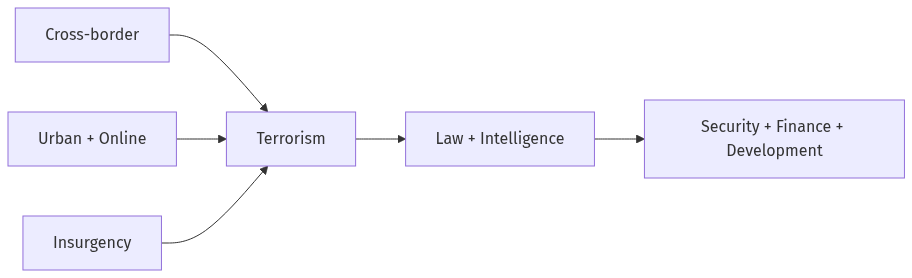
Conclusion
India's counter-terrorism strategy must move from merely reacting to attacks towards preventing radicalisation, financing and infiltration. A combination of UAPA–NIA architecture, intelligence fusion, FATF-aligned financial controls, technology and “Hearts and Minds” approaches can help secure India while preserving democratic rights and social cohesion.
Quick related
Students also ask
-
Explain how narco-terrorism has emerged as a serious threat across the country. Suggest suitable measures to counter narco-terrorism.
Next question on this syllabus topic (2024 · Q9). View answer →
-
Is every insurgency terrorism?
Insurgency can target the state. Terrorism as a method is the choice to kill civilians for effect. The overlap is real; the words are not identical.
-
Can a democracy end terrorism only with talks?
Talks matter for political causes. They do not replace intelligence against a cell that wants a camera, not a table.
Same topic · past papers
UPSC has asked this before
These previous-year questions sit on the same topic. Open one to practise the earlier ask.
More from this topic
Q10 · UPSC Mains 2026 · GS III · 10 marks · Solution
Ladakh is strategically located between China and Pakistan. As a measure to win hearts and minds of locals, discuss the Border Area Development Programmes (BADP) by the Central Government and civic actions by the Army. Also discuss demand of promulgation of provision of the Sixth Schedule of the Constitution for Ladakh.
Border Security and Organised Crime
• **Strategic Location:** Ladakh sits between China and Pakistan, making local civilian support vital for national security in this sensitive frontier. • **BADP Focus:** The Border Area Development Programmes bridge remote infrastructure gaps by funding schools, health centres, and local connectivity. • **Livelihood Growth:** BADP aims to reduce regional imbalances by empowering remote border habitations with sustainable economic opportunities. • **Army Civic Action:** Through Sadbhavana projects, the Indian Army builds local trust via healthcare camps, skill centres, and educational support. • **Humanitarian Aid:** The military provides vital winter stocking, high-altitude disaster relief, and youth engagement tours in isolated valleys. • **Sixth Schedule Demand:** Locals demand Sixth Schedule status to protect indigenous Ladakhi culture, land ownership, and demographic identity. • **Autonomous Governance:** This constitutional demand seeks to empower Hill Councils with greater legislative and financial decision-making powers.
Q19 · UPSC Mains 2024 · GS III · 15 marks · Solution
India has a long and troubled border with China and Pakistan, fraught with contentious issues. Examine the conflicting issues and security challenges along the border. Also give out the development being undertaken in these areas under the Border Area Development Programme (BADP) and Border Infrastructure andManagement (BIM) Scheme.
Border Security and Organised Crime
With Pakistan the live issues are the LoC, PoK, Sir Creek, Siachen, infiltration and drone-aided terror or narcotics. With China the issues are an undelimited LAC, Aksai Chin, Arunachal, patrol face-offs and a roads-and-villages race after Galwan 2020. A two-front stress is the strategic envelope. BADP funds border-block development so hamlets do not empty. BIM funds fencing, lighting, BOPs, roads and surveillance; it must not reduce the border resident to a cleared field of fire.
Q9 · UPSC Mains 2024 · GS III · 10 marks · Solution
Explain how narco-terrorism has emerged as a serious threat across the country. Suggest suitable measures to counter narco-terrorism.
Border Security and Organised Crime
Narco-terrorism is drug profit and drug routes used to fund terror and organised violence. India is exposed on the Pakistan–Afghanistan side and the Myanmar–Northeast side, now including drone drops and synthetic drugs. Punjab, J&K and the Northeast are the hardest-hit belts; highways and parcels move the inland trade. Measures: border and drone defence, NCB–ED–NIA money trails, precursor control, de-addiction, and UNODC-style cooperation. Rights-compliant seizures and a clear line between addict and financier keep the strategy legitimate.