
Revision summary
UNSC reform needs P5 ratification (Article 108); Intergovernmental Negotiations still lack an agreed text. G4, Uniting for Consensus and the Ezulwini African claim block one another. US vetoes and Russo-Chinese blocking on Ukraine, Gaza and other files show East–West (and North–South) entanglement. The quote is right on deadlock; it underplays African and Latin American vetoes on who joins. Practical movement: longer elected seats, veto restraint on atrocities, GA strength — not a speech about imminent permanency.
Model answer
Copper italics in this answer — like this — are the key facts. Each one is unpacked in the Facts & figures rail.
Introduction
The UN reform process, particularly UNSC reform, remains stalled because the post-1945 distribution of power no longer reflects contemporary geopolitical realities. The East–West confrontation, increasingly expressed through rivalry among the USA, Russia and China, combines with competing Global South claims to produce institutional paralysis.
Body
How East–West Confrontation Blocks UN Reform
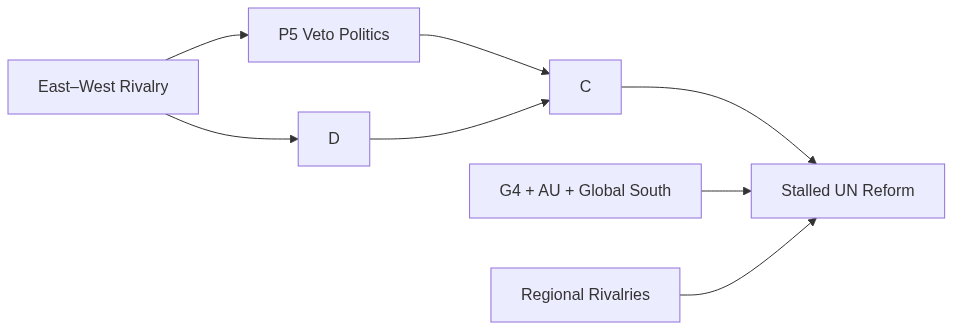
- 1. Veto power preserves the status quo: The P5 can block substantive decisions, while Article 108 requires ratification by all permanent members for Charter amendment. Thus, those benefiting from the existing order effectively possess a veto over its restructuring.
- 2. USA vs Russia-China strategic rivalry: The US, Russia and China increasingly use the UNSC as an arena of geopolitical contestation. Russia's vetoes on Ukraine-related matters and the US veto on Gaza ceasefire resolutions illustrate how major-power rivalry translates into Council paralysis.
- 3. Sanctions and monitoring disputes: US–Russia–China disagreements have weakened UN mechanisms, including disputes over sanctions regimes and the North Korea sanctions-monitoring mechanism, reducing the Council's enforcement capacity.
- 4. Reform negotiations remain politically controlled: Major powers can slow or narrow the Intergovernmental Negotiations (IGN) process, preventing the emergence of a concrete consensus on Council expansion.
Why the Deadlock Is Not Only an East–West Problem
- 1. Competing reform coalitions: The G4 — India, Brazil, Germany and Japan — support expansion of permanent and non-permanent seats, while the Uniting for Consensus (UfC) group opposes new permanent members and prefers elected seats.
- 2. Global South representation deficit: The African Union's Ezulwini Consensus demands two permanent African seats with veto rights. Therefore, the problem is also one of North–South representation, not simply USA versus Russia-China.
- 3. Regional rivalries: Even if P5 confrontation reduced, disagreements among potential beneficiaries would remain. Hence, the question is not merely who opposes reform, but also who should be included and on what terms.
Critical Evaluation
- 1. Institutional paralysis: Persistent veto politics obstruct comprehensive reform and weaken the Council's ability to respond collectively to crises such as Ukraine, Gaza and Sudan.
- 2. Declining legitimacy: The continued dominance of the same five permanent members makes the UNSC appear unrepresentative of the contemporary international order, particularly to developing countries.
- 3. Rise of alternative forums: Deadlock encourages countries to rely more heavily on G20, BRICS, regional organisations and issue-based coalitions, thereby weakening the centrality of the UN system.
- 4. Some scope for incremental reform: The UNGA Veto Initiative, which triggers a General Assembly debate after a UNSC veto, increases political scrutiny of P5 behaviour.
- 5. Pragmatic reform: Measures such as longer-term elected seats, voluntary veto restraint during mass atrocities, greater participation of elected members and cross-regional compromises can build momentum even without immediate Charter reform.
Flow diagram
Conclusion
The East–West confrontation is a major cause of the UN reform stalemate, but not its sole cause. The deeper problem is the interaction of P5 power rivalry, veto politics, Global South representation demands and regional disagreements. Meaningful reform therefore requires broader representation, greater institutional accountability and incremental consensus-building so that the UN can become more representative, legitimate and effective.
Quick related
Students also ask
-
'Terrorism has become a significant threat to global peace and security.' Evaluate the effectiveness of the United Nations Security Council's Counter Terrorism Committee (CTC) and its associated bodies in addressing and mitigating this threat at the international level.
Next question on this syllabus topic (2024 · Q19). View answer →
-
Would India on the P5 unfreeze the Council?
It would make the table fairer. It would not end vetoes. A sixth or seventh veto can also paralyse.
-
Is the UN useless until reform?
The Council fails on P5 wars. Humanitarian agencies, peacekeeping where there is consent, and treaty bodies still work. That split is the organisation’s truth.
Same topic · past papers
UPSC has asked this before
These previous-year questions sit on the same topic. Open one to practise the earlier ask.
More from this topic
Q19 · UPSC Mains 2024 · GS II · 15 marks · Solution
'Terrorism has become a significant threat to global peace and security.' Evaluate the effectiveness of the United Nations Security Council's Counter Terrorism Committee (CTC) and its associated bodies in addressing and mitigating this threat at the international level.
International Institutions
The Security Council’s Counter-Terrorism Committee was born of Resolution 1373 to monitor the global counter-terror legal order. The Executive Directorate, the 1267 ISIL/Al-Qaida sanctions, and Resolution 1540 form the associated cluster. Gains: binding duties, listings, capacity visits, aviation and finance norms. Limits: no common definition, permanent-member naming politics, rights abuse, new financing tech, no army. The Financial Action Task Force is separate and often hurts more than a Committee letter. The machine is a floor of laws, not a cure for a divided Council.
Q16 · UPSC Mains 2020 · GS II · 15 marks · Solution
"The incidence and intensity of poverty are more important in determining poverty based on income alone". In this context analyze the latest United Nations Multidimensional Poverty Index Report.
International Institutions
Income poverty ignores overlapping deprivations; MPI multiplies incidence by intensity. Global MPI 2020 (UNDP/OPHI) used health, education and living-standard indicators with a one-third cut-off. About 1.3 billion people were MPI-poor globally, many of them children, concentrated in South Asia and Africa. India had large MPI reductions but a still-large rural and high-intensity residual. COVID-19 was flagged as a shock that could reverse gains even if 2019 income looked better.
Q19 · UPSC Mains 2018 · GS II · 15 marks · Solution
What are the key areas of reform if the WTO has to survive in the present context of 'Trade War', especially keeping in mind the interest of India? (15).
International Institutions
US–China tariffs and the Appellate Body vacancy turned WTO politics into a trade war of power. Survival requires restoring two-tier dispute settlement and limiting security-exception abuse. India’s red lines are public stockholding, SSM, and livelihood-sensitive fisheries rules. Special and differential treatment, Mode 4 services and TRIPS health flexibilities must stay. Plurilateral e-commerce and investment rules should not replace consensus to India’s cost.