
Revision summary
The Security Council’s Counter-Terrorism Committee was born of Resolution 1373 to monitor the global counter-terror legal order. The Executive Directorate, the 1267 ISIL/Al-Qaida sanctions, and Resolution 1540 form the associated cluster. Gains: binding duties, listings, capacity visits, aviation and finance norms. Limits: no common definition, permanent-member naming politics, rights abuse, new financing tech, no army. The Financial Action Task Force is separate and often hurts more than a Committee letter. The machine is a floor of laws, not a cure for a divided Council.
Model answer
Copper italics in this answer — like this — are the key facts. Each one is unpacked in the Facts & figures rail.
Introduction
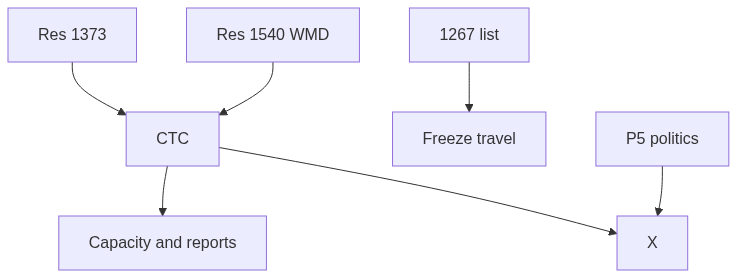
After 11 September 2001 the Security Council used Chapter VII to tell every State to starve terrorists of money, haven and arms (Resolution 1373). The Counter-Terrorism Committee was created to watch that order. Associated bodies — the Executive Directorate, the ISIL and Al-Qaida sanctions list, Resolution 1540 on weapons of mass destruction — built a global bureaucracy of lists. The threat is real. The effectiveness is partial, political and paper-heavy.
Body
The machine
1373 is binding on all United Nations members, not only on a few treaty parties.
- Peg: The Committee and its Executive Directorate assess laws, visit with consent, and match needy States with donors for border, aviation and financial capacity.
- Peg: The 1267 / 1989 / 2253 list still constrains travel and freezes assets of named ISIL and Al-Qaida affiliates.
- Peg: Resolution 1540 covers non-State access to weapons of mass destruction — a related but distinct file.
- Peg: Financial Action Task Force standards rhyme with this architecture and often bite harder on banks.
What it does well
Some plots have been made harder. That is not nothing.
- Peg: A worldwide legislative checklist now exists where, before 2001, many States had no terror-finance offence.
- Peg: Aviation security and passenger-name norms moved because Council pressure met the International Civil Aviation Organization.
- Peg: Capacity visits and donor matching are the unglamorous half of mitigation.
What it cannot do
The Committee is a committee of a divided Council.
- Peg: There is no agreed United Nations definition of terrorism; one State’s fighter is another’s listed name.
- Peg: Permanent-member politics decide when a listing moves; the Committee does not command troops and cannot stop a client of a veto.
- Peg: Special rapporteurs keep warning that 1373 was used to crush dissent; financing has moved to crypto, hawala and social media faster than listing cycles.
- Peg: Lone actors sit awkwardly on an ISIL-shaped list; regional organisations do the arrests. Effectiveness is high on the legislative checklist, medium on capacity, low on the politics of naming.
Flow diagram
Conclusion
The Counter-Terrorism Committee and its cluster built a worldwide legal floor after 1373. They help States write laws and freeze some names. They do not define terrorism, command force, or override a veto. Against a significant threat, that is useful infrastructure — not a victory.
Quick related
Students also ask
-
"The incidence and intensity of poverty are more important in determining poverty based on income alone". In this context analyze the latest United Nations Multidimensional Poverty Index Report.
Next question on this syllabus topic (2020 · Q16). View answer →
-
Can the Counter-Terrorism Committee sanction a State that sponsors terrorism?
The Security Council can. The Committee itself mainly monitors 1373. Sanctions are a separate, political Council act.
-
Is the Financial Action Task Force part of the Committee?
No. It is a separate standard-setter. Its grey lists often hurt more than a Committee letter.
Same topic · past papers
UPSC has asked this before
These previous-year questions sit on the same topic. Open one to practise the earlier ask.
More from this topic
Q20 · UPSC Mains 2025 · GS II · 15 marks · Solution
"The reform process in the United Nations remains unresolved, because of the delicate imbalance of East and West and entanglement of the USA vs. Russo-Chinese alliance." Examine and critically evaluate the East-West policy confrontations in this regard.
International Institutions
UNSC reform needs P5 ratification (Article 108); Intergovernmental Negotiations still lack an agreed text. G4, Uniting for Consensus and the Ezulwini African claim block one another. US vetoes and Russo-Chinese blocking on Ukraine, Gaza and other files show East–West (and North–South) entanglement. The quote is right on deadlock; it underplays African and Latin American vetoes on who joins. Practical movement: longer elected seats, veto restraint on atrocities, GA strength — not a speech about imminent permanency.
Q16 · UPSC Mains 2020 · GS II · 15 marks · Solution
"The incidence and intensity of poverty are more important in determining poverty based on income alone". In this context analyze the latest United Nations Multidimensional Poverty Index Report.
International Institutions
Income poverty ignores overlapping deprivations; MPI multiplies incidence by intensity. Global MPI 2020 (UNDP/OPHI) used health, education and living-standard indicators with a one-third cut-off. About 1.3 billion people were MPI-poor globally, many of them children, concentrated in South Asia and Africa. India had large MPI reductions but a still-large rural and high-intensity residual. COVID-19 was flagged as a shock that could reverse gains even if 2019 income looked better.
Q19 · UPSC Mains 2018 · GS II · 15 marks · Solution
What are the key areas of reform if the WTO has to survive in the present context of 'Trade War', especially keeping in mind the interest of India? (15).
International Institutions
US–China tariffs and the Appellate Body vacancy turned WTO politics into a trade war of power. Survival requires restoring two-tier dispute settlement and limiting security-exception abuse. India’s red lines are public stockholding, SSM, and livelihood-sensitive fisheries rules. Special and differential treatment, Mode 4 services and TRIPS health flexibilities must stay. Plurilateral e-commerce and investment rules should not replace consensus to India’s cost.