
Revision summary
Lok Adalat is a Legal Services Authorities Act forum: conciliation, award as a decree, generally no appeal. It hears civil matters and compoundable criminal cases, not non-compoundable crime. Arbitration is contractual under the 1996 Act: civil-commercial disputes, Section 34 challenge, no criminal trial. Booz Allen and Vidya Drolia mark what cannot be sent to a private tribunal. Permanent Lok Adalats for public utilities are a statutory hybrid, still not private arbitration. The working distinction is public compromise at little cost versus paid private adjudication.
Model answer
Copper italics in this answer — like this — are the key facts. Each one is unpacked in the Facts & figures rail.
Introduction
Lok Adalats and arbitration tribunals both sit outside the regular civil court queue. They are not twins. One is a statutory, conciliatory public forum under the Legal Services Authorities Act, 1987. The other is a consensual private court under the Arbitration and Conciliation Act, 1996. What they may hear, including crime, follows from that difference.
Body
Lok Adalat
A Lok Adalat is a Legal Services Authority sitting, not a hired private bench.
- Peg: Article 39A and the 1987 Act authorise Authorities to organise Lok Adalats of sitting or retired judges and other persons.
- Peg: The method is compromise; if parties agree, the award is a civil court decree, generally not appealable, though a fresh suit on limited grounds can remain.
- Peg: If they do not agree, the case goes back to the parent court; there is no forced private verdict.
- Peg: Permanent Lok Adalats for public-utility services can decide some matters on merits if conciliation fails — a statutory hybrid, still not private arbitration.
Arbitration tribunals
Arbitration exists only if the parties have a contract to arbitrate.
- Peg: Parties choose the seat, the rules and the arbitrators under the Arbitration and Conciliation Act, 1996.
- Peg: The dispute must be arbitrable; Booz Allen and Hamilton v. SBI Home Finance and Vidya Drolia v. Durga Trading keep criminal guilt, matrimonial status, insolvency and some tenancy and trust disputes out because they affect the public or third parties.
- Peg: The award binds the parties; challenge is a Section 34 set-aside petition, not a full appeal on facts.
- Peg: Consumer and labour forums have their own statutes; they are not arbitral tribunals unless a statute says so.
Civil and criminal coverage
The criminal question is answered by compoundability, not by the word “tribunal”.
- Peg: Lok Adalats routinely take civil claims — money, partition, agreed matrimonial settlements, motor-accident compensation, bank recovery — and may take only compoundable criminal offences.
- Peg: Murder, rape and other non-compoundable felonies cannot be bargained away in a Lok Adalat.
- Peg: An arbitral tribunal does not try a criminal charge or convict; a parallel prosecution may go on, but the award cannot replace a criminal court.
Flow diagram
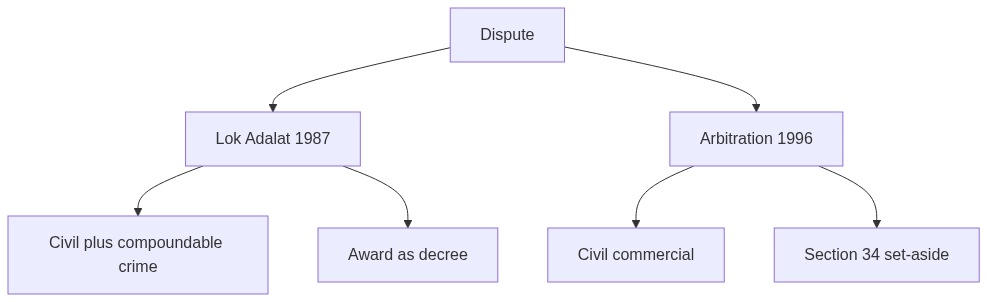
Conclusion
Lok Adalats settle civil and compoundable criminal matters by consent under the 1987 Act. Arbitration decides civil-commercial disputes by agreement under the 1996 Act. Neither is a criminal court for non-compoundable offences.
Quick related
Students also ask
-
Judicial Legislation is antithetical to the doctrine of separation of powers as envisaged in the Indian Constitution. In this context justify the filing of large number of public interest petitions praying for issuing guidelines to executive authorities.
Next question on this syllabus topic (2020 · Q12). View answer →
-
Can a rape or murder case go to Lok Adalat?
No. Those offences are not compoundable. A Lok Adalat cannot quash that prosecution by compromise.
-
Is a Permanent Lok Adalat an arbitral tribunal?
No. It is a statutory public-utility body under the 1987 Act, with a limited power to decide if conciliation fails.
Same topic · past papers
UPSC has asked this before
These previous-year questions sit on the same topic. Open one to practise the earlier ask.
More from this topic
Q14 · UPSC Mains 2026 · GS II · 15 marks · Solution
Examine how the separation of powers is practised in India compared to the rigid presidential model of the United States of America. In this context, compare the actual authority of the Indian Prime Minister with that of the President of the USA.
Separation of Powers
• India follows a parliamentary system with functional overlap between the executive and legislature, unlike the US presidential model. • The US Constitution enforces a rigid separation of powers, where the President is elected independently and cannot dissolve Congress. • In India, the executive (Council of Ministers) is drawn from the legislature and remains collectively responsible to the Lok Sabha under Article 75. • The Indian Supreme Court exercises wide judicial review and enforces the Basic Structure doctrine to check legislative and executive overreach. • The US President uses veto powers, while the Senate checks executive authority through appointment confirmations and treaty ratifications. • The Indian Prime Minister rules as 'first among equals' with majority parliamentary support, whereas the US President holds supreme, independent executive command.
Q12 · UPSC Mains 2020 · GS II · 15 marks · Solution
Judicial Legislation is antithetical to the doctrine of separation of powers as envisaged in the Indian Constitution. In this context justify the filing of large number of public interest petitions praying for issuing guidelines to executive authorities.
Separation of Powers
Indian separation of powers is checks and balances with a justiciable Part III, not a sealed legislative monopoly. Guidelines that mimic a statute sit uneasily with Article 245 if they become permanent. Vishaka and D.K. Basu justified PIL guidelines as interim rights protection until Parliament or the executive acted. Volume of PILs tracks executive failure on police, environment and welfare as much as judicial overreach. Justification holds only if courts retreat when a competent law occupies the field and throw out frivolous petitions.
Q1 · UPSC Mains 2019 · GS II · 10 marks · Solution
Do you think that constitution of India does not accept principle of strict separation of powers rather it is based on the principle of 'checks and balance'? Explain.
Separation of Powers
India does not follow a rigid American separation of powers. Ram Jawaya Kapur (1955) treated the Cabinet as part of a parliamentary legislature. Articles 13, 32 and 226, charged judicial salaries, and a hard removal process are mutual checks. Kesavananda and Minerva Mills keep judicial review inside the basic structure. The design is checks and balances, not sealed branches.