
Revision summary
• Tundra regions have permafrost, low biodiversity and very slow ecological recovery. • Permafrost thaw can release methane and carbon dioxide. • Arctic amplification makes these regions highly climate-sensitive. • Oil, gas, nickel, palladium and other minerals create strong economic interest. • The Northern Sea Route shows the commercial value of melting Arctic ice. • Indigenous livelihoods are central to tundra geography, not a side issue. • Development must be selective, consent-based and tightly regulated.
Model answer
Copper italics in this answer — like this — are the key facts. Each one is unpacked in the Facts & figures rail.
Introduction
Tundra regions are found mainly around the Arctic margins of Alaska, Canada, Greenland, Scandinavia and Siberia, with smaller alpine tundra in high mountains. The same regions also contain oil, gas, minerals, fisheries, shipping routes and indigenous livelihoods. So the statement is correct, but it must be examined critically because economic use can damage a system that recovers very slowly.
Body
Core Explanation
Permafrost Carbon Store: Tundra soils remain frozen for long periods and store huge amounts of organic carbon. When permafrost thaws, this old organic matter begins to decompose and releases carbon dioxide and methane. That turns local warming into a global climate feedback. Permafrost Carbon Store anchors the discussion in concrete evidence rather than a general claim. It shows how cold soils, short growing seasons, ice, carbon and slow biological recovery make small disturbances last for decades in practice. The setting includes Himalayan cryosphere lessons, Arctic shipping interest, energy security and climate negotiations, giving the point clear place, time and Indian weight. But keep the caution: economic value is real, but extraction in tundra regions carries global climate and indigenous livelihood costs.
- Eg: Thawing permafrost in Siberia and Alaska is linked with methane release, ground collapse and damage to roads and pipelines.
Arctic Amplification: The Arctic is warming faster than the global average because sea ice loss reduces albedo. Earlier, white ice reflected sunlight; now darker ocean and land surfaces absorb more heat. This extra warming changes snow cover, vegetation zones and animal habitats. The chain is straightforward: cold soils, short growing seasons, ice, carbon and slow biological recovery make small disturbances last for decades. Set it against Himalayan cryosphere lessons, Arctic shipping interest, energy security and climate negotiations; then the point has roots. That is the catch: economic value is real, but extraction in tundra regions carries global climate and indigenous livelihood costs.
- Eg: Reduced summer sea ice in the Arctic Ocean has opened longer navigation windows but also accelerated regional heating.
Slow Tundra Recovery: Tundra vegetation is low, slow-growing and adapted to a short summer. Mosses, lichens, sedges and dwarf shrubs cannot quickly repair damage from vehicles, drilling pads or oil spills. Even a track mark can disturb the insulating layer and deepen thaw. You can see the scale in actual actors, sites and decisions: Cold soils, short growing seasons, ice, carbon and slow biological recovery make small disturbances last for decades. Put Himalayan cryosphere lessons, Arctic shipping interest, energy security and climate negotiations in the same paragraph so the answer stays grounded. The important limit is: economic value is real, but extraction in tundra regions carries global climate and indigenous livelihood costs.
- Eg: Heavy vehicles on Arctic tundra can create ruts that remain visible long after the project has ended.
Prudhoe Bay Oilfield: Tundra regions are economically important because they hold major hydrocarbon reserves. Oil and gas from Alaska, Yamal and other Arctic areas support revenue, employment, energy security and pipelines. But extraction here is costly and risky because spills are hard to clean in cold, remote conditions. Here the chain has to be spelt out: cold soils, short growing seasons, ice, carbon and slow biological recovery make small disturbances last for decades. The Indian setting is visible in Himalayan cryosphere lessons, Arctic shipping interest, energy security and climate negotiations; that keeps the point close to the question. Still, economic value is real, but extraction in tundra regions carries global climate and indigenous livelihood costs.
- Eg: Alaska's Prudhoe Bay on the North Slope became one of North America's major oil-producing regions.
Norilsk Nickel Region: The tundra and sub-Arctic belt also contain important minerals such as nickel, copper, palladium and rare materials. These minerals are needed for stainless steel, batteries, electric vehicles and clean-energy supply chains. Without strict pollution control, the ecological price becomes very high. Norilsk Nickel Region anchors the discussion in concrete evidence rather than a general claim. It shows how cold soils, short growing seasons, ice, carbon and slow biological recovery make small disturbances last for decades in practice. The setting includes Himalayan cryosphere lessons, Arctic shipping interest, energy security and climate negotiations, giving the point clear place, time and Indian weight. That is the catch: economic value is real, but extraction in tundra regions carries global climate and indigenous livelihood costs.
- Eg: Russia's Norilsk region is economically valuable for nickel and palladium, but it is also known for severe industrial pollution.
Northern Sea Route: Melting ice has increased interest in Arctic shipping routes. The Northern Sea Route can reduce the distance between Europe and East Asia compared with the Suez route in some cases. But the route is still risky due to ice variability, poor rescue infrastructure, oil-spill danger and geopolitical tensions. The chain is straightforward: cold soils, short growing seasons, ice, carbon and slow biological recovery make small disturbances last for decades. Set it against Himalayan cryosphere lessons, Arctic shipping interest, energy security and climate negotiations; then the point has roots. That is the catch: economic value is real, but extraction in tundra regions carries global climate and indigenous livelihood costs.
- Eg: Ships using Russia's Arctic coast may save distance, but they often need ice-class vessels, icebreaker support and careful seasonal planning.
Indigenous Reindeer Herding: The tundra is not empty land; it is home to communities such as the Sami, Nenets, Inuit and Chukchi. Their livelihoods depend on reindeer migration, hunting, fishing and seasonal movement. Roads, pipelines, mines and climate change can break these routes and weaken cultural life. This is where the answer gets depth: cold soils, short growing seasons, ice, carbon and slow biological recovery make small disturbances last for decades through actual actors, sites and decisions. Put Himalayan cryosphere lessons, Arctic shipping interest, energy security and climate negotiations in the same paragraph so the answer stays grounded. That is the catch: economic value is real, but extraction in tundra regions carries global climate and indigenous livelihood costs.
- Eg: Nenets reindeer herders in the Yamal region face disruption when gas infrastructure cuts across migration paths.
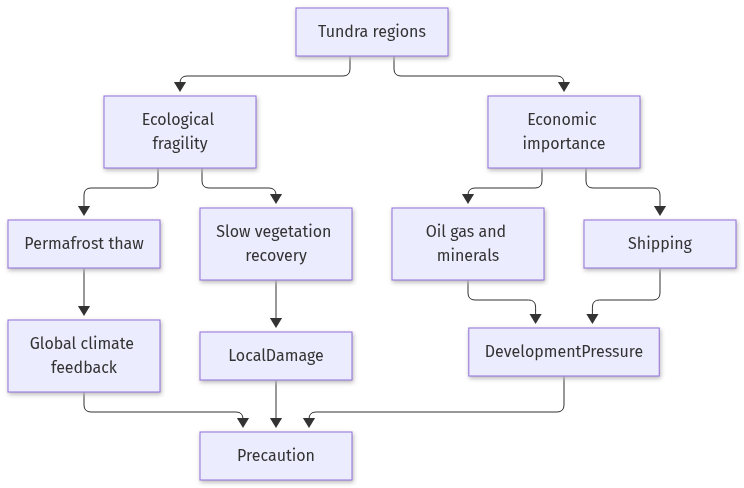
Flow diagram
Conclusion
The statement is valid because tundra regions are both fragile and economically significant. Their oil, gas, minerals and shipping routes attract states and companies, but their permafrost, slow recovery and climate feedbacks make careless exploitation dangerous. A critical answer must therefore go beyond a simple environment-versus-development debate. The wiser approach is selective, consent-based and scientifically monitored development, where climate costs and indigenous rights are counted before profits.
Quick related
Students also ask
-
Discuss the role of aeolian processes in desertification and land degradation.
Next question on this syllabus topic (2026 · Q6). View answer →
-
Why are tundra regions ecologically fragile?
They have permafrost, short growing seasons, slow nutrient cycling and vegetation that recovers poorly after disturbance.
-
Why are they economically important?
They contain oil, gas and strategic minerals, and melting sea ice is increasing interest in Arctic shipping routes.
-
What makes the issue critical?
Economic activity can trigger climate feedbacks, pollution and indigenous displacement, so development needs precaution and consent.
More from this topic
Q17 · UPSC Mains 2026 · GS I · 15 marks · Solution
Analyze the major drivers of human-induced land-use changes in India and their geographical consequences.
World's Physical Geography
India's land-use change is driven by agricultural intensification, urban growth, infrastructure, mining, plantations, tourism and livelihood shifts. These changes support food, connectivity and jobs, but they also disturb hydrology, soil, habitats, microclimates, hills, coasts and access to commons. Sustainable land governance must combine mapping, carrying-capacity assessment and local participation.
Q16 · UPSC Mains 2026 · GS I · 15 marks · Solution
"The centre of global trade is gradually shifting from the Atlantic region to the Indo-Pacific region." Examine this statement.
World's Physical Geography
Global trade’s centre of gravity is moving towards the Indo-Pacific because manufacturing, consumption, energy shipping and new tech rules are concentrating between the Indian and Pacific Oceans. China-plus-one, ASEAN growth, India’s market, Malacca–Hormuz lanes, RCEP/IPEF and semiconductor corridors drive the trend. The Atlantic still matters in finance and standards, so the change is gradual rebalancing. India gains only if ports, manufacturing and sea-lane security keep pace.
Q14 · UPSC Mains 2026 · GS I · 15 marks · Solution
Compare the Loo, Chinook and Foehn winds with respect to their regions of prevalence, their nature and climatic impacts.
World's Physical Geography
The Loo is a hot, dusty pre-monsoon wind of northwestern India and the Indo-Gangetic plains. Chinook and Foehn are warm, dry downslope winds of the Rockies and Alps, formed by adiabatic compression. Their impacts differ from Indian heat stress to snowmelt and mountain hazards.