
Revision summary
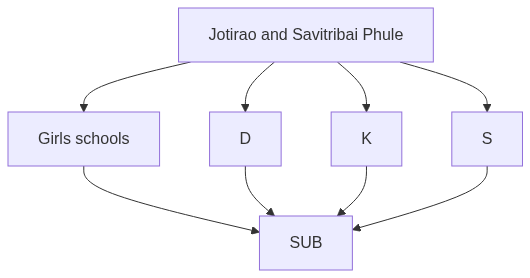
Phule wrote Gulamgiri and Shetkaryacha Asud to name caste as slavery and to defend the peasant. With Savitribai he opened schools for girls and for Mahar and Mang children in Pune. The Satyashodhak Samaj sought ritual and marriage without priestly monopoly. Women, Dalits and cultivators were treated as one excluded order, which is why almost all subaltern classes is a fair phrase. His world was Deccan and agrarian, so mill labour would be a later chapter. The reform is joint politics at the school gate, not a single-community charity.
Model answer
Copper italics in this answer — like this — are the key facts. Each one is unpacked in the Facts & figures rail.
Introduction
Jotirao Phule (1827–1890) wrote and organised in colonial Maharashtra when caste ordered land, labour, knowledge and the home. Subaltern here means those shut out of the official story: women, Dalits, peasants and artisans. His books and schools aimed at almost that whole field, not at one polite reform of the upper-caste household.
Body
Writing that named the structure
- Gulamgiri (1873): Phule compared caste hierarchy to American slavery and attacked the Brahmanical claim to own knowledge.
- Shetkaryacha Asud: He turned to the Deccan peasant crushed by moneylender, official and priest, and wrote that pain in Marathi the cultivator could hear.
- Bali legend: He gave the labouring majority a history in which they were not born only to serve.
- Savitribai Phule: Together they wrote and taught for girls' schooling when female literacy was treated as a scandal.
- Social theory from below: His pages treated caste, gender and the field as one order of exclusion, not as separate charity files.
Work that was not only a book
- Girls' school, 1848: They opened a school for girls in Pune when that act itself was politics.
- Mahar and Mang schools: They opened schools for Dalit children who were kept from wells and classrooms.
- Satyashodhak Samaj, 1873: The society sought truth-seeking without a priestly middleman, cheaper marriage and less ruinous ritual.
- Widow dignity: Phule argued for widow respect and against practices that destroyed women's lives, including infanticide.
- British rule as lever: He sometimes judged colonial power by whether it loosened local caste tyranny, a test later nationalists found uncomfortable.
Almost all subaltern classes
- One excluded order: A girl kept from school, a Mahar kept from the well, and a kunbi kept from crop surplus were linked victims of the same hierarchy.
- Why almost all is fair: Women, Dalits, peasants and the urban poor of the Deccan sat inside one reform imagination.
- Limit of his world: Industrial mill labour in Bombay would become a later socialist subject; Phule's main stage remained agrarian and small-town.
- Not a full class theory: He did not write Marx's complete theory of capital, yet he wrote the first sustained modern Marathi case that caste, gender and the field belong together.
- Joint politics: The discussion is incomplete if Savitribai is only a footnote, because the school gate was their shared politics.
Flow diagram
Conclusion
Phule's books attacked priestly slavery and the peasant's whip. His schools and the Satyashodhak Samaj reached girls, Dalits and cultivators together. That is a subaltern reform of almost the whole excluded field of his Maharashtra, not a single-caste charity.
Quick related
Students also ask
-
How can Artificial Intelligence (AI) and drones be effectively used along with GIS and RS techniques in locational and areal planning?
Next question on this syllabus topic (2025 · Q15). View answer →
-
Was Phule only a Dalit thinker?
Dalit emancipation is central, but his peasant and women's work is equally on the page. The subaltern field is wider.
-
Why did he sometimes praise British rule?
He judged power by whether it loosened local caste tyranny. Later nationalism judged power by the flag. Those tests can clash.
Same topic · past papers
UPSC has asked this before
These previous-year questions sit on the same topic. Open one to practise the earlier ask.
More from this topic
Q11 · UPSC Mains 2026 · GS I · 15 marks · Solution
Vijayanagara architecture exemplifies the amalgamation of past traditions with contemporary practices. Elucidate with examples.
Indian Heritage and Culture
• The Vijayanagara architectural style (14th–17th centuries) brilliantly synthesized classical Dravidian traditions with contemporary Deccan innovations. • It preserved grand spatial layouts, towering gopurams, and enclosed prakaras inspired by earlier Chola and Pandya idioms. • Sacred centers maintained canonical sanctum alignments while expanding peripheral structures to encourage greater public participation. • Secular buildings, such as the Lotus Mahal and Elephant Stables, integrated Islamic arched vaults and domes. • Builders utilized locally available hard granite, shifting ornamentation techniques toward bold, deep-relief stone carving. • Innovative structural typologies included multi-shafted composite pillars featuring rearing yalis, horse riders, and hanging brackets. • The Vittalaswami Temple at Hampi showcased pioneering acoustic engineering through famous resonant musical pillars.
Q1 · UPSC Mains 2026 · GS I · 10 marks · Solution
Analyze the importance of Ashokan inscriptions for reconstructing Mauryan history.
Indian Heritage and Culture
Ashokan inscriptions serve as the bedrock for reconstructing Mauryan history by offering authentic, contemporaneous evidence directly from the emperor. Written primarily in Brahmi, Kharosthi, Aramaic, and Greek scripts, they illuminate Ashoka's administrative reach, socio-religious policies, and the moral framework of Dhamma. Distributed across the Indian subcontinent and beyond, these edicts document spatial boundaries, diplomatic ties with Hellenistic kingdoms, and the socio-economic milieu. They bridge the gap between literary accounts and archaeological finds, providing an invaluable indigenous chronology.
Q15 · UPSC Mains 2025 · GS I · 15 marks · Solution
How can Artificial Intelligence (AI) and drones be effectively used along with GIS and RS techniques in locational and areal planning?
Indian Heritage and Culture
Remote sensing supplies pictures of land and water; GIS stores them with administrative boundaries. Drones add cheap, repeatable local maps for disasters, utilities and village layouts. Artificial intelligence classifies pixels and can forecast flood, heat or sprawl on that GIS base. Indian platforms such as Bhuvan and Gati Shakti already try to combine these tools. Planning still needs ground checks and a public purpose, or the map only watches the poor. The four tools are a chain: locate, refresh, read, then choose the public use.