
Revision summary
England’s mills produced cheap, uniform cloth that undercut many Indian handlooms after trade opened wider in the nineteenth century. Colonial specialisation pushed raw cotton out and piece-goods in. Naoroji and Dutt named this pattern as drain. Railways carried mill cloth inland and tied India into that division of labour. Company monopoly, land revenue, and loss of court patronage had already hurt artisans. Revisionists note adaptation and later Indian mills. Nationalists note a real industrial share loss in regions such as the east. The Industrial Revolution was a major cause. Empire was the political condition that made it so destructive.
Model answer
Copper italics in this answer — like this — are the key facts. Each one is unpacked in the Facts & figures rail.
Introduction
The Industrial Revolution in England produced cheap machine-made cloth and metal goods that entered Indian markets in the nineteenth century. Indian weavers and metal-smiths did not decline because they forgot their craft. They met mill production from Lancashire and Sheffield, carried on Company and Crown ships, under trade rules that were not equal for both sides. The Industrial Revolution was a real cause of the decline of Indian cottage production. It was not the only cause. Tariffs, railways, colonial policy, and changes inside India also share the responsibility.
Body
The mechanism from Manchester to the loom
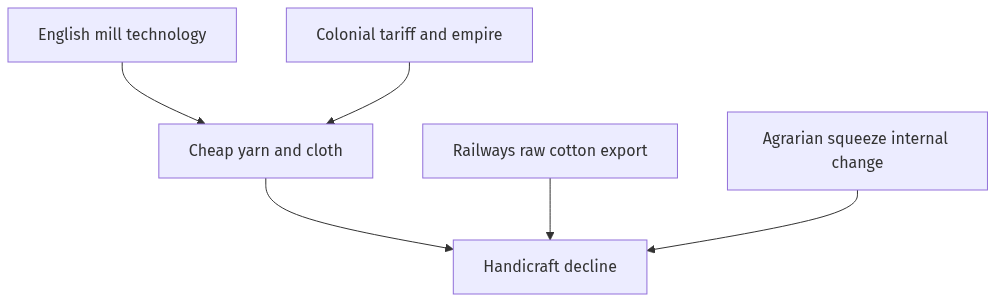
English cotton mills after the late eighteenth century made cloth cheaper, more uniform, and endlessly repeatable. Indian handloom had been an export strength. It became an import-competing survivor. After the Charter Act of 1813 opened trade more widely, Lancashire piece-goods flooded presidency ports. Drain theorists such as Dadabhai Naoroji and R.C. Dutt argued that India was made to export raw cotton and import cloth. That was a colonial division of labour that mill industry in England needed. Railways carried mill cloth inland faster than a pack bullock had carried handicrafts. Machine twist and yarn also undercut village spinning. This was deindustrialisation of the spindle before the loom.
Iron, coal, and steam in Britain similarly pressured Indian wootz, village furnaces, and artisan steel, though the story is regionally uneven.
- Price shock: Mill cloth undercut many grades of handloom.
- One-way specialisation: Raw fibre went out. Yarn and piece-goods came in.
- Transport: Rail and steam reduced the protected distance of the interior.
How far “responsible”
How far is not the same as entirely. Company rule had already distorted textiles through monopoly procurement in the eighteenth century. Indian revenue demand pushed artisans toward agriculture. Internal competition, changing court patronage after the Mughal collapse, and later Indian mills in Bombay and Ahmedabad themselves displaced some hand production. Tirthankar Roy and others stress market integration and artisan adaptation, not only a nationalist ruin story. Amiya Bagchi and the nationalist school stress a real fall in secondary-sector share in eastern India.
England’s Industrial Revolution supplied the technology and the cheap goods. Colonial power supplied the tariff asymmetry, the unfree political response, and the use of India as a captive market. Without empire, Indian states might still have faced mill cloth, as Japan did. Japan had a sovereign tariff. That difference is why England’s Industrial Revolution in this question is also England’s empire.
- Necessary cause: Machine production made the price war possible.
- Not sufficient alone: Policy, railways as colonial tools, and agrarian squeeze completed the decline in many crafts.
- Survival: Handloom did not die. It shrank, specialised, and later received swadeshi and state khadi politics.
Nationalist, revisionist, and a middle line
The nationalist school treated deindustrialisation as proof of drain. Revisionists reply that real wages, regional variety, and artisan shift into agriculture or mill work muddy a single ruin graph. Both can be true in different districts. Bengal’s fine muslin story is not identical to western India’s later mill story. For a GS comment, the Industrial Revolution remains causally central wherever machine cloth met a non-sovereign tariff. The debate is about how complete the decline was. It is not about whether Manchester’s steam mattered.
- Bagchi line: There was a measurable fall in industrial employment in parts of the east.
- Roy line: Markets, skills, and survival in niches also matter.
- Exam verdict: English responsibility was substantial. It was shared with colonial power and internal change.
The responsible verdict is substantial but shared. The Industrial Revolution supplied the cheap machine goods. Colonial rule set the tariffs and the market rules that made those goods so destructive.
Flow diagram
Conclusion
Lancashire mill cloth and a captive Indian market broke the old export supremacy of the handloom and reduced many cottage trades. The Industrial Revolution was a prime cause. It was not the only one. A sovereign tariff and a different revenue state might have helped crafts adapt instead of watching them shrink. That nationalist insight still holds after the revisionists have spoken.
Quick related
Students also ask
-
" There arose a serious challenge to the Democratic State System between the two World Wars." Evaluate the statement.
Next question on this syllabus topic (2021 · Q13). View answer →
-
Did Indian handicrafts disappear?
No. Many shrunk or moved upmarket. Khadi and later handloom policy are evidence of survival under stress, not of a clean death.
-
Would mills have hurt India without colonialism?
Machine cloth would still have competed. Without political power over tariffs and revenue, the shock need not have been so one-sided.
Same topic · past papers
UPSC has asked this before
These previous-year questions sit on the same topic. Open one to practise the earlier ask.
-
2024 · Q14 · GS I · 15 marks
The groundwater potential of the gangetic valley is on a serious decline. How may it affect the food security of India? -
2017 · Q12 · GS I · 15 marks
Examine how the decline of traditional artisanal industry in colonial India crippled the rural economy. (250 words).
More from this topic
Q13 · UPSC Mains 2025 · GS I · 15 marks · Solution
The French Revolution has enduring relevance to the contemporary world. Explain.
History of the World
The 1789 Declaration treated rights as universal and the nation as the source of law. Secular public authority and the attack on privilege still shape constitutions and civil codes. The Terror remains the warning that revolution can devour procedure and people. Contemporary human-rights talk, square protests and populist claims to be the people all use this inheritance. Colonial limits of French liberty, as in Haiti, also remain relevant to debates on race and international order. Enduring relevance is a live choice among rights, nation, equality and violence.
Q12 · UPSC Mains 2024 · GS I · 15 marks · Solution
How far is it correct to say that the First World War was fought essentially for the preservation of balance of power?
History of the World
The balance-of-power view sees 1914 as a response to German hegemony and a rigid alliance system. Britain’s Belgian case fits an old habit of stopping one power from dominating the Channel coast. Imperial rivalry, Balkan nationalism, and railway mobilisation are causes that this view underplays. Fischer and others stress German war aims, not only equilibrium. 1919 did not restore a stable balance. It created new grievances. The word “essentially” is too strong. Balance of power was a major logic. It was not the only one.
Q13 · UPSC Mains 2021 · GS I · 15 marks · Solution
" There arose a serious challenge to the Democratic State System between the two World Wars." Evaluate the statement.
History of the World
Fascist Italy, Nazi Germany, Franco, and Japanese militarism attacked parliamentary systems. The Depression and a weak League made dictators look effective. The USSR offered a second non-democratic path. Britain, the US, and some others held their elections. The challenge was serious and regional, not the end of democracy as an idea.