
Revision summary
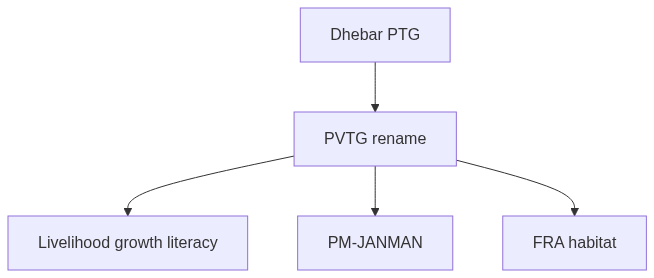
PVTGs are a vulnerable subset of STs, about 75 groups, identified on pre-agricultural livelihood, lagging population and literacy. The name changed from Primitive Tribal Groups to drop a colonial adjective. Distribution: mainland scatters plus Andaman isolates with a separate contact ethic. PM-JANMAN, older CCD plans, FRA habitat rights and Niyamgiri are the status markers. Gaps: missed hamlets, standard housing, weak habitat titles.
Model answer
Copper italics in this answer — like this — are the key facts. Each one is unpacked in the Facts & figures rail.
Introduction
Particularly Vulnerable Tribal Groups are a subset of Scheduled Tribes named for sharper historical decline. The category began as Primitive Tribal Groups after the Dhebar Commission, was renamed to drop the word primitive, and now sits at the centre of PM-JANMAN. Criteria, names and maps must be kept distinct.
Body
Criteria
The administrative tests, grown from Dhebar (1960–61) and later MoTA practice, are typically: pre-agricultural or hunting-gathering / shifting livelihood, zero or negative population growth at the time of identification, extremely low literacy, and a related economic backwardness compared with other STs. They are identified within the ST list, not instead of it. About 75 groups (the count taught after later inclusions) are spread across many states, with concentrations in Odisha, Andhra–Telangana, Bihar–Jharkhand, Madhya Pradesh–Chhattisgarh, Gujarat, the Andaman Islands (including Sentinelese, Jarawa, Onge, Great Andamanese), and Kerala–Tamil Nadu hills (Toda, Kota, Kurumba, Irula appear in this Paper’s Nilgiri question; some of these are PVTG-listed in state files).
- Criteria fail in the same way Lokur fails: a PVTG hamlet may now have a phone and a PDS card and still lack forest title. Shyness should not return as a test.
Nomenclature
Primitive Tribal Groups (PTG) was the old name. It was changed to Particularly Vulnerable Tribal Groups (PVTG) to remove the colonial insult while keeping the targeting. The Gazette and scheme documents now use PVTG. Anthropology should use PVTG in the exam and mention PTG as history.
Status and distribution
Numbers are small relative to the ST population, but habitations are scattered. Andaman groups raise isolation and epidemic ethics (contact policy). Mainland groups (Chenchu, Birhor, Paharia, Dongria Kondh, Lodha, Kharia, etc.) face FRA eviction pressure, mining, and thin hostels.
PM-JANMAN (Pradhan Mantri Janjati Adivasi Nyaya Maha Abhiyan) packages housing, water, education, health, connectivity and livelihood for PVTG habitations. DAJGUA and earlier CCD (Conservation-cum-Development) plans were the older tools. FRA community rights and habitat rights (section 3(1)(e) of FRA, still weakly implemented) are the land core. Niyamgiri Dongria are the judicial emblem of PVTG religious-forest rights.
- Gaps: habitation lists miss seasonal camps; housing packets ignore jhum architecture; Sentinelese policy is non-contact, which is not a house-and-tap scheme. Status is targeted but still precarious.
Flow diagram
Conclusion
PVTGs are STs identified for pre-agricultural livelihood, stagnant population at identification, and extreme educational lag. The name replaced PTG. Distribution is a scatter of hamlets plus Andaman isolates. PM-JANMAN and FRA habitat rights are the present instruments; consent and title remain the test of status.
Quick related
Students also ask
-
What are the demographic challenges of India's changing population dynamics in the next 50 years?
Next question on this syllabus topic (2024 · Q4(c)). View answer →
-
Is every small ST a PVTG?
No. Only notified groups. A small ST can be politically strong; a PVTG can be numerically tiny and administratively invisible.
-
Should the Sentinelese be brought under PM-JANMAN housing?
Andaman isolated peoples are governed by non-contact and buffer policy. A mainland housing packet would be an epidemic and rights disaster.
Same topic · past papers
UPSC has asked this before
These previous-year questions sit on the same topic. Open one to practise the earlier ask.
-
2025 · Q4(c) · Anthropology GS 2 · 15 marks
Critically examine the concept of Scheduled Tribe (ST) and mention the limitations of administrator's criteria
More from this topic
Q4(b) · UPSC Mains 2026 · Anthropology GS 2 · 15 marks · Solution
Why have the classifications of Indian populations, based on somatometric and somatoscopic characteristics, failed to develop a common understanding of the population diversity?
Demographic profile of India
• Early classifications used body measurements (somatometry) and visual traits (somatoscopy) to group Indians into rigid racial categories. • These methods failed because physical traits are subjective, easily influenced by the environment, and overlap heavily across different groups. • Static racial models ignored India's indigenous evolution, long-term gene flow, and continuous biological variation. • Centuries of social mixing, migration, and endogamy created complex hybrid populations that defied pure typological grouping. • Modern DNA research proves there is deep genetic continuity beneath superficial physical differences across Indian groups. • Anthropology has now shifted away from outdated racial types toward dynamic studies of population genetics and linguistics.
Q4(b) · UPSC Mains 2025 · Anthropology GS 2 · 15 marks · Solution
Elucidate the role of demographic and social factors for population growth in India
Demographic profile of India
Demographic factors: falling mortality, delayed fertility decline, young age structure and momentum. Social factors: early marriage, son preference, class and region, women’s education and work. NFHS shows convergence, with remaining high-fertility pockets. NPP 2000, Mission Parivar Vikas and girls’ education are the humane policy line; Emergency coercion is the warning. Javed (2003) allowed two-child rules for panchayat office; the social cost is still debated.
Q3(b) · UPSC Mains 2025 · Anthropology GS 2 · 15 marks · Solution
Examine the environmental and biocultural factors influencing the health of tribals of India
Demographic profile of India
Environmental loads include malaria, mining dust, indoor smoke, iodine and water, plus displacement from dams and parks. Biocultural loads include shrinking forest diets, migration-TB, gender and fertility, medical pluralism and sickle-cell without counselling. Xaxa and the tribal health expert group asked for local cadres and disease-specific work, not a single plains protocol. PM-JANMAN, sickle-cell mission, Nikshay, POSHAN and Jal Jeevan matter only if hamlets are reached in their language. Forest rights are nutrition rights.