
Revision summary
Siwaliks are a Himalayan foreland molasse with Lower, Middle and Upper groups. Miocene hominoids centre on Sivapithecus (including former Ramapithecus) and large Indopithecus/Gigantopithecus. Haritalyangar, Ramnagar and Potwar Chinji are key localities. Ramapithecus is no longer a hominin; the face aligns with orangutans. The sequence is vital for Asian apes, not for an Indian origin of Homo.
Model answer
Copper italics in this answer — like this — are the key facts. Each one is unpacked in the Facts & figures rail.
Introduction
The Siwalik Hills are a Neogene–Quaternary foreland sequence along the southern Himalaya. For palaeoanthropology they are India’s richest hominoid archive: not a cradle of Homo sapiens, but a long record of Miocene apes and later mammals against which African and Chinese finds are compared.
Body
Subdivisions
Geologists divide the Siwaliks, in broad teaching order, into Lower (Kamlial–Chinji), Middle (Nagri–Dhok Pathan) and Upper (Tatrot–Pinjor–Boulder Conglomerate) groups. Ages run roughly from the Middle Miocene into the Pleistocene. Chinji and Nagri beds matter most for large hominoids. Pinjor holds later fauna, including some disputed hominin-bearing claims. The sequence is a molasse: rivers dumped sand and clay south of the rising Himalaya, so fossils sit in fluvial channels and floodplains, often fragmentary.
G. E. Lewis, Pilgrim, Colbert, then S. R. K. Chopra, W. E. Le Gros Clark, David Pilbeam, J. G. E. Lewis’s Ramapithecus, and Indian teams at Chandigarh and the Wadia Institute built the primate list.
Fossil primate fauna
- Sivapithecus (including material once split as Ramapithecus): a Miocene ape with a dished face close to the orangutan line. Localities include Haritalyangar (Himachal), Chinji and Potwar (Pakistan), and other Himachal–Punjab Siwalik pockets.
- Gigantopithecus teeth from the Indian Siwaliks (and better Chinese cave samples) show a huge ape, not a human ancestor.
- Indopithecus / “Gigantopithecus” giganteus from Haritalyangar is a large Indian hominoid.
- Smaller catarrhines and pliopithecoid-like forms appear in some lists; many are poorly preserved.
- Later beds yield cercopithecoids and a rich ungulate–proboscidean fauna that dates the primates by association.
Ramapithecus, once sold as a 14-million-year-old hominin with small canines, was folded back into Sivapithecus after face and palate finds (Pilbeam and others). The Siwaliks therefore record pongine (orang-related) apes, not early Australopithecus.
Major localities
Haritalyangar remains the Indian type landscape for Sivapithecus and Indopithecus. Ramnagar (Jammu) has added Sivapithecus. Pakistani Potwar sections (Khaur, Chinji) are stratigraphically clearer. Narmada (Hathnora calvarium) is not Siwalik; it is a central Indian Pleistocene hominin and must not be mixed into this answer.
Significance
The Siwaliks prove that large hominoids lived on the Indian plate in the Miocene, that orangutan ancestry has an Asian fossil story, and that Himalayan uplift and monsoon rivers created the burial setting. They do not prove that humans originated in India. Out of Africa for Homo still stands. Siwalik work is biostratigraphy plus careful taxonomy, not nationalism about “the first man”.
Flow diagram
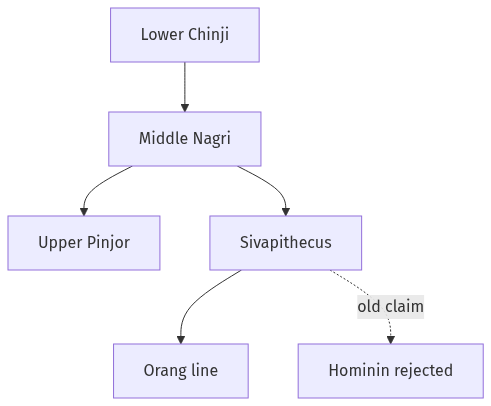
Conclusion
Lower to Upper Siwalik stages frame a Miocene ape fauna led by Sivapithecus at Haritalyangar and related beds. Ramapithecus as a hominin is retired. The range is central to Asian hominoid phylogeny and silent on the origin of modern humans.
Quick related
Students also ask
-
Taxonomic status of Ramapithecus in the light of Ramapithecus-Sivapithecus controversy.
Next question on this syllabus topic (2025 · Q5(b)). View answer →
-
Are Siwaliks and Narmada the same story?
No. Siwaliks are mainly Miocene apes in foothill molasse. Hathnora on the Narmada is a Pleistocene calvarium in central India.
-
Did humans evolve in the Siwaliks?
There is no accepted Siwalik Australopithecus or early Homo. The fossils are hominoids on the orang side or later mammals.
Same topic · past papers
UPSC has asked this before
These previous-year questions sit on the same topic. Open one to practise the earlier ask.
-
2023 · Q6(c) · Anthropology GS 2 · 15 marks
"Siwalik deposits show a variety of Neogene fossil primates." Critically examine. -
2015 · Q3(c) · Anthropology GS 2 · 15 marks
Describe the paleoanthropological fossil finds from Siwalik hills. Examine the contribution of Siwalik fossils to paleoanthropological knowledge
More from this topic
Q5(b) · UPSC Mains 2026 · Anthropology GS 2 · 10 marks · Solution
Debate regarding the phylogenetic position of Narmada Man.
Palaeo-Anthropological evidences from India with special reference to Siwaliks and Narmada basin (Ramapithecus, Sivapithecus and Narmada Man).
* Discovered by Arun Sonakia in 1982 at Hathnora, Narmada Man is India's only well-documented hominin fossil. * The fossil displays thick skull bones and a heavy brow ridge, showing primitive traits similar to *Homo erectus*. * However, it also features a larger cranial capacity of 1150–1400 cc, pointing toward advanced traits. * Early researchers like Sonakia classified the specimen as an advanced form of *Homo erectus* due to its robust build. * Later paleoanthropologists, including Kenneth Kennedy, re-classified it as an archaic or early *Homo sapiens*. * This ongoing debate highlights its role as a transitional fossil bridging the Middle Pleistocene gap in South Asia. * Definitive classification still awaits new fossil finds and precise chronometric dating in the Narmada basin.
Q5(b) · UPSC Mains 2025 · Anthropology GS 2 · 10 marks · Solution
Taxonomic status of Ramapithecus in the light of Ramapithecus-Sivapithecus controversy.
Palaeo-Anthropological evidences from India with special reference to Siwaliks and Narmada basin (Ramapithecus, Sivapithecus and Narmada Man).
Lewis named Ramapithecus from Siwalik jaws; Simons and Pilbeam once put it on the human line. Sivapithecus faces from Potwar and Haritalyangar are orang-like, not australopith-like. Ramapithecus is now folded into Sivapithecus; it is not a hominin. The lesson is not to read human ancestry from a jaw fragment alone. Gigantopithecus/Indopithecus is a separate large ape, also not Homo.
Q5(b) · UPSC Mains 2023 · Anthropology GS 2 · 10 marks · Solution
Ramapithecus-Sivapithecus debate
Palaeo-Anthropological evidences from India with special reference to Siwaliks and Narmada basin (Ramapithecus, Sivapithecus and Narmada Man).
Lewis named Ramapithecus from Siwalik jaws and it was treated as a Miocene hominin. Pilbeam and later face finds showed an orang-like profile. Ramapithecus is now included in Sivapithecus. Haritalyangar and Potwar are key localities. The debate does not support an Indian origin of Homo.