
Revision summary
Lewis named Ramapithecus from Siwalik jaws and it was treated as a Miocene hominin. Pilbeam and later face finds showed an orang-like profile. Ramapithecus is now included in Sivapithecus. Haritalyangar and Potwar are key localities. The debate does not support an Indian origin of Homo.
Model answer
Copper italics in this answer — like this — are the key facts. Each one is unpacked in the Facts & figures rail.
Introduction
Ramapithecus was once presented as a mid-Miocene hominin ancestor with small canines. Sivapithecus is a Siwalik ape whose face matches the orangutan line. The debate ended by folding Ramapithecus into Sivapithecus. It is a lesson in how jaws without faces mislead phylogeny.
Body
The old claim
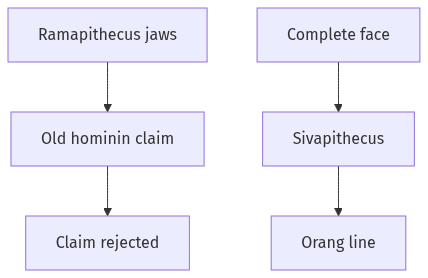
- G. E. Lewis named Ramapithecus from Siwalik jaws. Small canines and a supposedly arched palate were read as hominin.
- Popular and some textbook accounts in the 1960s–70s placed a 12–14 million-year-old “first man” in India.
The revision
- Better faces from Potwar (Pakistan) and Haritalyangar (Himachal), studied by David Pilbeam and others, showed a dished, orang-like profile.
- Ramapithecus specimens belong with Sivapithecus. They are pongine (orang-related) apes, not Australopithecus.
- Elwyn Simons and others had kept the hominin reading longer; anatomy of the complete face closed it.
Localities
- Haritalyangar, Chinji–Nagri Siwaliks, and Ramnagar (Jammu) are the Indian–Pakistan teaching sites.
- Narmada Hathnora is a Pleistocene calvarium and must not be mixed into this Miocene debate.
Significance
- The Siwaliks remain central for Asian hominoids. They do not prove an Indian origin of humans.
Flow diagram
Conclusion
Ramapithecus as a hominin is retired. The fossils are Sivapithecus, on the orangutan line. The debate shows why isolated teeth should not be sold as the first human.
Quick related
Students also ask
-
What are the arguments for excluding Narmada Man from Homo erectus category?
Next question on this syllabus topic (2022 · Q2(b)). View answer →
-
Is Ramapithecus still a valid hominin genus?
No. The name survives in older literature. The fossils are classified with Sivapithecus.
-
Did humans evolve in the Siwaliks?
There is no accepted Siwalik Australopithecus. These Miocene apes are on the Asian great-ape side.
More from this topic
Q5(b) · UPSC Mains 2026 · Anthropology GS 2 · 10 marks · Solution
Debate regarding the phylogenetic position of Narmada Man.
Palaeo-Anthropological evidences from India with special reference to Siwaliks and Narmada basin (Ramapithecus, Sivapithecus and Narmada Man).
* Discovered by Arun Sonakia in 1982 at Hathnora, Narmada Man is India's only well-documented hominin fossil. * The fossil displays thick skull bones and a heavy brow ridge, showing primitive traits similar to *Homo erectus*. * However, it also features a larger cranial capacity of 1150–1400 cc, pointing toward advanced traits. * Early researchers like Sonakia classified the specimen as an advanced form of *Homo erectus* due to its robust build. * Later paleoanthropologists, including Kenneth Kennedy, re-classified it as an archaic or early *Homo sapiens*. * This ongoing debate highlights its role as a transitional fossil bridging the Middle Pleistocene gap in South Asia. * Definitive classification still awaits new fossil finds and precise chronometric dating in the Narmada basin.
Q5(b) · UPSC Mains 2025 · Anthropology GS 2 · 10 marks · Solution
Taxonomic status of Ramapithecus in the light of Ramapithecus-Sivapithecus controversy.
Palaeo-Anthropological evidences from India with special reference to Siwaliks and Narmada basin (Ramapithecus, Sivapithecus and Narmada Man).
Lewis named Ramapithecus from Siwalik jaws; Simons and Pilbeam once put it on the human line. Sivapithecus faces from Potwar and Haritalyangar are orang-like, not australopith-like. Ramapithecus is now folded into Sivapithecus; it is not a hominin. The lesson is not to read human ancestry from a jaw fragment alone. Gigantopithecus/Indopithecus is a separate large ape, also not Homo.
Q2(a) · UPSC Mains 2025 · Anthropology GS 2 · 20 marks · Solution
Discuss the palaeoanthropological significance of Siwaliks of India giving its subdivisions, fossil primate fauna and major primate fossil localities
Palaeo-Anthropological evidences from India with special reference to Siwaliks and Narmada basin (Ramapithecus, Sivapithecus and Narmada Man).
Siwaliks are a Himalayan foreland molasse with Lower, Middle and Upper groups. Miocene hominoids centre on Sivapithecus (including former Ramapithecus) and large Indopithecus/Gigantopithecus. Haritalyangar, Ramnagar and Potwar Chinji are key localities. Ramapithecus is no longer a hominin; the face aligns with orangutans. The sequence is vital for Asian apes, not for an Indian origin of Homo.