
Revision summary
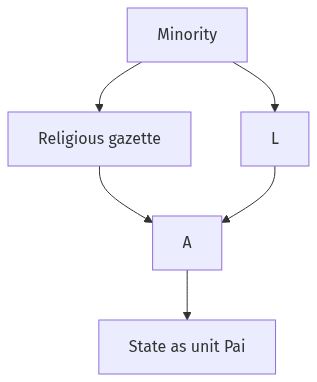
Minority is a non-dominant group in a specified unit; in education law the unit is the state (T. M. A. Pai). Central religious minorities: Muslim, Christian, Sikh, Buddhist, Parsi, Jain. Linguistic minorities sit under Articles 29, 350A and 350B and the Eighth Schedule plus unscheduled tongues. Patterns follow regions: North-East Christians, Kerala mix, Hindi-belt Urdu, migrant cities. Sachar, Bommai and personal-law cases are the contemporary legal weather.
Model answer
Copper italics in this answer — like this — are the key facts. Each one is unpacked in the Facts & figures rail.
Introduction
A minority is a group that is fewer and politically vulnerable in a given unit, not a group that is culturally thin. In India the unit may be the Union or a state: Hindus are a majority nationally and a minority in some states. The Constitution protects religion and language more clearly than it defines the word.
Body
Definition
UN usage stresses non-dominant groups with distinct identity. T. M. A. Pai (2002) and P. A. Inamdar (2005) treat minority as state-wise for educational rights under Articles 29 and 30. National Commission for Minorities Act, 1992 notifies Muslims, Christians, Sikhs, Buddhists, Parsis, Jains (Jains added later) as religious minorities at the Centre. Linguistic minorities have a Commissioner for Linguistic Minorities under Article 350B.
- Minority is relational: Tamil speakers are a minority in Delhi and a majority in Tamil Nadu.
Linguistic patterns
The Eighth Schedule lists scheduled languages; many more are unscheduled (Santhali is scheduled; many tribal languages are not). Patterns: Hindi belt states with Urdu, Punjabi, tribal languages; South with linguistic states after Fazal Ali, yet with Urdu, Tulu, Lambadi; North-East with English as associate and many unwritten languages; Mumbai and Bengaluru as migrant-language cities.
Article 29 protects distinct language and culture; 350A asks for mother-tongue primary instruction. States Reorganisation reduced some conflicts and created new minorities inside new states (Telangana Urdu, Gorkha Nepali).
Religious patterns
Muslims are the largest religious minority, concentrated in J&K (as it was), Kerala, Bengal, Assam, UP, Hyderabad. Christians concentrate in Kerala, Goa, and the ST hills of the North-East and Chotanagpur. Sikhs in Punjab and a diaspora belt. Buddhists include Himalayan communities and Ambedkarite converts. Jains are urban-trading minorities. Parsis are a tiny, high-literacy group.
Sachar mapped Muslim development. S. R. Bommai treated secularism as basic structure. Shayara Bano, Sabarimala, and hijab litigation show personal law and public space as the conflict zone. CAA 2019 and NRC debates recoded some religious minorities as citizenship questions.
- Anthropology adds: a “minority” hamlet may be a local majority. Status follows the unit you choose.
Flow diagram
Conclusion
Minority means non-dominance in a named unit. India recognises religious minorities by gazette and linguistic minorities by language rights. Articles 29, 30, 350A–B, T. M. A. Pai and Sachar are the working kit. The pattern is regional, not a single national pie chart.
Quick related
Students also ask
-
Religious pluralism and social solidarity.
Next question on this syllabus topic (2023 · Q1(e)). View answer →
-
Are Hindus ever a minority?
In some states and in some districts, yes. T. M. A. Pai uses the state as the frame for educational rights.
-
Is ST a religious minority?
ST is a separate constitutional list. Many STs are Hindu, Christian or follow indigenous ritual; minority religion law and ST law can both apply.
Same topic · past papers
UPSC has asked this before
These previous-year questions sit on the same topic. Open one to practise the earlier ask.
-
2021 · Q8(b) · Anthropology GS 2 · 15 marks
Delineate the constitutional safeguard for religious minorities in India -
2015 · Q2(c) · Anthropology GS 2 · 15 marks
Discuss the problems faced by religious minorities in India -
2025 · Q6(a) · Anthropology GS 2 · 20 marks
"The village was not merely a place where people lived; it had a design in which were reflected the basic values of Indian civilization." Who said this? Elaborate
More from this topic
Q8(c) · UPSC Mains 2023 · Anthropology GS 2 · 15 marks · Solution
How are Other Backward Classes identified. Enumerating the important features elucidate the recent changes in their social and economic life.
Linguistic and religious minorities and their social, political and economic status.
OBCs are socially and educationally backward classes other than SC and ST, listed for reservation. Mandal’s indicators and 1990 implementation, then Indra Sawhney’s creamy layer and 50 percent ceiling, structure identification. The 102nd Amendment (2018) gave NCBC constitutional status (Article 338B) and a Presidential Central list (Article 342A). The 105th Amendment (2021) restored States’ power to identify OBCs for State lists after the Maratha case reading of the 102nd. Recent change includes an OBC political and educational middle class, internal inequality, and list-agitation; marriage remains largely endogamous.
Q1(e) · UPSC Mains 2023 · Anthropology GS 2 · 10 marks · Solution
Religious pluralism and social solidarity.
Linguistic and religious minorities and their social, political and economic status.
Religious pluralism is several faiths sharing one public life. Social solidarity is the cooperation that Durkheim split into likeness and interdependence. Srinivas, Madan, and Vidyarthi show local mixing in village, Islam, and pilgrimage towns. The Constitution protects practice; Gandhi treated unity as political work. Ambedkar showed that caste can block solidarity even inside a plural society.
Q7(c) · UPSC Mains 2022 · Anthropology GS 2 · 15 marks · Solution
Explain the social and religious consequences of contact between tribal and non-tribal populations
Linguistic and religious minorities and their social, political and economic status.
Contact produces Sanskritisation and class splits inside tribes. Ghurye called the social path Hinduisation; Elwin called it loss. Religion may Hinduise, Christianise, or throw up a prophet such as Birsa. Sacred groves and brew are early casualties of plough and mission. Consequences are mixed, not a single conversion story.