
Revision summary
OBCs are socially and educationally backward classes other than SC and ST, listed for reservation. Mandal’s indicators and 1990 implementation, then Indra Sawhney’s creamy layer and 50 percent ceiling, structure identification. The 102nd Amendment (2018) gave NCBC constitutional status (Article 338B) and a Presidential Central list (Article 342A). The 105th Amendment (2021) restored States’ power to identify OBCs for State lists after the Maratha case reading of the 102nd. Recent change includes an OBC political and educational middle class, internal inequality, and list-agitation; marriage remains largely endogamous.
Model answer
Copper italics in this answer — like this — are the key facts. Each one is unpacked in the Facts & figures rail.
Introduction
Other Backward Classes are socially and educationally backward groups, other than SC and ST, listed for affirmative action. Identification is a legal-political process, not a racial test. Recent change includes a larger OBC middle class, creamy-layer rules, and a constitutional fight over who may draw the list.
Body
How OBCs are identified
- The Constitution originally spoke of socially and educationally backward classes (Articles 15(4) and 16(4) after the First Amendment, following State of Madras v. Champakam Dorairajan).
- The Kaka Kalelkar Commission (1955) was the first national attempt; its report was not fully implemented.
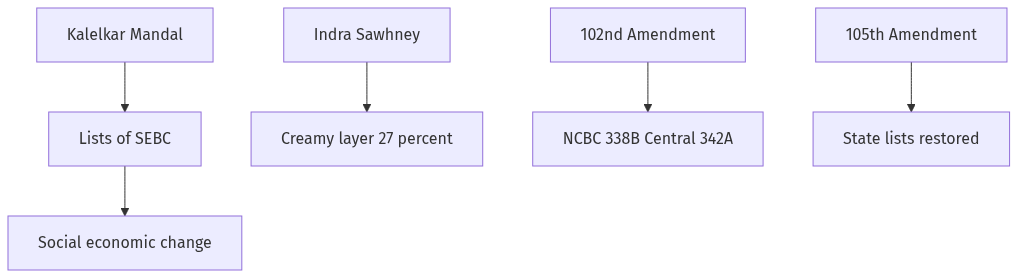
- The Mandal Commission (1979–80, B. P. Mandal) used eleven social, educational, and economic indicators and estimated a large OBC population. The Union implemented 27 percent reservation in central jobs in 1990.
- Indra Sawhney v. Union of India (1992) upheld OBC reservation, imposed a creamy layer exclusion, and set an ordinary 50 percent ceiling. Identification must be of a class that is backward, not a random political gift.
- Lists exist at Central and State levels and need not be identical. Castes, communities, and some occupational groups appear. SC and ST are separate.
- The National Commission for Backward Classes began as a statutory body after Indra Sawhney (NCBC Act, 1993). The 102nd Constitutional Amendment, 2018, inserted Article 338B (NCBC with constitutional status) and Article 342A (President notifies the Central SEBC list, after consultation with the Governor).
- In Jaishri Laxmanrao Patil (Maratha reservation, 2021), the Supreme Court read the 102nd Amendment as taking away States’ power to identify OBCs. Parliament answered with the 105th Constitutional Amendment, 2021, which restored the power of State governments to identify socially and educationally backward classes for their own lists, while the President’s list under 342A remains the Central list.
- Identification today is therefore dual: a Central list for Central institutions, State lists for State services, with NCBC advice on the Centre’s side.
Important features
- OBC is a heterogeneous category: dominant peasant castes in one district, poor artisan jatis in another.
- Backwardness is social and educational, with economic indicators as support, not a pure income census (except creamy layer screening).
- Endogamy, occupational stigma or low ritual rank, and under-representation in public services are typical features used in reports.
- Creamy layer (income and high posts) removes the most advanced members from job reservation.
Recent social and economic change
- After 1990, OBC enrolment in colleges and presence in state assemblies rose. Yadav, Kurmi, Jatav-adjacent OBC politics, Thevar, Vokkaliga, and similar groups used both numbers and quotas (Srinivas’s dominant caste meeting Mandal).
- Agrarian change, Green Revolution belts, and urban informal work split OBCs internally. Some are landlords; some are footloose labour.
- 102nd/105th show that list-making is now a constitutional high-stakes process, as Maratha, Patel, and Jat agitations also showed.
- Private-sector jobs, contract labour, and the EWS quota (103rd Amendment, a different track) have changed the competition field. OBC identity remains strong in marriage and parties even when income rises.
Caution
- OBC is not a tribe and not a race. Risley types do not identify them.
- Sub-categorisation debates (Rohini Commission) exist because a few castes capture a large share of the quota.
Flow diagram
Conclusion
OBCs are identified by commissions and notified lists using social and educational backwardness, structured by Mandal and Indra Sawhney. The 102nd Amendment constitutionalised NCBC and the Central list; the 105th Amendment restored State identification after the Maratha judgment. Features are heterogeneity, creamy layer, and endogamy. Recent change is political rise plus internal class split, not the end of caste.
Quick related
Students also ask
-
Explain the social and religious consequences of contact between tribal and non-tribal populations
Next question on this syllabus topic (2022 · Q7(c)). View answer →
-
Did the 102nd Amendment abolish State OBC lists?
The Supreme Court in the Maratha case read it that way for identification power. The 105th Amendment was enacted to restore State power to identify SEBCs for State lists.
-
Is EWS the same as OBC?
No. EWS (103rd Amendment) is an economic quota for those not in SC, ST, or OBC lists. It is a different constitutional track.
Same topic · past papers
UPSC has asked this before
These previous-year questions sit on the same topic. Open one to practise the earlier ask.
More from this topic
Q8(b) · UPSC Mains 2025 · Anthropology GS 2 · 15 marks · Solution
Define minority. Elaborate the patterns of linguistic and religious minorities in India
Linguistic and religious minorities and their social, political and economic status.
Minority is a non-dominant group in a specified unit; in education law the unit is the state (T. M. A. Pai). Central religious minorities: Muslim, Christian, Sikh, Buddhist, Parsi, Jain. Linguistic minorities sit under Articles 29, 350A and 350B and the Eighth Schedule plus unscheduled tongues. Patterns follow regions: North-East Christians, Kerala mix, Hindi-belt Urdu, migrant cities. Sachar, Bommai and personal-law cases are the contemporary legal weather.
Q1(e) · UPSC Mains 2023 · Anthropology GS 2 · 10 marks · Solution
Religious pluralism and social solidarity.
Linguistic and religious minorities and their social, political and economic status.
Religious pluralism is several faiths sharing one public life. Social solidarity is the cooperation that Durkheim split into likeness and interdependence. Srinivas, Madan, and Vidyarthi show local mixing in village, Islam, and pilgrimage towns. The Constitution protects practice; Gandhi treated unity as political work. Ambedkar showed that caste can block solidarity even inside a plural society.
Q7(c) · UPSC Mains 2022 · Anthropology GS 2 · 15 marks · Solution
Explain the social and religious consequences of contact between tribal and non-tribal populations
Linguistic and religious minorities and their social, political and economic status.
Contact produces Sanskritisation and class splits inside tribes. Ghurye called the social path Hinduisation; Elwin called it loss. Religion may Hinduise, Christianise, or throw up a prophet such as Birsa. Sacred groves and brew are early casualties of plough and mission. Consequences are mixed, not a single conversion story.