
Revision summary
Religious pluralism is several faiths sharing one public life. Social solidarity is the cooperation that Durkheim split into likeness and interdependence. Srinivas, Madan, and Vidyarthi show local mixing in village, Islam, and pilgrimage towns. The Constitution protects practice; Gandhi treated unity as political work. Ambedkar showed that caste can block solidarity even inside a plural society.
Model answer
Copper italics in this answer — like this — are the key facts. Each one is unpacked in the Facts & figures rail.
Introduction
Religious pluralism is the public fact of several religions sharing one society. Social solidarity is the bonding that lets people cooperate. In India the two meet in villages, towns, and the Constitution.
Body
Pluralism as a social fact
- Hindu, Muslim, Sikh, Christian, Jain, Buddhist, and tribal faiths share territory, markets, and often kinship neighbourhoods.
- M. N. Srinivas showed that village festivals can include several jatis; Imtiaz Ahmad and T. N. Madan showed that Indian Islam and everyday Hindu–Muslim living are also local, not only textual.
- Ashis Nandy and Gandhi treated lived pluralism as neighbourly practice, not only as a census of communities.
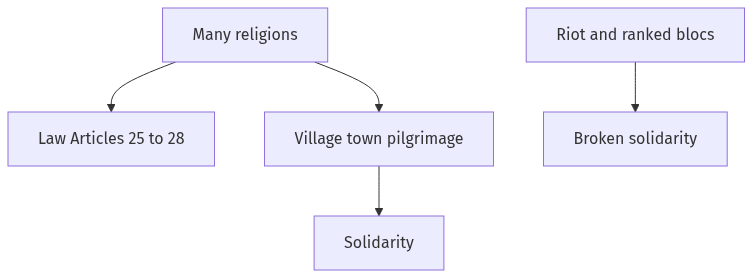
- The Constitution’s Articles 25–28 protect profession and practice, which is the legal form of pluralism.
Solidarity
- Emile Durkheim distinguished mechanical solidarity of likeness from organic solidarity of interdependence. Indian towns mix both: caste and faith blocs, plus market and office interdependence.
- Shared work, jajmani remnants, and urban trade can bind unlike faiths. L. P. Vidyarthi’s sacred complex shows pilgrimage towns hosting many sects in one geography.
- M. K. Gandhi used Hindu–Muslim unity as a political form of solidarity. B. R. Ambedkar warned that caste inside Hinduism can block solidarity even when many religions exist.
When pluralism does not produce solidarity
- Riot, conversion panic, and unequal citizenship turn plurality into ranked blocs.
- Solidarity then needs law, shared livelihood, and local peace institutions, not only festival photographs.
Flow diagram
Conclusion
India is religiously plural by history and by law. Solidarity grows where work, neighbourhood, and equal citizenship hold. It fails when faith is used as a bloc against neighbours.
Quick related
Students also ask
-
How are Other Backward Classes identified. Enumerating the important features elucidate the recent changes in their social and economic life.
Next question on this syllabus topic (2023 · Q8(c)). View answer →
-
Does pluralism automatically create solidarity?
No. Sharing a map is not the same as equal cooperation. Riots and ranked citizenship show the gap.
-
Is tribal religion part of this plurality?
Yes. Sacred groves, clan cults, and later Hindu, Christian, or Islamic overlays are part of Indian religious plurality.
Same topic · past papers
UPSC has asked this before
These previous-year questions sit on the same topic. Open one to practise the earlier ask.
-
2025 · Q8(b) · Anthropology GS 2 · 15 marks
Define minority. Elaborate the patterns of linguistic and religious minorities in India -
2022 · Q7(c) · Anthropology GS 2 · 15 marks
Explain the social and religious consequences of contact between tribal and non-tribal populations -
2021 · Q8(b) · Anthropology GS 2 · 15 marks
Delineate the constitutional safeguard for religious minorities in India -
2015 · Q2(c) · Anthropology GS 2 · 15 marks
Discuss the problems faced by religious minorities in India -
2024 · Q6(b) · Anthropology GS 2 · 15 marks
Elucidate the difference between secularism, religiosity, religious fundamentalism, and spiritualism from an anthropological perspective.
More from this topic
Q8(b) · UPSC Mains 2025 · Anthropology GS 2 · 15 marks · Solution
Define minority. Elaborate the patterns of linguistic and religious minorities in India
Linguistic and religious minorities and their social, political and economic status.
Minority is a non-dominant group in a specified unit; in education law the unit is the state (T. M. A. Pai). Central religious minorities: Muslim, Christian, Sikh, Buddhist, Parsi, Jain. Linguistic minorities sit under Articles 29, 350A and 350B and the Eighth Schedule plus unscheduled tongues. Patterns follow regions: North-East Christians, Kerala mix, Hindi-belt Urdu, migrant cities. Sachar, Bommai and personal-law cases are the contemporary legal weather.
Q8(c) · UPSC Mains 2023 · Anthropology GS 2 · 15 marks · Solution
How are Other Backward Classes identified. Enumerating the important features elucidate the recent changes in their social and economic life.
Linguistic and religious minorities and their social, political and economic status.
OBCs are socially and educationally backward classes other than SC and ST, listed for reservation. Mandal’s indicators and 1990 implementation, then Indra Sawhney’s creamy layer and 50 percent ceiling, structure identification. The 102nd Amendment (2018) gave NCBC constitutional status (Article 338B) and a Presidential Central list (Article 342A). The 105th Amendment (2021) restored States’ power to identify OBCs for State lists after the Maratha case reading of the 102nd. Recent change includes an OBC political and educational middle class, internal inequality, and list-agitation; marriage remains largely endogamous.
Q7(c) · UPSC Mains 2022 · Anthropology GS 2 · 15 marks · Solution
Explain the social and religious consequences of contact between tribal and non-tribal populations
Linguistic and religious minorities and their social, political and economic status.
Contact produces Sanskritisation and class splits inside tribes. Ghurye called the social path Hinduisation; Elwin called it loss. Religion may Hinduise, Christianise, or throw up a prophet such as Birsa. Sacred groves and brew are early casualties of plough and mission. Consequences are mixed, not a single conversion story.