
Revision summary
Birsa Munda (1875–1900) led a Munda revitalisation and agrarian revolt, the Ulgulan. He preached a purified Munda faith against diku landlords, forced labour and colonial power. He died in Ranchi jail in 1900 after capture. The Chotanagpur Tenancy Act, 1908, and later Jharkhand politics are part of his impact. His martyrdom is a living language of land rights; dispossession has not automatically ended.
Model answer
Copper italics in this answer — like this — are the key facts. Each one is unpacked in the Facts & figures rail.
Introduction
Birsa Munda (1875–1900) was a Munda prophet and political leader of Chotanagpur whose Ulgulan (great tumult) joined agrarian rights to a new religious community. His death in British custody made him a lasting symbol of tribal self-respect. Anthropology reads him with S. C. Roy, not only with later statues.
Body
Life history
Birsa was born at Ulihatu (present-day Khunti district, Jharkhand) in a Munda khuntkatti world already stressed by diku landlords, moneylenders, and the colonial state. He encountered missionary schooling (German mission circuits), Vaishnava and popular Hindu practice, and Munda singbonga religion. In the 1890s he emerged as Birsa Bhagwan, preaching a purified Munda faith: one God, ethical conduct, rejection of beth begari (forced labour), and recovery of land.
Followers, the Birsaite community, practised distinctive marks and gatherings. The movement was millenarian in Anthony Wallace’s sense of a revitalisation movement: a new sacred order to restore a broken world. It was also a political revolt. In 1899–1900 the Ulgulan attacked symbols of diku and colonial power in the Ranchi–Khunti–Chakradharpur belt. Troops suppressed it. Birsa was captured in 1900 and died in Ranchi jail in June 1900; official accounts said cholera. He was about twenty-five.
S. C. Roy documented Munda custom and the khuntkatti constitution that Birsa defended: original lineage rights in land against later zamindari and forest contractors. The Chotanagpur Tenancy Act, 1908 followed in the wake of this and earlier sardari agitations, restricting tribal land transfer — a legal monument to the revolt, even if the Act was also a colonial device to pacify.
Context
Forest reservation, beth begari, missionary–sardar competition, and famine-era debt produced the crisis. Elwin later placed such rebellions in a wider aboriginal resistance. K. S. Singh (Birsa Munda and His Movement) remains the standard historical anthropology: Birsa fused religion, ethnicity and agrarian programme. He was not a Congress nationalist in the later sense, nor a simple “Hindu reformer”. He was a tribal modern who used prophecy to organise.
Impact of his sacrifice
- Immediate impact was military defeat and martyrdom. Medium-term impact was legal: CNTA 1908 and a stronger Munda political identity. Long-term impact is civilisational memory. Jharkhand’s statehood movement, the Jharkhand Party and later JMM, used Birsa as ancestor. 15 November, his birth anniversary, is Janajati Gaurav Divas. The new Parliament building’s name-politics and the Birsa Munda airport and university show the republic claiming him.
Among Mundas and other Adivasis, Birsaite sects continue. His sacrifice taught that land and faith are one struggle, which Vidyarthi’s nature–man–spirit and later Xaxa both recognise. It also taught a danger: the state can honour a dead rebel while still leasing the same plateau to mines. Impact on tribal society is therefore identity, law, and an unfinished land question. Women in the Ulgulan and in later memory are less documented; a critical essay should say so.
Birsa’s death did not end dispossession. It created a language of rights that PESA, FRA and anti-mining Gram Sabhas still speak.
Flow diagram
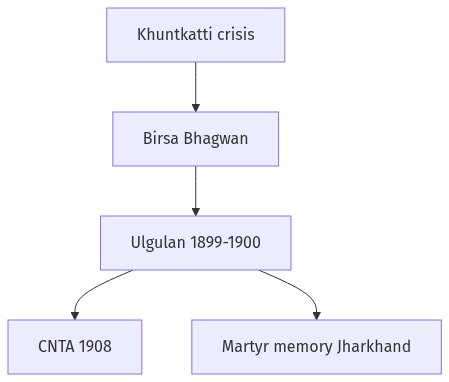
Conclusion
Birsa Munda lived a short life as prophet and organiser of the Ulgulan. His death made Munda land rights a public Indian fact. The CNTA, Jharkhand politics and national commemoration are his institutional afterlife. The measure of the sacrifice is whether jal, jungle and jameen are actually secure, not only whether his statue is tall.
Quick related
Students also ask
-
Discuss the basic tenets of Jainism and its impact on Indian society.
Next question on this syllabus topic (2023 · Q2(c)). View answer →
-
Was Birsa only a religious preacher?
No. Religion organised the following; the programme was land, forced labour and Munda self-rule under a new sacred order.
-
Did the Ulgulan create Jharkhand?
Not directly. It created a memory and a land law that later statehood movements used.
Same topic · past papers
UPSC has asked this before
These previous-year questions sit on the same topic. Open one to practise the earlier ask.
-
2025 · Q6(c) · Anthropology GS 2 · 15 marks
Trace the history and describe the methods of formulating the lists of OBCs, both at the State and National levels -
2024 · Q2(c) · Anthropology GS 2 · 15 marks
Deconstruct the colonial history of Indian Anthropology highlighting the critical role played by the Indian Anthropologists in sustaining its autonomy.
More from this topic
Q2(c) · UPSC Mains 2023 · Anthropology GS 2 · 15 marks · Solution
Discuss the basic tenets of Jainism and its impact on Indian society.
Impact of Buddhism, Jainism, Islam and Christianity on Indian society.
Jainism teaches anekantavada, karmic bondage of the jiva, and the three jewels of faith, knowledge, and conduct. Monastic vows centre on ahimsa and aparigraha; householders keep a milder code. Impact includes vegetarian ethics, mercantile specialisation, and temples at Abu, Palitana, and Shravanabelagola. Caste endogamy continued; occupation was ranked by injury to life. Gandhi’s political ahimsa drew on this Gujarati neighbourhood without making the nation a Jain polity.
Q7(b) · UPSC Mains 2016 · Anthropology GS 2 · 15 marks · Solution
Discuss the impact of Islam on scheduled tribes of India
Impact of Buddhism, Jainism, Islam and Christianity on Indian society.
Islam met tribes through trade, state, and reform, not one wave. Lakshadweep and some western Himalayan groups show deep mix. Central Indian ST conversion is limited; list politics still matters. Inheritance and mosque may strain clan land and groves. Elwin’s caution applies to any rapid creed that splits territory.
Q1(d) · UPSC Mains 2016 · Anthropology GS 2 · 10 marks · Solution
Impact of Jainism on Indian society
Impact of Buddhism, Jainism, Islam and Christianity on Indian society.
Jainism spread ahimsa and a vegetarian public ethic. Merchant Jains shaped western Indian towns and credit. Monasticism offered release outside Vedic sacrifice. Jati-like ranks continued inside Jain society. Hindu civilisation absorbed Jain shrines into a shared sacred map.