
Revision summary
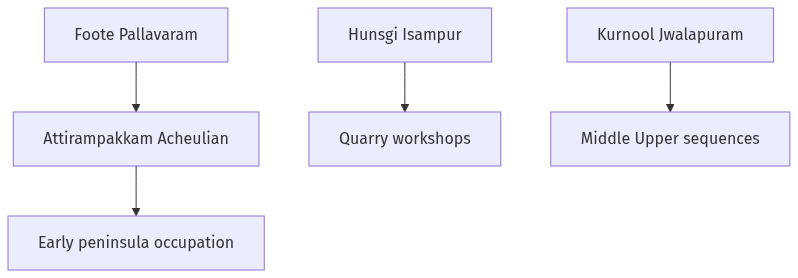
Key sites: Attirampakkam (early dated Acheulian), Hunsgi–Baichbal and Isampur (limestone workshops), Pallavaram (Foote), Kurnool caves and Jwalapuram (later Pleistocene). South India is Acheulian country, distinct from classic Soanian cobble tools. Isampur shows organised quarrying; Attirampakkam shows great antiquity. Middle and Upper Palaeolithic appear in caves and river valleys without copying Europe’s labels. Significance is early occupation and behaviour; makers’ fossils are still scarce.
Model answer
Copper italics in this answer — like this — are the key facts. Each one is unpacked in the Facts & figures rail.
Introduction
South Indian Palaeolithic cultures are the stone-tool record of Pleistocene hominins in the peninsula south of the Narmada–Son line, especially the Eastern Ghats, Tamil plains, Karnataka basins and Andhra–Telangana rivers. They matter because they give some of the oldest dated Acheulian in India and a long, well-studied sequence.
Body
Lower Palaeolithic / Acheulian
Attirampakkam (Kortalayar valley, Tamil Nadu), excavated by Shanti Pappu and colleagues, has a deep stratigraphy. Optically stimulated luminescence and palaeomagnetic work have been used to argue for Early Pleistocene Acheulian (published ages on the order of about 1.5 million years for some horizons, with debate on method and context). Tools include handaxes, cleavers and flakes in a landscape of older Mode 1 (Oldowan-like) pieces in the same valley. This site places South India inside Out of Africa Acheulian dispersal, not as a late cul-de-sac.
Hunsgi–Baichbal valleys (Kalaburagi / Gulbarga, Karnataka), worked by K. Paddayya, are open-air Acheulian factory and occupation sites on limestone. Isampur in the Hunsgi valley is a quarry-workshop where limestone slabs were flaked into cleavers and handaxes — a rare window on production organisation, not only finished tools. Yediyapur, Fatehpur and related localities thicken the same basin.
Other South Indian Lower Palaeolithic occurrences include Nagarjunakonda region, Kurnool foothills, Chittoor, Gudiyam, and laterite contexts of Kerala–Tamil coasts (often mixed or later). Robert Bruce Foote’s 1863 Pallavaram handaxe is the founding find of Indian prehistory, from the Chennai area — the same landscape as Attirampakkam.
Middle and Upper Palaeolithic
Middle Palaeolithic (prepared cores, scrapers, points) is documented in Kurnool caves (Billasurgam and others), Jwalapuram (Jurreru valley, Andhra — important also for Toba ash debates), and surface contexts across the Deccan. Upper Palaeolithic blade and burin assemblages appear in Kurnool caves, Renigunta, and parts of the Eastern Ghats, often leading toward microlithic Mesolithic. South India does not copy the European Chatelperronian sequence; it has its own flake-to-blade timing.
Significance
- Antiquity: Attirampakkam pushes Indian Acheulian deep into the Early Pleistocene, so the peninsula was occupied early by Acheulian-making hominins (likely Homo erectus grade; fossils in the far south remain scarce compared with Narmada).
- Behaviour: Isampur shows quarry planning and transport of finished bifaces — cognition and landscape use.
- Against a north-only story: Soanian cobble tools of the Siwaliks are not the only Indian Lower Palaeolithic. South India is Acheulian country.
- Continuity into later Stone Age: cave sequences in Kurnool link Pleistocene tools to later foragers, a bridge to living hunter-gatherer studies (Chenchu hinterland), without claiming ethnic identity across that time.
- Methods: South Indian projects professionalised OSL, palaeomagnetism and chaîne opératoire in Indian archaeology (Pappu, Paddayya, Petraglia collaborations).
- Limits: many sites are surface mixes; dates are argued; no rich hominin fossil from Attirampakkam or Hunsgi to name the maker. Significance is archaeological and biogeographic, not a racial history of Dravidian speakers. Language families are Holocene political facts; Acheulian is Pleistocene technology.
Flow diagram
Conclusion
South Indian Palaeolithic cultures, from Foote’s Pallavaram through Attirampakkam, Hunsgi and Isampur to Kurnool caves, show early and long Acheulian occupation and a later flake-and-blade record. They fix the peninsula on the world map of Pleistocene humans and display organised stone production. Fossils of the makers remain the missing half of the story.
Quick related
Students also ask
-
"Globalisation, on one hand has provided opportunities and on the other hand thrown challenges to Indian villages." Elucidate
Next question on this syllabus topic (2022 · Q4(a)). View answer →
-
Did Dravidian speakers make Acheulian tools?
There is no evidence tying Pleistocene industries to Holocene language families. Tools are hundreds of thousands of years older than attested Dravidian.
-
Is South Indian Palaeolithic only Acheulian?
Acheulian dominates the Lower Palaeolithic story, but Middle and Upper Palaeolithic assemblages exist, especially in Kurnool and related valleys.
Same topic · past papers
UPSC has asked this before
These previous-year questions sit on the same topic. Open one to practise the earlier ask.
-
2026 · Q7(b) · Anthropology GS 2 · 15 marks
Does caste as a social category exist among the non-Hindu communities in India? Illustrate your answer with suitable examples -
2016 · Q6(a) · Anthropology GS 2 · 20 marks
Explain Indian village as a social system with suitable examples -
2023 · Q3(b) · Anthropology GS 2 · 15 marks
Was Mesolithic culture the first step towards a sedentary way of life? Illustrate your answer by citing suitable examples. -
2023 · Q7(c) · Anthropology GS 2 · 15 marks
Elucidate the role of anthropology in nation building. Illustrate with suitable examples. -
2021 · Q2(b) · Anthropology GS 2 · 15 marks
Give the distribution and characteristic features of Upper Paleolithic culture in India
More from this topic
Q7(b) · UPSC Mains 2026 · Anthropology GS 2 · 15 marks · Solution
Does caste as a social category exist among the non-Hindu communities in India? Illustrate your answer with suitable examples
Indian Village
• Caste is a pan-Indian social structure that extends beyond Hinduism due to historical conversions and shared regional cultures. • Indian Muslims are stratified into Ashraf (upper), Ajlaf (intermediate), and Arzal (marginalized) groups, practicing strict endogamy. • South Asian Christianity features persistent caste divides, notably discrimination against Dalit Christians and segregated burial grounds. • Sikhism rejects caste scripturally, but practical society shows dominance by Jat Sikhs over lower-caste groups like Mazhabis. • Kinship networks (biradaris) and hereditary occupations maintain these hierarchical divisions across all major religious communities. • Recognizing these internal stratifications is essential for understanding South Asian social reality and designing targeted welfare policies.
Q3(a) · UPSC Mains 2026 · Anthropology GS 2 · 20 marks · Solution
Critically examine the salience of F. G. Bailey's study on Bisipara village of Odisha
Indian Village
F.G. Bailey's study of Bisipara village in Odisha represents a major shift from holistic structural-functionalism to processual and political anthropology. By focusing on caste, land, and political competition in the context of economic and administrative changes introduced by the state, Bailey highlighted how traditional hierarchies adapt to democratic politics. However, critics argue his focus on factionalism and conflict underplays wider systemic integration and cultural cohesion. Despite these limitations, his work remains seminal for introducing dynamic analytical tools like pivot/core castes and the distinction between safe and unsafe arenas of social action.
Q3(b) · UPSC Mains 2024 · Anthropology GS 2 · 15 marks · Solution
Compare and contrast the approaches of M.N. Srinivas and L.P. Vidyarthi to social change in village India.
Indian Village
Srinivas explained village change through field view, sanskritisation, westernisation and dominant caste. Vidyarthi explained organisation and change through the sacred complex and the nature–man–spirit complex. Srinivas’s motor is internal rank-climbing plus Western and state resources. Vidyarthi’s motor is contact with development, mine, market and mission. Use both: caste plains and tribal-sacred landscapes are not one model.