
Revision summary
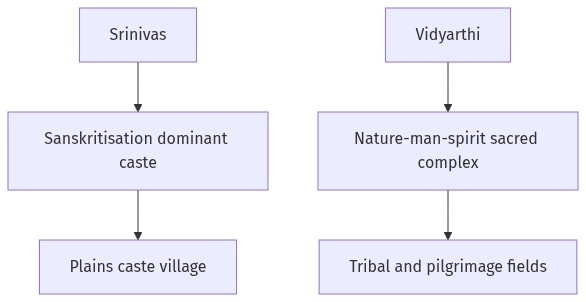
Srinivas explained village change through field view, sanskritisation, westernisation and dominant caste. Vidyarthi explained organisation and change through the sacred complex and the nature–man–spirit complex. Srinivas’s motor is internal rank-climbing plus Western and state resources. Vidyarthi’s motor is contact with development, mine, market and mission. Use both: caste plains and tribal-sacred landscapes are not one model.
Model answer
Copper italics in this answer — like this — are the key facts. Each one is unpacked in the Facts & figures rail.
Introduction
M. N. Srinivas and L. P. Vidyarthi both made the Indian village a theoretical object, but they did not ask the same question. Srinivas explained how caste society moves through sanskritisation, westernisation and the dominant caste. Vidyarthi explained how a tribal and sacred landscape is organised through the sacred complex and nature–man–spirit, and how development then disturbs that organisation.
Body
Srinivas: field view and mobility
From Rampura (Mysore) and from Religion and Society among the Coorgs, Srinivas opposed the book view of Indology with the field view. Change in village India was not the death of caste but its recasting. Sanskritisation is the process by which a lower caste copies the ritual, diet and origin story of a locally higher group and claims a better rank over a generation or two. Westernisation is the take-up of British-derived education, dress, law and occupation, often by the same groups. The dominant caste — numerous, landed, with an educated elite — mediates both processes and captures panchayat and party.
Srinivas’s village is a caste system with a territory. Factions, patrons and the vote (after 1950) are the political surface of that system. Social change means mobility within hierarchy, plus the new resources of the state and the market. He is closer to British structural-functionalism (Radcliffe-Brown, Evans-Pritchard) than to a tribal ecology. Critics (André Béteille, Marxists, Ambedkarite writers) say he underplayed class, untouchability as violence, and women’s labour.
Vidyarthi: sacred complex and tribal village
Vidyarthi’s Sacred Complex in Hindu Gaya (and later work) used Redfield’s great and little traditions: a pilgrimage centre organises specialists, sacred geography and a hinterland of villages. Nature–man–spirit complex (The Maler) models a hill tribe’s ecology, social organisation and religion as one adaptive set. The tribal village is not first a caste ladder; it is a forest-field-spirit system. Change comes when mines, missions, markets and planned development break that set — the Ranchi school’s development anthropology.
Vidyarthi institutionalised tribal research at Ranchi, worked on Chotanagpur, and trained students to see cultural change as disruption of an integrated complex, not only as sanskritisation. He could also describe Hindu sacred cities, so he is not “only a tribalist”. Compared with Srinivas, he gave more space to Adivasi India and to applied anthropology for administration.
Compare
| Axis | Srinivas | Vidyarthi |
|---|---|---|
| Classic field | Mysore / Coorg peasant-caste village | Gaya sacred city; Maler and Chotanagpur tribes |
| Master concepts | Sanskritisation, westernisation, dominant caste, field view | Sacred complex, nature–man–spirit, tribal transformation |
| Motor of change | Internal imitation plus Western/state resources | External development, market, mine, mission meeting an ecological-religious whole |
| Hierarchy | Caste rank is central | Tribe–Hindu civilisation contact; sacred specialists |
| Policy mood | How the village absorbs democracy and mobility | How to plan without shattering tribal complexes |
Both rejected armchair Indology. Both used intensive fieldwork. Both can miss gender and class unless supplemented. Srinivas travels poorly to a Birhor or Maler hamlet if one only looks for a dominant caste. Vidyarthi travels poorly to Rampura if one only looks for a nature–man–spirit triangle and misses jati politics.
- A full picture of village India needs both: caste mobility in the plains and ecological-sacred disruption in the hills, with Bailey’s tribe–caste continuum as the bridge.
Flow diagram
Conclusion
Srinivas theorised social change as recast hierarchy in the caste village. Vidyarthi theorised it as transformation of sacred and ecological complexes, especially in tribal India. They are complementary regional theories, not two names for the same village.
Quick related
Students also ask
-
Describe the important Paleolithic sites from South India with suitable examples. What is the significance of South Indian Paleolithic cultures?
Next question on this syllabus topic (2024 · Q8(a)). View answer →
-
Did Vidyarthi deny caste?
No. He wrote on Hindu sacred centres as well. His distinctive emphasis is tribal ecology and civilisation contact, not a claim that caste is unreal.
-
Is sanskritisation Vidyarthi’s tool?
It is Srinivas’s tool. Tribal groups may sanskritise, but Vidyarthi would first ask what happened to forest, spirit and village constitution.
Same topic · past papers
UPSC has asked this before
These previous-year questions sit on the same topic. Open one to practise the earlier ask.
-
2023 · Q3(a) · Anthropology GS 2 · 20 marks
"Sanskritization is a culture-bound concept." Critically comment to assess the strength and limitation of this concept in developing a theoretical framework to study social change. -
2023 · Q4(b) · Anthropology GS 2 · 15 marks
Critically compare Risley's and Sarkar's approaches to the classification of peoples of India. -
2015 · Q1(d) · Anthropology GS 2 · 10 marks
Panchayati Raj Institutions and Social Change -
2015 · Q7(b) · Anthropology GS 2 · 15 marks
Discuss the nature of social change in tribal India under the impact of developmental programmes
More from this topic
Q7(b) · UPSC Mains 2026 · Anthropology GS 2 · 15 marks · Solution
Does caste as a social category exist among the non-Hindu communities in India? Illustrate your answer with suitable examples
Indian Village
• Caste is a pan-Indian social structure that extends beyond Hinduism due to historical conversions and shared regional cultures. • Indian Muslims are stratified into Ashraf (upper), Ajlaf (intermediate), and Arzal (marginalized) groups, practicing strict endogamy. • South Asian Christianity features persistent caste divides, notably discrimination against Dalit Christians and segregated burial grounds. • Sikhism rejects caste scripturally, but practical society shows dominance by Jat Sikhs over lower-caste groups like Mazhabis. • Kinship networks (biradaris) and hereditary occupations maintain these hierarchical divisions across all major religious communities. • Recognizing these internal stratifications is essential for understanding South Asian social reality and designing targeted welfare policies.
Q3(a) · UPSC Mains 2026 · Anthropology GS 2 · 20 marks · Solution
Critically examine the salience of F. G. Bailey's study on Bisipara village of Odisha
Indian Village
F.G. Bailey's study of Bisipara village in Odisha represents a major shift from holistic structural-functionalism to processual and political anthropology. By focusing on caste, land, and political competition in the context of economic and administrative changes introduced by the state, Bailey highlighted how traditional hierarchies adapt to democratic politics. However, critics argue his focus on factionalism and conflict underplays wider systemic integration and cultural cohesion. Despite these limitations, his work remains seminal for introducing dynamic analytical tools like pivot/core castes and the distinction between safe and unsafe arenas of social action.
Q8(a) · UPSC Mains 2024 · Anthropology GS 2 · 20 marks · Solution
Describe the important Paleolithic sites from South India with suitable examples. What is the significance of South Indian Paleolithic cultures?
Indian Village
Key sites: Attirampakkam (early dated Acheulian), Hunsgi–Baichbal and Isampur (limestone workshops), Pallavaram (Foote), Kurnool caves and Jwalapuram (later Pleistocene). South India is Acheulian country, distinct from classic Soanian cobble tools. Isampur shows organised quarrying; Attirampakkam shows great antiquity. Middle and Upper Palaeolithic appear in caves and river valleys without copying Europe’s labels. Significance is early occupation and behaviour; makers’ fossils are still scarce.