
Revision summary
PVTGs are 75 listed communities identified by vulnerability, not by a primitive essence. CCD plans, FRA habitat rights and PM-JANMAN (2023) are the main recent measures. Delivery still misses hamlets; mining and land loss can cancel welfare. Primitive Tribal Groups was an evolutionist and colonial name that ranked cultures. Particularly vulnerable correctly points to isolation and dispossession as historical facts.
Model answer
Copper italics in this answer — like this — are the key facts. Each one is unpacked in the Facts & figures rail.
Introduction
Particularly Vulnerable Tribal Groups are a smaller list inside the Scheduled Tribes, marked by declining or stagnant population, pre-agricultural or simple technology, low literacy, and economic backwardness. Recent welfare has become more targeted. The older label Primitive Tribal Groups was wrong in science and in politics, which is why the name was changed.
Body
Who PVTGs are
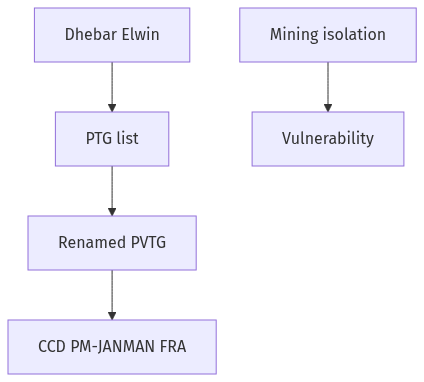
The category grew from the Dhebar Commission (1960–61) concern with the most isolated tribes, and from Verrier Elwin’s NEFA and central-Indian writing on groups that should not be rushed into the market. The Government of India later listed Primitive Tribal Groups (1975–76 onward, expanded in the 1980s). There are 75 PVTGs in 18 states and the Andaman and Nicobar Islands. Examples: Birhor, Asur, Birjia, Korwa, Hill Kharia in Jharkhand; Baiga, Sahariya in Madhya Pradesh and Rajasthan; Dongria Kondh, Bonda, Juang in Odisha; Toda, Kurumba in the Nilgiris; Jarawa, Onge, Great Andamanese, Sentinelese in the islands; Cholanaikkan in Kerala.
Criteria are administrative, not a separate racial stock. B. S. Guha’s older racial types and colonial “primitive” language should not be read into the list. Virginius Xaxa (2014) treated PVTGs as historically dispossessed communities, not as leftovers of evolution.
Recent welfare measures
The Conservation-cum-Development (CCD) plans under the Ministry of Tribal Affairs funded habitat, land, education and health for PVTGs. States run micro-projects (Odisha’s PVTG micro-projects are a known model). Forest Rights Act, 2006 section 3(1)(e) recognises community and habitation rights that matter especially for PVTGs. PESA Gram Sabhas, where notified, should consent to land acquisition.
PM-JANMAN (Pradhan Mantri Janjati Adivasi Nyaya Maha Abhiyan, 2023) is the largest recent package: housing, piped water, roads, mobile connectivity, anganwadis, hostels, sick-cell and TB care, and sustainable livelihoods, aimed at PVTG habitations mapped as left-out of ordinary schemes. PM-JANMAN sits beside DA-JGUA / PM-AJAY housing and the older Vanbandhu and Eklavya school architecture. Land titles, FRA claims and habitat rights remain the slower, more decisive layer.
Criticism of the measures
Targeting is right; delivery repeats older failures. Hamlets are missed in surveys. Contractors capture housing. Connectivity arrives without language-ready health staff. Island groups need protection from contact, not tourism or road-first development — a lesson from Andaman policy and from Elwin’s caution. Samata (1997) and Niyamgiri (2013) show that mining can erase a PVTG livelihood faster than a scheme can rebuild it. Cash and houses without jal, jungle, jameen are relief, not justice.
CCD plans were often utilisation-poor. Literacy hostels can detach children from language. Anthropological monitoring is still thin compared with the money now announced.
Why “Primitive Tribal Groups” was erroneous
Primitive is an evolutionist word. It implies that these communities are earlier humans, stuck on a ladder that Tylor and colonial census ethnography had drawn. Indian anthropology after S. C. Roy, N. K. Bose, D. N. Majumdar and Elwin had already shown that so-called primitives have complex kinship, ritual and ecological knowledge. G. S. Ghurye’s “backward Hindus” was a different error — forced assimilation — but it shared the ranking impulse.
- The groups are particularly vulnerable because of isolation plus dispossession: forest reservation, mining, dams, and demographic shock (Andaman). They are not primitive in mind or culture. The 2006 renaming to PVTG, used in Xaxa and in later ministry language, corrects the insult and the science. Vulnerability is a relation to the state and the market, not a stage of culture.
ILO Convention 107, which India ratified, still uses older “tribal and semi-tribal” integration language; Convention 169 (1989) speaks of peoples and rights. India’s PVTG policy is closer to welfare targeting than to 169’s consent standard — another reason names and rights must be held together.
Flow diagram
Conclusion
PVTG welfare is now more visible, especially through PM-JANMAN, CCD and FRA habitat claims. It will fail if it is only concrete and SIM cards. The name Primitive Tribal Groups was erroneous because it ranked living peoples as evolutionary leftovers. Particularly vulnerable names a political condition, which is the accurate anthropological point.
Quick related
Students also ask
-
Elucidate the problems faced by Particularly Vulnerable Tribal Groups and the major challenges in the formulation of special programmes for their development.
Next question on this syllabus topic (2023 · Q4(a)). View answer →
-
Is every Scheduled Tribe a PVTG?
No. PVTGs are a smaller administrative list inside STs, created because some groups were being missed by ordinary tribal development.
-
When did the name change?
The Government shifted from Primitive Tribal Groups to Particularly Vulnerable Tribal Groups in 2006; older documents still say PTG.
Same topic · past papers
UPSC has asked this before
These previous-year questions sit on the same topic. Open one to practise the earlier ask.
-
2025 · Q8(c) · Anthropology GS 2 · 15 marks
What are the identifying criteria for PVTGs in India? Examine their current status, nomenclature and distribution
More from this topic
Q4(a) · UPSC Mains 2023 · Anthropology GS 2 · 20 marks · Solution
Elucidate the problems faced by Particularly Vulnerable Tribal Groups and the major challenges in the formulation of special programmes for their development.
History of administration of tribal areas, tribal policies, plans, programmes of tribal development and their implementation. The concept of PTGs (Primitive…
PVTGs are about 75 ST groups listed after the Dhebar line, defined by fragile demography, pre-agricultural technology, and low literacy. Problems include forest loss, disease on contact, language-mismatched schools, and collapsed crafts such as Asur smelting. Programme challenges are bad lists, scattered hamlets, one-size housing, and under-used FRA habitat rights. Andaman contact ethics and PM-JANMAN saturation sit at opposite risks: neglect versus forced assimilation. Elwin’s limit on over-administration is still a design rule.
Q5(d) · UPSC Mains 2022 · Anthropology GS 2 · 10 marks · Solution
Role of the Governor in the Fifth Schedule areas
History of administration of tribal areas, tribal policies, plans, programmes of tribal development and their implementation. The concept of PTGs (Primitive…
The Governor is the Fifth Schedule’s special law-maker for Scheduled Areas. Regulations may cover land, allotment, and money-lending after TAC consultation. PESA adds Gram Sabha but does not delete the Governor’s scale. Samata showed what land rules can do; Xaxa showed weak use. Paper power exceeds political practice.
Q5(e) · UPSC Mains 2015 · Anthropology GS 2 · 10 marks · Solution
Role of Governor in Fifth Schedule Areas.
History of administration of tribal areas, tribal policies, plans, programmes of tribal development and their implementation. The concept of PTGs (Primitive…
The Fifth Schedule gives the Governor special law and land powers in Scheduled Areas. A Tribes Advisory Council and a report to the President are mandatory tools. The aim is to stop tribal land alienation. In practice the powers are under-used. PESA and FRA still need that gubernatorial watch.