
Revision summary
Siwaliks are Himalayan foreland molasse from Miocene into the Pleistocene. Neogene primate fossils centre on Sivapithecus and large Indopithecus or Gigantopithecus. Haritalyangar, Ramnagar, and Potwar Chinji are key localities. Ramapithecus is not a hominin; faces align with orangutans. Variety is real but fragmentary; Narmada Hathnora is not part of this fauna.
Model answer
Copper italics in this answer — like this — are the key facts. Each one is unpacked in the Facts & figures rail.
Introduction
The Siwalik Group is a Neogene to early Quaternary molasse along the Himalayan front. It does yield several fossil primates, especially Miocene hominoids. The statement is true in outline and must be qualified on variety, preservation, and what those primates are not.
Body
Deposits and time
- Teaching order: Lower Siwaliks (Kamlial–Chinji), Middle (Nagri–Dhok Pathan), Upper (Tatrot–Pinjor–Boulder Conglomerate).
- Neogene covers Miocene and Pliocene. Chinji and Nagri beds are the main hominoid windows. Pinjor is later and richer in other mammals.
- Fossils sit in river sands and clays. They are often teeth and jaw fragments, not complete skeletons.
The primate variety
- Sivapithecus (including former Ramapithecus) is the principal large ape, with an orang-like face. Haritalyangar, Potwar Chinji, and Ramnagar are localities.
- Large forms classed as Indopithecus or Siwalik Gigantopithecus (e.g. G. giganteus) add a giant ape, not a human.
- Smaller catarrhines and some cercopithecoids appear in later lists; many are poorly preserved and taxonomically unstable.
- A diverse ungulate–proboscidean fauna dates the primates by association (Pilgrim, Colbert, later S. R. K. Chopra and Chandigarh teams).
Critical limits
- “Variety” is real at family and genus level for hominoids, not a rainforest full of living monkey species.
- Surface mixes and old collections inflated names. Robin Dennell and later workers urge caution on mixed terraces.
- Ramapithecus as hominin is rejected. Variety is Asian ape variety, not a set of human ancestors.
- Hathnora (Narmada) is not a Siwalik primate fauna.
Verdict
- The statement is acceptable if Neogene Siwaliks are credited with Sivapithecus, large Indopithecus/Gigantopithecus, and some smaller catarrhines.
- It is misleading if it implies a rich, well-dated primate community or an Indian human origin.
Flow diagram
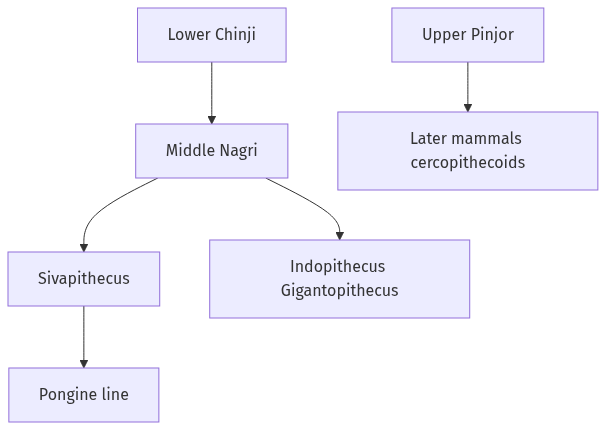
Conclusion
Siwalik deposits do show several Neogene fossil primates, led by Sivapithecus and giant ape forms. Variety is modest, preservation is fragmentary, and the fauna is pongine, not hominin. The statement survives as a cautious summary, not as a boast.
Quick related
Students also ask
-
Pit-dwellers of Kashmir
Next question on this syllabus topic (2022 · Q1(a)). View answer →
-
Are Siwalik primates the same as living Indian monkeys?
No. The famous finds are Miocene apes. Later beds have some cercopithecoids. Most living monkeys have a different fossil story.
-
Do Siwaliks prove many human species in India?
No. They prove several fossil apes. Human evolution in the Pleistocene is a separate, thinner record.
Same topic · past papers
UPSC has asked this before
These previous-year questions sit on the same topic. Open one to practise the earlier ask.
-
2015 · Q3(c) · Anthropology GS 2 · 15 marks
Describe the paleoanthropological fossil finds from Siwalik hills. Examine the contribution of Siwalik fossils to paleoanthropological knowledge
More from this topic
Q6(a) · UPSC Mains 2026 · Anthropology GS 2 · 20 marks · Solution
Make a critical appraisal of the mesolithic culture of Ganga basin with reference to artifacts, faunal and human skeletal remains excavated from different sites
Evolution of the Indian Culture and Civilization
• Ganga basin Mesolithic sites like Sarai Nahar Rai, Mahadaha, and Damd
Q5(e) · UPSC Mains 2026 · Anthropology GS 2 · 10 marks · Solution
Contribution of L. K. Ananthakrishna Iyer in Anthropology.
Evolution of the Indian Culture and Civilization
L. K. Ananthakrishna Iyer is a pioneering figure in Indian anthropology, known for his monumental ethnographic surveys like The Cochin Tribes and Castes and The Mysore Tribes and Castes. Working during the colonial era, he bridged western anthropological methods with indigenous scholarship. His documentation of social stratification, material culture, and folklore laid the empirical foundation for Indian sociology and anthropology. Iyer also established the first department of anthropology in India at the University of Calcutta, shaping institutional teaching and research.
Q5(c) · UPSC Mains 2026 · Anthropology GS 2 · 10 marks · Solution
Article 371A of the Indian Constitution.
Evolution of the Indian Culture and Civilization
Article 371A of the Indian Constitution grants special autonomous status to Nagaland, protecting its traditional socio-religious practices, customary laws, and land ownership rights. Enacted via the 13th Constitutional Amendment Act, 1962, following the 16-point Agreement, it reflects the asymmetrical federal framework of India. The article places a special responsibility on the Governor regarding law and order and regional financial allocations. It balances tribal autonomy with national integration, though it faces implementation challenges in modern governance.