
Revision summary
Karma is moral causation; rebirth is continuation in samsara. Hindu, Buddhist, and Jain systems share the pair with different views of the self. Socially the pair has justified caste and also supported ahimsa and pilgrimage merit. Ambedkar rejected karmic theodicy as a defence of inequality. Tribal funerary practice may take Hindu karmic words without dropping clan ancestors.
Model answer
Copper italics in this answer — like this — are the key facts. Each one is unpacked in the Facts & figures rail.
Introduction
Karma is the moral law of action and consequence. Rebirth is the continuation of the person or subtle self in another life. Together they form a civilisational ethic in Hindu, Buddhist, and Jain thought, with different metaphysics but a shared social force.
Body
Doctrine
- In Brahmanical thought, karma binds the soul (atman) to samsara until knowledge or devotion releases it.
- Buddhism denies a permanent atman but keeps karmic continuity of the stream of becoming. The eightfold path aims at stopping rebirth.
- Jainism treats karma as a kind of matter that sticks to the jiva; release needs extreme restraint.
- Purushartha places moksha as the aim that ends the cycle; grihastha still acts, but with dharma.
Social effects
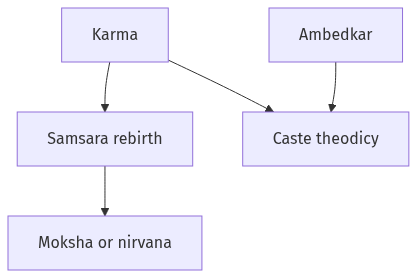
- Caste rank has been justified as fruit of past karma. Ambedkar attacked this as a theodicy of inequality.
- The same ethic also supports ahimsa, gift, and restraint, which Dumont read as a world-renouncing value inside caste society.
- Bhakti and some tantric lines offer grace that softens a strict karma ledger.
- Among tribes, N. K. Bose and S. C. Roy recorded Hindu karmic language entering Oraon and Munda funerary talk, while clan ancestors and sarna groves remained.
Anthropological point
- Karma and rebirth are Great Tradition ideas that parochialise into village fate, witchcraft accusation, and merit-making at pilgrimage sites (Vidyarthi’s Gaya).
Flow diagram
Conclusion
Karma and rebirth explain suffering and rank, and they organise ethics of ahimsa and gift. They can freeze caste as deserved, which Ambedkar rejected. Living India mixes them with bhakti, law, and tribal ancestor rites.
Quick related
Students also ask
-
Do all Indians believe in rebirth equally?
No. Intensity varies by sect, education, and religion. Many Muslims and Christians in India do not hold Hindu-Buddhist rebirth, yet live beside those who do.
-
Does karma make social reform impossible?
As theodicy it can delay reform. Bhakti, law, and Ambedkarite conversion treat rank as changeable in this life.
More from this topic
Q8(a) · UPSC Mains 2025 · Anthropology GS 2 · 20 marks · Solution
Describe the nature of traditional socioeconomic interdependence among the Toda, Kota, Kurumba and Irula tribes of Nilgiri Hills. Highlight the changes occurring in these interrelationships
The structure and nature of traditional Indian social system
Toda: buffalo pastoralists; Kota: artisans and funeral musicians; Kurumba and Irula: forest producers and ritual-forest roles. Exchange was a hill jajmani of dairy, pots, tools, honey and ceremony. Rivers described Todas; Mandelbaum and Walker placed them in regional interdependence. Tea plantations, cash, schools and ST/FRA administration broke the closed circuit. Today they share markets and hostels more than ghee and pots.